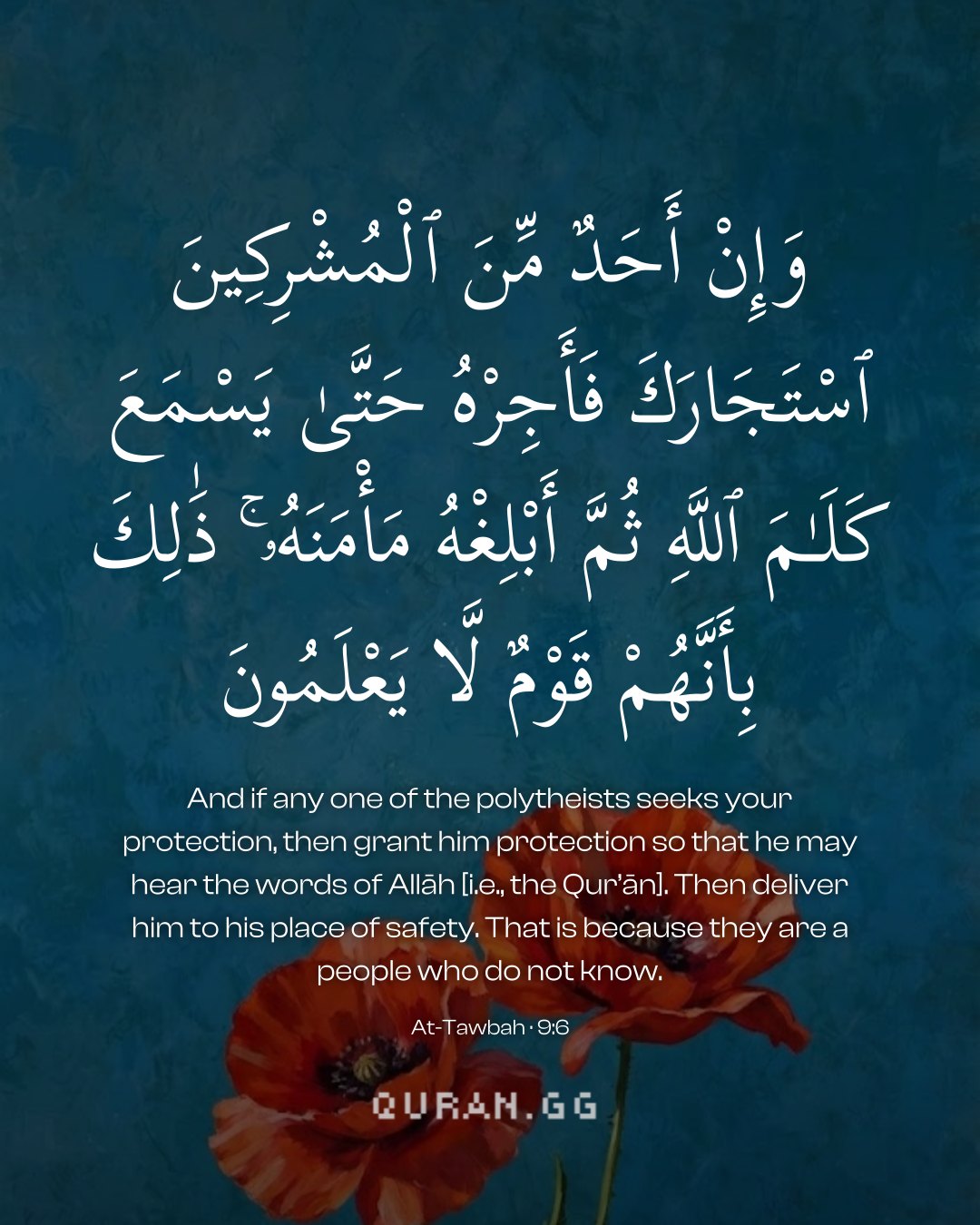
And if any one of the polytheists seeks your protection, then grant him protection so that he may hear the words of Allāh [i.e., the Qur’ān]. Then deliver him to his place of safety. That is because they are a people who do not know.
Idolators are granted Safe Passage if They seek It
Allah said to His Prophet, peace be upon him,
وَإِنْ أَحَدٌ مِّنَ الْمُشْرِكِينَ
(And if anyone of the Mushrikin), whom you were commanded to fight and We allowed you their blood and property,'
اسْتَجَارَكَ
(seeks your protection), asked you for safe passage, then accept his request until he hears the Words of Allah, the Qur'an. Recite the Qur'an to him and mention a good part of the religion with which you establish Allah's proof against him,
ثُمَّ أَبْلِغْهُ مَأْمَنَهُ
(and then escort him to where he can be secure) and safe, until he goes back to his land, his home, and area of safety,
ذَلِكَ بِأَنَّهُمْ قَوْمٌ لاَّ يَعْلَمُونَ
(that is because they are men who know not.) The Ayah says, `We legislated giving such people safe passage so that they may learn about the religion of Allah, so that Allah's call will spread among His servants. Ibn Abi Najih narrated that Mujahid said that this Ayah, "Refers to someone who comes to you to hear what you say and what was revealed to you (O Muhammad). Therefore, he is safe until he comes to you, hears Allah's Words and then proceeds to the safe area where he came from." The Messenger of Allah ﷺ used to thereafter grant safe passage to those who came to him for guidance or to deliver a message. On the day of Hudaybiyyah, several emissaries from Quraysh came to him, such as `Urwah bin Mas`ud, Mikraz bin Hafs, Suhayl bin `Amr and several others. They came mediating between him and the Quraysh pagans. They witnessed the great respect the Muslims had for the Prophet , which astonished them, for they never before saw such respect for anyone, kings nor czars. They went back to their people and conveyed this news to them; this, among other reasons, was one reason that most of them accepted the guidance. When Musaylimah the Liar sent an emissary to the Messenger of Allah ﷺ, he asked him, "Do you testify that Musaylimah is a messenger from Allah" He said, "Yes." The Messenger of Allah ﷺ said,
(I would have cut off your head, if it was not that emissaries are not killed.) That man, Ibn An-Nawwahah, was later beheaded when `Abdullah bin Mas`ud was the governor of Al-Kufah. When it became known that he still testified that Musaylimah was a messenger from Allah, Ibn Mas`ud summoned him and said to him, "You are not delivering a message now!" He commanded that Ibn An-Nawwahah be decapitated, may Allah curse him and deprive him of His mercy. In summary, those who come from a land at war with Muslims to the area of Islam, delivering a message, for business transactions, to negotiate a peace treaty, to pay the Jizyah, to offer an end to hostilities, and so forth, and request safe passage from Muslim leaders or their deputies, should be granted safe passage, as long as they remain in Muslim areas, until they go back to their land and sanctuary.
Ma'arif al-Qur'an
Mufti Muhammad Shafi
Commentary
It was said in the first five verses of Surah At-Taubah that, soon after the Conquest of Makkah, general amnesty was granted to all polytheists and disbelievers of Makkah and its environs. But, in view of their dismal record of treachery and breach of trust in the past, it was decided that no treaty would be signed with them in the future. It was despite this policy decision that injunctions to honor the treaty - made with these people earlier and which they had never contravened - were revealed whereby they were required to fulfill the terms of the treaty until it expired. As for those with whom there was just no treaty, or there was no treaty with a fixed duration, they too were granted suitable concession. Rather than they be ordered to leave Makkah immediately, they were allowed a respite of four months so that, during this period of time, they could arrange to leave Makkah and go wherever they deemed fit, with convenience and in peace. Or, if the truth of Islam had become apparent to them in the meantime, they were welcome to become Muslims. The outcome of these injunctions was that the sacred site of Makkah was to be vacated by all treacherous disbelievers. The evacuation was being implemented without any intention to retaliate. In fact, it was enforced in self-defense because of consistent experience. Therefore, the door to a good future for them was left open even then. This has been mentioned in the sixth verse the substance of which is: If someone from among the disbelievers seeks asylum with you, then, you should grant it so that he could come close to you and listen to the Word of Allah and understand the veracity of Islam. Then, your responsibility does not end at granting him a temporary asylum. The truth of the matter is that, as soon as he has done what he had come for, it is the responsibility of Muslims that they should escort him under full protective arrangements to the place where he considers himself safe and happy. At the end of the verse, it was said that the particular injunction has been sent because these people are not sufficiently aware. By coming close, they could know things better.
Some rulings and points of guidance come out from this verse (11) as well. These have been discussed in details by Imam Abu Bakr al-Jassas. In brief, they are:
Proving the Veracity of Islam is the Duty of Muslim Scholars
1. First of all, this verse confirms that, in case, a disbeliever asks Muslims to explain the veracity of Islam to him with valid proofs, then, it becomes their duty to accede to his demand.
2. Secondly, it is obligatory on Muslims that they should allow and protect anyone who comes to them to learn more about Islam. Causing any hurt or harm to such a person is not permissible. This injunction, according to Tafsir al-Qurtubi, is operative only in a situation when the purpose of the visitor is to listen to the Word of Allah and know more about Islam. In case, the objective of the visitor is business, or some other pursuit, it would depend on the discretion of relevant Muslim officials who would decide in terms of what is best in Muslim interests. Should they deem it fit, they may permit and should they think other-wise, they can act at their discretion.
Non-Resident Non-Muslims should not be permitted to stay in Dar al-Islam any longer than necessary
3. The third ruling stipulates that a non-Muslim at war, with whom Muslims have no treaty, should not be allowed to stay any longer than necessary – because, in the cited verse, a limit of stay and protection has been set by saying: حَتَّىٰ يَسْمَعَ كَلَامَ اللَّـهِ (until he listens to the Word of Allah).
4. According to the fourth element of guidance embedded here, it is the duty of a Muslim ruling authority to remain aware of the progress of the mission undertaken by any non-Muslim at war once he has entered into the Muslim country with valid permission (visa) and purpose. And, as soon as he has completed his job in the country, it is also the duty of Muslim Amir (ruler) that he should arrange for his safe return.
Stated in the next four verses (7-10) is the wisdom behind the proclamation of withdrawal mentioned in the initial verses of Surah At-Taubah. Here, by referring to the inherent meanness of pledge-breaking disbelievers whose malice and hostility against Muslims knew no bounds, it was advised in verses 7 and 8 that entertaining any hope from such people that they would ever abide by their pledge was simply wrong to begin with. It was said in the text: Except for some people with whom Muslims had entered into a treaty near the masjid al-Haram, how could any pledge given by these disbelievers be credible before Allah and His Messenger? The fact was that they were a set of people who, if given the least opportunity, would not blink about any relationship they had with them or bother to honor the word of promise given by them. The simple reason was that these people had no intention of honoring the treaty even when they were signing it. Their sole purpose was just to placate them. With their hearts set elsewhere, most of them were sinners, compulsive breakers of pledges and practitioners of treachery.
Tazkirul Quran
Maulana Wahiduddin KhanOn ayahs 5–7
The command to do battle given here after the lapse of four months of respite was not about an ordinary fight. This was God’s retribution imposed on those who denied the truth due to their rejection of the Prophet. By rejecting God’s prophet even after the completion of the process of arguments, they had made themselves liable to be left with no option but to accept the faith or fight. This was a special principle of God which related to the addressees of the Prophet and not to the general people. However, even after the completion of the process of preaching, this order was not made applicable immediately; even at the last stage they were given four months’ respite. Revenge does not know pardon. One with a revengeful mentality is satisfied only when he sees his opponent disgraced and destroyed. But the action taken against the polytheists of Arabia was not in any way connected with any type of revenge; it was based on an absolutely realistic principle. That is the reason why, in spite of the order being so severe, it was always open to them to embrace the Islamic religion and save themselves from punishment and acquire a respectable position in the Islamic brotherhood. For anybody’s repentance to be acceptable, only two practical conditions were enough—prayer (salat) and religious alms-giving (zakat). In times of conflict, if any individual from amongst the enemies says that he wants to understand Islam, Muslims have been ordered to give him protection, to give him an opportunity to be in their atmosphere and to try to see that the message of Islam is implanted in his heart. Even then, if he does not accept Islam, he should be led back to his place of residence under their protection. In wartime, it is usually unwise to give such a concession to the enemy, because it is quite possible that an enemy spy, taking advantage of this concession, may enter the Muslim camp and try to find out its strategic secrets. But, Islam holds that, the question of preaching in order to invite people towards the right path is so important that, in spite of this risk, its door should never be closed. If a man indulges in transgression unknowingly or out of ignorance, he will be treated with all possible lenience until his unawareness or ignorance is rectified.