Tafsir Ibn Kathir (abridged)
Ismail ibn Kathir
Affirming the Disavowel of the Idolators
Allah mentions the wisdom in dissolving all obligations to the idolators and giving them a four month period of safety, after which they will meet the sharp sword wherever they are found,
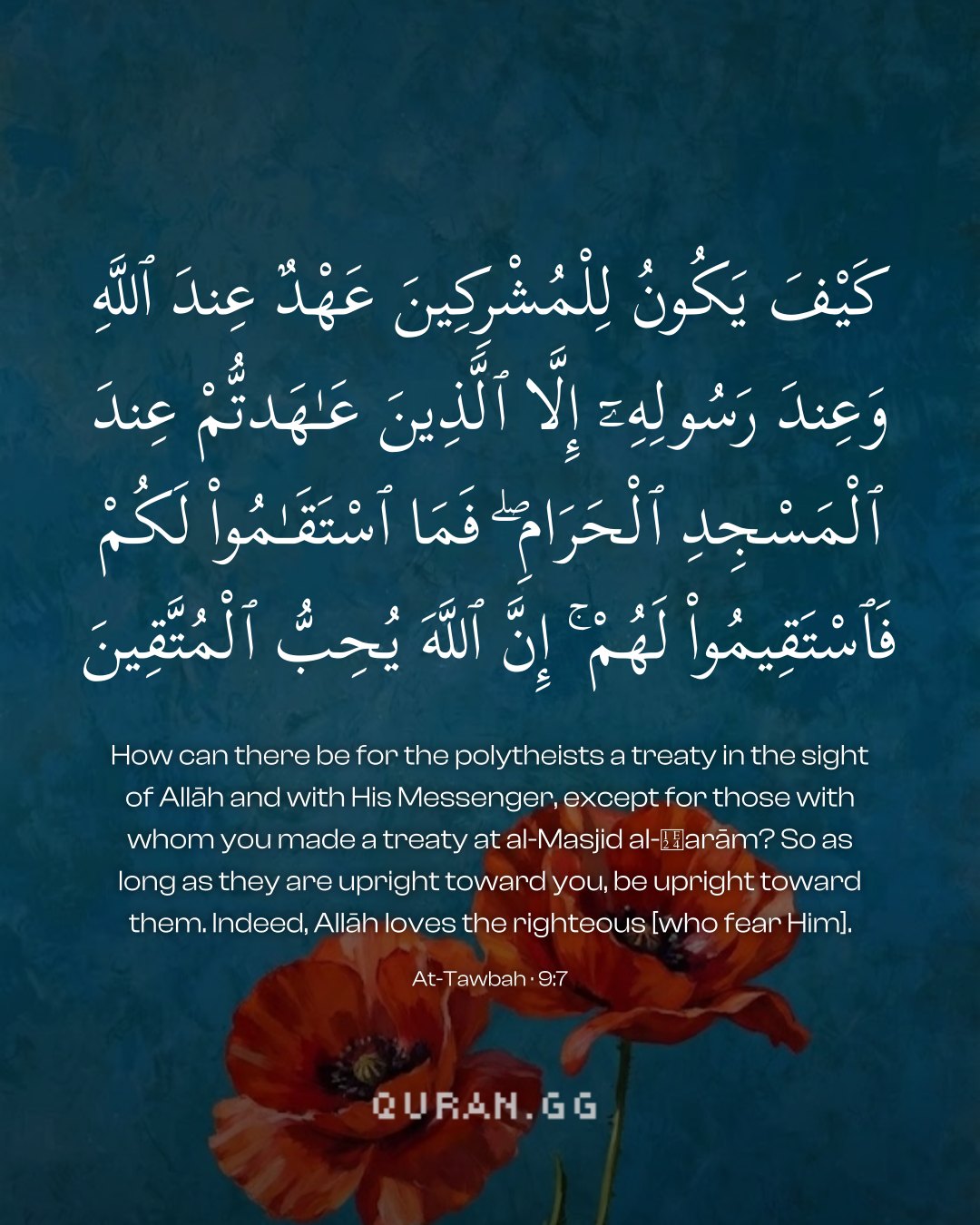
كَيْفَ يَكُونُ لِلْمُشْرِكِينَ عَهْدٌ
(How can there be a covenant for the Mushrikin), a safe resort and refuge, while they persist in Shirk with Allah, and disbelief in Him and His Messenger,
إِلاَّ الَّذِينَ عَـهَدْتُمْ عِندَ الْمَسْجِدِ الْحَرَامِ
(except those with whom you made a covenant near Al-Masjid Al-Haram), on the day of Hudaybiyyah. Allah said in another Ayah concerning the day of Hudaybiyyah,
هُمُ الَّذِينَ كَفَرُواْ وَصَدُّوكُمْ عَنِ الْمَسْجِدِ الْحَرَامِ وَالْهَدْىَ مَعْكُوفاً أَن يَبْلُغَ مَحِلَّهُ
(They are the ones who disbelieved and hindered you from Al-Masjid Al-Haram and detained the sacrificial animals, from reaching their place of sacrifice.) 48:25 Allah said next,
فَمَا اسْتَقَـمُواْ لَكُمْ فَاسْتَقِيمُواْ لَهُمْ
(So long as they are true to you, stand you true to them.), if they keep the terms of the treaties you conducted with them, including peace between you and them for ten years,
فَاسْتَقِيمُواْ لَهُمْ إِنَّ اللَّهَ يُحِبُّ الْمُتَّقِينَ
(then stand you true to them. Verily, Allah loves those who have Taqwa.) The Messenger of Allah ﷺ and the Muslims preserved the terms of the treaty with the people of Makkah from the month of Dhul-Qa`dah in the sixth year of Hijrah, until the Quraysh broke it and helped their allies, Banu Bakr, against Khuza`ah, the allies of Allah's Messenger ﷺ. Aided by the Quraysh, Banu Bakr killed some of Bani Khuza`ah in the Sacred Area! The Messenger of Allah ﷺ led an invasion army in the month of Ramadan, of the eighth year, and Allah opened the Sacred Area for him to rule over them, all thanks are due to Allah. The Messenger of Allah ﷺ freed the Quraysh who embraced Islam after they were overpowered and defeated. These numbered around two thousands, and they were refered to by the name `Tulaqa' afterwards. Those among them who remained in disbelief and ran away from Allah's Messenger ﷺ were sent promises of safe refuge for four months, during which they were allowed to move about freely. They included Safwan bin Umayyah, `Ikrimah bin Abi Jahl and many others. Allah later on guided them to Islam, and they became excellent believers. Surely, Allah is worthy of all praise for all His actions and decrees.
Ma'arif al-Qur'an
Mufti Muhammad Shafi
Uphold truth and commit no excess or injustice even against disbelievers is the teaching of Qur'an
This statement of the Qur'an provides guidance for Muslims that they should never surrender truth and justice even when they are dealing with confronting enemies. Whenever they have to take up an issue with them, they are required not to slip into taking exaggerated approaches and stances against them. This is as it has been demonstrated in these verses where full consideration has been given to the case of the disbelievers of Makkah. The fact was that most of them had broken their pledge. Naturally, when something like this happens in that setting, people tend to make a sweeping allegation against every-one. But, the Holy Qur'an, by saying: إِلَّا الَّذِينَ عَاهَدتُّمْ عِندَ الْمَسْجِدِ الْحَرَامِ (except those with whom you made a treaty near al-masjid-al-Haram), has exempted those who had not broken their pledge. In fact, it has ordered that Muslims should stay firm on their commitment as long as the others remain committed and faithful to their pledge. The breach of trust committed by other people should in no case influence their stance whereby they themselves may be led to become breakers of the pledge given to them.
The command to do battle given here after the lapse of four months of respite was not about an ordinary fight. This was God’s retribution imposed on those who denied the truth due to their rejection of the Prophet. By rejecting God’s prophet even after the completion of the process of arguments, they had made themselves liable to be left with no option but to accept the faith or fight. This was a special principle of God which related to the addressees of the Prophet and not to the general people. However, even after the completion of the process of preaching, this order was not made applicable immediately; even at the last stage they were given four months’ respite. Revenge does not know pardon. One with a revengeful mentality is satisfied only when he sees his opponent disgraced and destroyed. But the action taken against the polytheists of Arabia was not in any way connected with any type of revenge; it was based on an absolutely realistic principle. That is the reason why, in spite of the order being so severe, it was always open to them to embrace the Islamic religion and save themselves from punishment and acquire a respectable position in the Islamic brotherhood. For anybody’s repentance to be acceptable, only two practical conditions were enough—prayer (salat) and religious alms-giving (zakat). In times of conflict, if any individual from amongst the enemies says that he wants to understand Islam, Muslims have been ordered to give him protection, to give him an opportunity to be in their atmosphere and to try to see that the message of Islam is implanted in his heart. Even then, if he does not accept Islam, he should be led back to his place of residence under their protection. In wartime, it is usually unwise to give such a concession to the enemy, because it is quite possible that an enemy spy, taking advantage of this concession, may enter the Muslim camp and try to find out its strategic secrets. But, Islam holds that, the question of preaching in order to invite people towards the right path is so important that, in spite of this risk, its door should never be closed. If a man indulges in transgression unknowingly or out of ignorance, he will be treated with all possible lenience until his unawareness or ignorance is rectified.
Continue reading the tafsir of ayahs 5–7 Uthmani text of the Madinah mushaf (King Fahd Complex). Translation: Saheeh International. Tafsir via Quran.com.