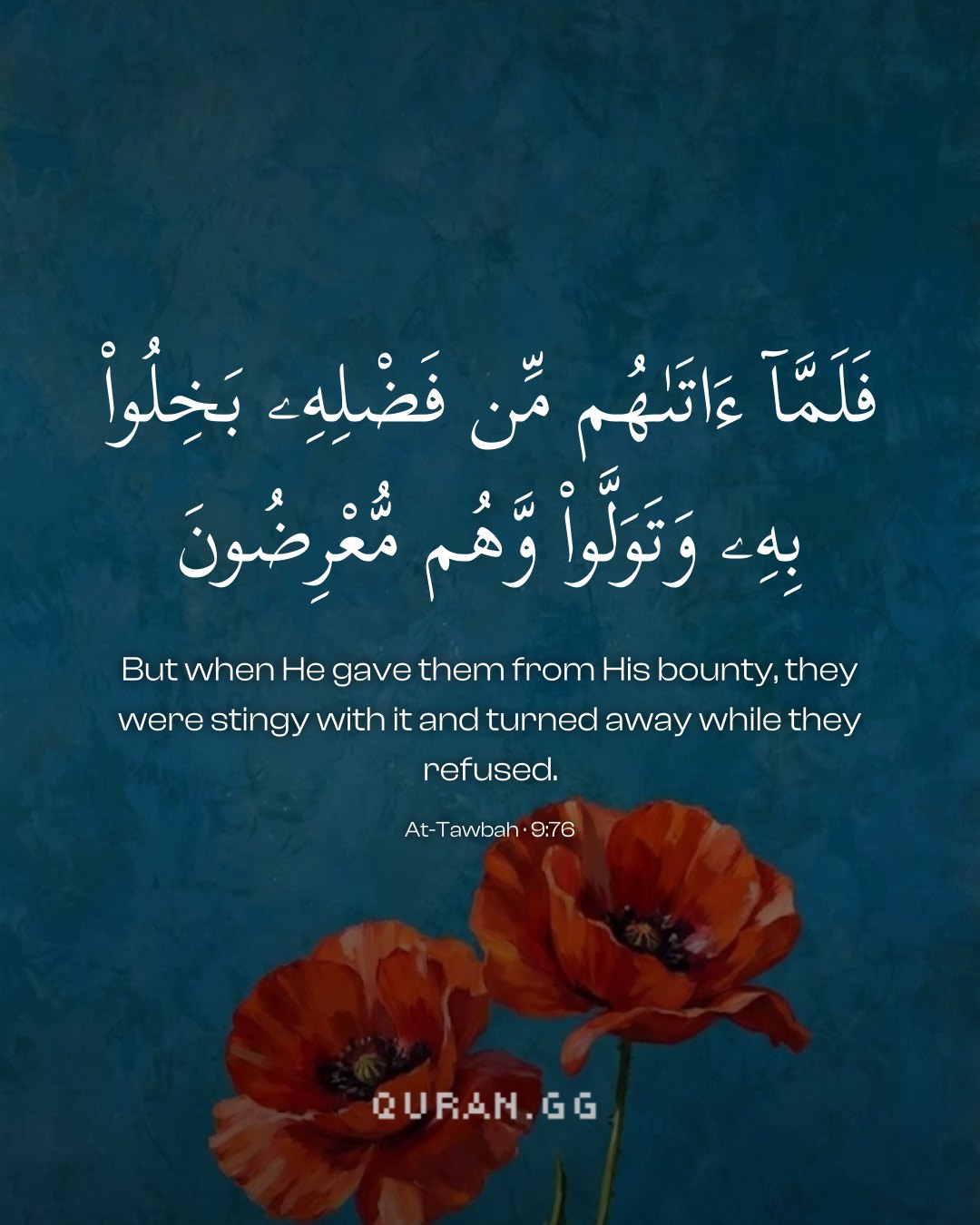
Allah says, some hypocrites give Allah their strongest oaths that if He enriches them from His bounty, they will give away alms and be among the righteous. However, they did not fulfill their vows or say the truth with their words. The consequence of this action is that hypocrisy was placed in their hearts until the Day they meet Allah the Exalted, on the Day of Resurrection. We seek refuge with Allah from such an end. Allah said,
بِمَآ أَخْلَفُواْ اللَّهَ مَا وَعَدُوهُ
(...because they broke that (covenant) with Allah which they had promised to Him) He placed hypocrisy in their hearts because they broke their promise and lied. In the Two Sahihs, it is recorded that the Messenger of Allah ﷺ said,
(There are three signs for a hypocrite: if he speaks, he lies; if he promises, he breaks the promise; and if he is entrusted, he betrays the trust.) Allah said,
(Know they not that Allah knows their secret ideas, and their Najwa,) Allah states that He knows the secret and what is more hidden than the secret. He has full knowledge of what is in their hearts, even when they pretend that they will give away alms, if they acquire wealth, and will be grateful to Allah for it. Truly, Allah knows them better than they know themselves, for He is the All-Knower of all unseen and apparent things, every secret, every session of counsel, and all that is seen and hidden.
Ma'arif al-Qur'an
Mufti Muhammad ShafiOn ayahs 75–76
The second verse: وَمِنْهُم مَّنْ عَاهَدَ اللَّـهَ (And among them there are those who made a pledge with Allah - 75) is also connected with a particular event which has been reported by Ibn Jarir, Ibn Abi Hatim, Ibn Marduwayh, Al-Tabarani and Al-Baihaqi on the authority of a narration from Sayyidna Abu Umamah Bahili ؓ . According to this report, a person called Tha'labah ibn Hatib al-Ansari presented himself before the Holy Prophet ﷺ and requested him to pray that he becomes rich. He said, ` Is it that you do not like my way? By the Being that holds my life in his His hands, if I had wished, mountains of Madinah would have turned into solid gold following behind me on my walkways. But, I do not like being that wealthy.' The man went away. But, he returned later and repeated his request for the same prayer with the pledge that, should he get the wealth prayed for, he would give every deserving person his share from it. The Holy Prophet ﷺ made the prayer. The effect of the prayer showed up in an unprecedented increase in the number of goats he owned. When the number increased further, the space in Madinah became too small for him. So, he moved out into the outskirts from where he used to come to Madinah where he offered the Sa1ah of Zuhr and ` Asr with the Holy Prophet ﷺ As for the rest of the prayers, he used to perform these in the wilderness where his herd of goats, his prized possession, was located.
According to a tradition, during the period of the Prophet Muhammad, there were about eighty hypocrites in Madinah. This indicates that the jihad ordered here against hypocrites did not mean waging (qital) war on them. Had it been so, the Prophet would have had them eliminated. According to a hadith narrated by Ibn ‘Abbas, here jihad meant striving by word of mouth. Hence, according to the majority of Muslims, jihad with the sword against hypocrites is not in accordance with the Shariah. Hypocrisy is the adoption of Islam in such a way that it is subservient to personal interests and worldly considerations. When hypocrites see that true believers have adopted Islam in a manner devoid of self-interest and worldly consideration and invite others also to accept the true Islam, they feel that this Islam amounts to degrading their form of Islam. Therefore, they begin to hate such preachers (da‘is). They become the enemies of the inviters to that very Islam in the name of which they have flourishing business. This enmity of hypocrites expresses itself by way of conspiracy and ridicule. If they observe that somebody has ill feelings towards the believers, the hypocrites encourage and incite these feelings with a view to making sure that fighting breaks out against the believers. They make fun of sincere people of faith. They utter words which belittle their sacrifices. They trivialize and distort their doings in order to spoil their image among the people. During the Tabuk journey, it once happened that the Prophet Muhammad’s camel strayed from a camp site and a search was started by some of the Muslims. When the hypocrites came to know of this, they mockingly said, ‘This gentleman tells about happenings in the skies, but he is not aware of the whereabouts of his camel.’ The hypocritical Muslims become the accomplices and instruments of Satan in order to defeat the believers. But, God is ever the supporter of true believers, and He saves them in spite of all the conspiracies of hypocrites. The fate of the hypocrites is that, their transgressions having been established beyond doubt, they become liable for punishment in this world as well as in the Hereafter. a Tha‘laba ibn Hathib Ansari requested the Prophet Muhammad to pray to God to bless him with wealth. The Prophet said that to be grateful to God for less wealth is better than acquiring a lot of wealth and then being unable to be grateful to Him. But Tha‘laba repeated his request several times. So, the Prophet prayed, ‘O God, bless Tha‘laba with wealth.’ Thereafter, Tha‘laba reared a goat. The breed of goats increased to such an extent that the land of Madinah could not provide enough fodder for his goats. Tha‘laba then shifted to a valley outside Madinah. Now Tha‘laba started becoming remiss in his Islamic observances. First of all he missed the congregational prayers. Then he missed the Friday prayers. A stage came when an official on behalf of the Prophet Muhammad approached Tha‘laba to collect alms (zakat) and he refused, saying, ‘This is nothing but a capital tax (jizyah); this is in no way different from the tax levied on those who deny the truth.’