Surah At-Tawbah Ayah 81 (9:81) — Meaning & Tafsir | Quran.GG

Surah At-Tawbah, Ayah 81

9:81 · Meaning and tafsir

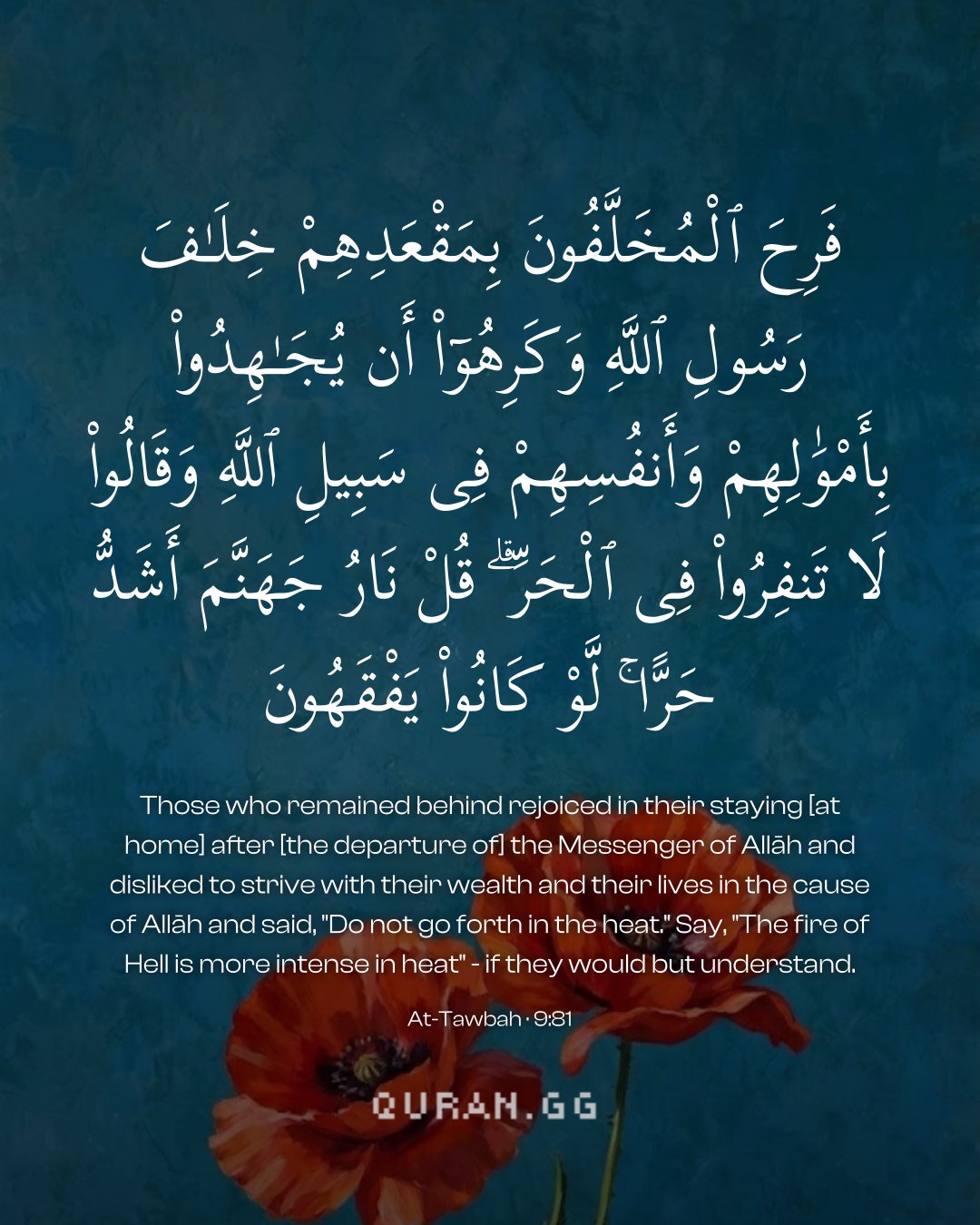
فَرِحَ ٱلْمُخَلَّفُونَ بِمَقْعَدِهِمْ خِلَـٰفَ رَسُولِ ٱللَّهِ وَكَرِهُوٓا۟ أَن يُجَـٰهِدُوا۟ بِأَمْوَٰلِهِمْ وَأَنفُسِهِمْ فِى سَبِيلِ ٱللَّهِ وَقَالُوا۟ لَا تَنفِرُوا۟ فِى ٱلْحَرِّ ۗ قُلْ نَارُ جَهَنَّمَ أَشَدُّ حَرًّا ۚ لَّوْ كَانُوا۟ يَفْقَهُونَ ٨١

Those who remained behind rejoiced in their staying [at home] after [the departure of] the Messenger of Allāh and disliked to strive with their wealth and their lives in the cause of Allāh and said, "Do not go forth in the heat." Say, "The fire of Hell is more intense in heat" - if they would but understand.

Surah At-Tawbah 9:81 in Arabic with its translation: “Those who remained behind rejoiced in their staying [at home] after [the departure of] the Messenger of Allāh…”

Make something with this ayah

Turn it into a video for Stories, Reels or TikTok, recited by the reciter you pick, or an image on a background you choose. Free, in your browser.

Download this image

Tafsir Ibn Kathir (abridged)

Hypocrites rejoice because They remained behind from Tabuk!

Allah admonishes the hypocrites who lagged behind from the battle of Tabuk with the Companions of the Messenger of Allah ﷺ, rejoicing that they remained behind after the Messenger ﷺ departed for the battle,

وَكَرِهُواْ أَن يُجَـهِدُواْ

(they hated to strive and fight), along with the Messenger ,

بِأَمْوَلِهِمْ وَأَنْفُسِهِمْ فِى سَبِيلِ اللَّهِ وَقَالُواْ

(with their properties and their lives in the cause of Allah, and they said), to each other,

لاَ تَنفِرُواْ فِى الْحَرِّ

("March not forth in the heat.") Tabuk occurred at a time when the heat was intense and the fruits and shades became delightful. This is why they said,

لاَ تَنفِرُواْ فِى الْحَرِّ

("March not forth in the heat") Allah said to His Messenger ,

قُلْ

(Say) to them,

نَارُ جَهَنَّمَ

("The fire of Hell...), which will be your destination because of your disobedience,

أَشَدُّ حَرًّا

(". ..is more intense in heat;"), than the heat that you sought to avoid; it is even more intense than fire. Imam Malik narrated that Abu Az-Zinad said that Al-A`raj narrated that Abu Hurayrah said that the Messenger of Allah said,

«نَارُ بَنِي آدَمَ الَّتِي تُوقِدُونَهَا جُزْءٌ مِنْ سَبْعِينَ جُزْءًا مِنْ نَارِ جَهَنَّم»

(The fire that the son of Adam kindles is but one part of seventy parts of the Fire of Jahannam.) They said, "O Allah's Messenger! This fire alone is enough." He said,

«فُضِّلَتْ عَلَيْهَا بِتِسْعَةٍ وَسِتِّينَ جُزْءًا»

((Hellfire) was favored by sixty-nine parts.) The Two Sahihs collected this Hadith. Al-A`mash narrated that Abu Ishaq said that An-Nu`man bin Bashir said that the Messenger of Allah ﷺ said,

«إِنَّ أَهْوَنَ أَهْلِ النَّارِ عَذَابًا يَوْمَ الْقِيَامَةِ لِمَنْ لَهُ نَعْلَانِ وَشِرَاكَانِ مِنْ نَارِ جَهَنَّمَ يَغْلِي مِنْهُمَا دِمَاغُهُ كَمَا يَغْلِي الْمِرْجَلُ، لَا يَرَى أَنَّ أَحَدًا مِنْ أَهْلِ النَّارِ أَشَدُّ عَذَابًا مِنْهُ وَإِنَّهُ أَهْوَنُهُمْ عَذَابًا»

(On the Day of Resurrection, the person who will receive the least punishment among the people of the Fire, wears two slippers made from the Fire of Jahannam causing his brain to boil, just as a pot boils. He thinks that none in the Fire is receiving a more severe torment than he, when in fact he is receiving the least torment.) The Two Sahihs collected this Hadith. There are many other Ayat and Prophetic Hadiths on this subject. Allah said in His Glorious Book,

كَلاَّ إِنَّهَا لَظَى - نَزَّاعَةً لِّلشَّوَى

(By no means! Verily, it will be the Fire of Hell. Taking away (burning completely) the scalp!) 70:15-16,

هَـذَانِ خَصْمَانِ اخْتَصَمُواْ فِى رَبِّهِمْ فَالَّذِينَ كَفَرُواْ قُطِّعَتْ لَهُمْ ثِيَابٌ مِّن نَّارِ يُصَبُّ مِن فَوْقِ رُءُوسِهِمُ الْحَمِيمُ - يُصْهَرُ بِهِ مَا فِى بُطُونِهِمْ وَالْجُلُودُ - وَلَهُمْ مَّقَامِعُ مِنْ حَدِيدٍ - كُلَّمَآ أَرَادُواْ أَن يَخْرُجُواْ مِنْهَا مِنْ غَمٍّ أُعِيدُواْ فِيهَا وَذُوقُواْ عَذَابَ الْحَرِيقِ

(Al-Hamim (boiling water) will be poured down over their heads. With it will melt (or vanish away) what is within their bellies, as well as (their) skins. And for them are hooked rods of iron (to punish them). Every time they seek to get away therefrom, from anguish, they will be driven back therein, and (it will be said to them): "Taste the torment of burning!") 22:19-22, and,

إِنَّ الَّذِينَ كَفَرُواْ بِـَايَـتِنَا سَوْفَ نُصْلِيهِمْ نَاراً كُلَّمَا نَضِجَتْ جُلُودُهُمْ بَدَّلْنَـهُمْ جُلُوداً غَيْرَهَا لِيَذُوقُواْ الْعَذَابَ

(Surely, those who disbelieved in Our Ayat, We shall burn them in Fire. As often as their skins are roasted through, We shall change them for other skins that they may taste the punishment.)4:56 Allah said here,

قُلْ نَارُ جَهَنَّمَ أَشَدُّ حَرًّا لَّوْ كَانُوا يَفْقَهُونَ

(Say: "The fire of Hell is more intense in heat;" if only they could understand!) meaning, if they have any comprehension or understanding, they would have marched with the Messenger of Allah ﷺ during the heat, so as to save themselves from the Fire of Jahannam, which is much more severe. Allah, the Exalted, then warns the hypocrites against their conduct,

فَلْيَضْحَكُواْ قَلِيلاً

(So let them laugh a little...) Ibn Abi Talhah reported that Ibn `Abbas commented, "Life is short, so let them laugh as much as they like in it. But when life ends and they are returned to Allah, the Exalted and Most Honored, they will start crying forever without end."

Ma'arif al-Qur'an

Commentary

Behavior patterns of hypocrites who did not take part in the battle of Tabuk, despite the general call of Jihad, continue to be the main theme since several previous verses.

The current verses give another example of their behavior. Then, it was said that they will be punished in the Hereafter, their names will be eliminated from the list of the mujahidin of Islam forever in this mortal world and that they will never be allowed to take part in any future Jihad.

The word: مُخَلَّفُونَ (those who were left behind - 81) is the plural of مُخَلَّفُ (mukhallaf) which means ` abandoned' or left out. The subtle hint thus released is that these people are pleased with the idea that they have stayed away from endangering their lives by not participating in the Jihad. But, the truth of the matter is that Allah Ta` ala did not consider them to be worthy of this supreme honor. Therefore, it is not they who have abandoned the Jihad, in fact, it is Jihad that has abandoned them. The reason is that Allah and His Messenger have, at their discretion, considered it fit that they should be left out.

Following immediately, there is the word: خلاف (khilaf) in: خِلَافَ رَ‌سُولِ اللَّـهِ translated as ` to the displeasure of the Messenger of Allah.' This word could be taken in the sense of ` behind' or ` after' as well. In fact, this is the meaning Abu ` Ubayd has gone by. If so, it would mean that these people were rejoicing in their staying (at home) after (the departure of) the Messenger of Allah - an occasion not really worth the mirth. As for the word: بِمَقْعَدِهِمْ (bimaq` adihim: their sitting back) in the same verse, it appears here in the sense of قعود (qu’ ud: sitting) as a verbal noun.

It is also possible to take the word khilaf in the sense of mukhalafat (contravention, opposition). In that case, it would mean that they sat home in contravention of the command of the Holy Prophet ﷺ . Then, they did not leave it at that. They prompted others too by saying that they should not march in that hot weather: (لَا تَنفِرُ‌وا فِي الْحَرِّ‌.

We already know that the command to fight the battle of Tabuk was given at a time when the heat was intense. The rejoinder to their comment came from Allah Ta` ala: قُلْ نَارُ‌ جَهَنَّمَ أَشَدُّ حَرًّ‌ا (Say: [ 0 Prophet ] the fire of Jahannam is more intense in heat) that is, these people are really unfortunate. They see the heat of a certain given time and try to beat it one way or the other. But, they do not realize that their disobedience to the command of Allah and His Messenger would bring them face to face with the fire of Jahannam. Why would they not worry about it? Is it that the heat of our seasons is more intense than the heat of Hell?

Tazkirul Quran

That person is a hypocrite in the eyes of God who prays to God for the blessing of wealth and when God makes him wealthy, forgets to keep aside God’s share. When a man has no wealth, he finds fault with wealthy persons, saying that they are wasting wealth in improper ways; and that if he were to be blessed with wealth by God, he would spend it on good and charitable causes. But when he receives wealth, his mentality changes. He forgets what he had said earlier and what feelings he had expressed. Now, he thinks that his wealth is the result of his own diligence and talents, which gives him the right to sole possession of it. He forgets to set aside God’s share in his wealth. Such people, in order to cover up their weaknesses, indulge in further arrogance by ridiculing those who spend their wealth for the cause of God. If a person spends more, they belittle him by calling him ostentatious, and of one who can spend only a little, in view of his circumstances, they ask derisively whether God was in need of this man’s charity. Those people who are in this way obsessed with their own greatness, are never able to see the higher realities outside themselves.

Uthmani text of the Madinah mushaf (King Fahd Complex). Translation: Saheeh International. Tafsir via Quran.com.