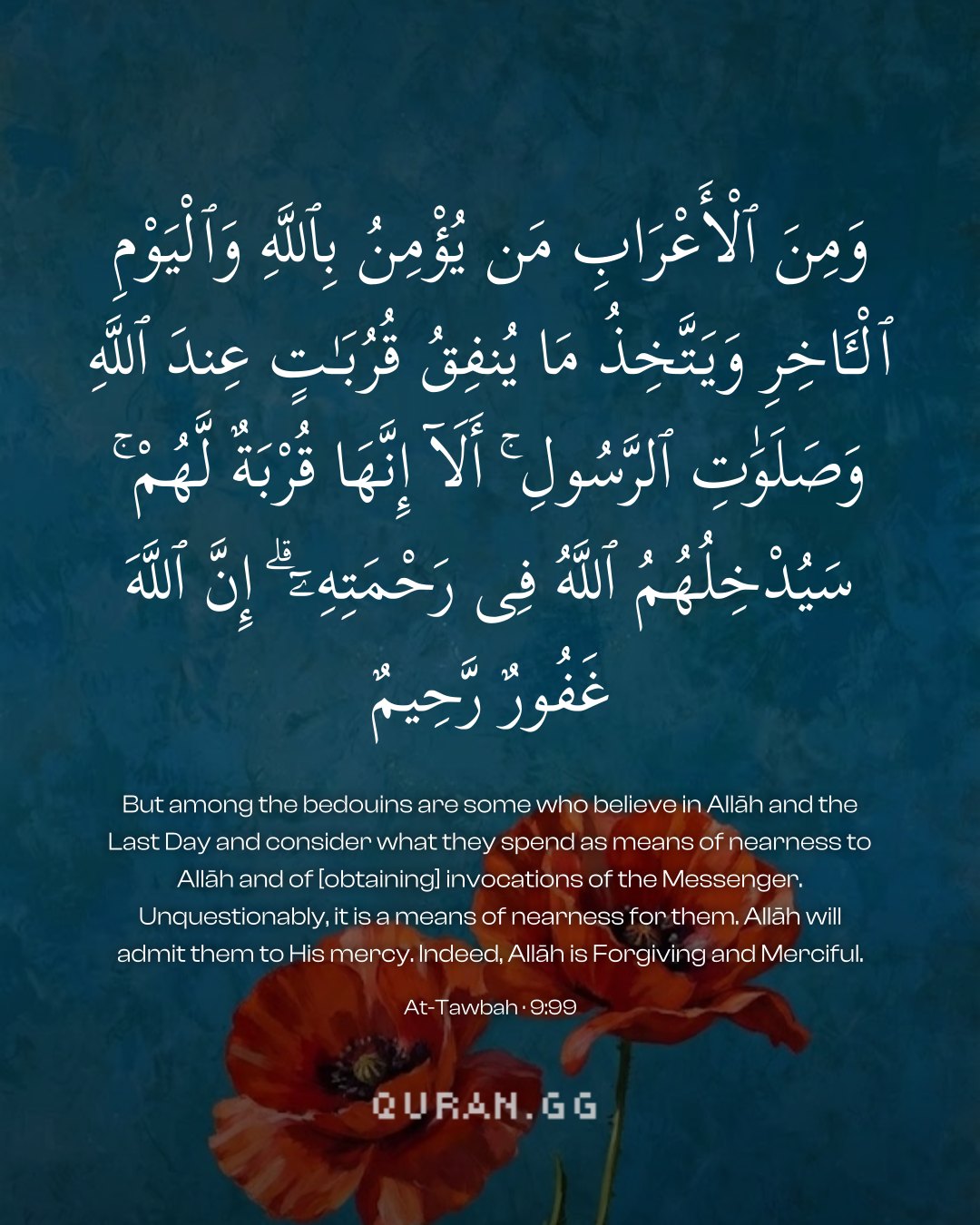
But among the bedouins are some who believe in Allāh and the Last Day and consider what they spend as means of nearness to Allāh and of [obtaining] invocations of the Messenger. Unquestionably, it is a means of nearness for them. Allāh will admit them to His mercy. Indeed, Allāh is Forgiving and Merciful.
The Bedouins are the Worst in Disbelief and Hypocrisy
Allah states that there are disbelievers, hypocrites and believers among the bedouins. He also states that the disbelief and hypocrisy of the bedouins is worse and deeper than the disbelief and hypocrisy of others. They are the most likely of being ignorant of the commandments that Allah has revealed to His Messenger . Al-A`mash narrated that Ibrahim said, "A bedouin man sat next to Zayd bin Sawhan while he was speaking to his friends. Zayd had lost his hand during the battle of Nahawand. The bedouin man said, `By Allah! I like your speech. However, your hand causes me suspicion.' Zayd said, `Why are you suspicious because of my hand, it is the left hand that is cut' The bedouin man said, `By Allah! I do not know which hand they cut off (for committing theft), is it the right or the left' Zayd bin Sawhan said, `Allah has said the truth,
After having described the state of affairs prevailing among hypocrites of distant deserts, it was considered appropriate that the true and staunch Muslims from among the same stock of Bedouins should also be mentioned. This was done in verse 99 - very much in line with the typical style of the Qur'an - so that, it stands established that Bedouins too are not all alike. Among them, there are many sincere Muslims, and people of sense and discernment as well. Their style of life is different. When they give in obligatory alms (Zakah) or in voluntary charities (Sadaqat), they regard these as a source of nearness to Allah Ta` ala and hope that the Holy Prophet ﷺ would be praying for them.
That Sadaqat are a source of nearness to Allah Ta` ala is obvious. However, the hope of prayers from the Holy Prophet ﷺ is on a different basis. It should be borne in mind that the Holy Qur'an - wherever it has asked the Holy Prophet ﷺ to collect Zakah on the wealth and property of Muslims - has also directed him that he should also pray for those who pay Zakah. The forthcoming verse (103): خُذْ مِنْ أَمْوَالِهِمْ صَدَقَةً تُطَهِّرُهُمْ وَتُزَكِّيهِم بِهَا وَصَلِّ عَلَيْهِمْ (Take out of their wealth a Sadaqah [ obligatory alms ] through which you may cleanse and purify them, and pray for them) is a good example? The instruction to the Holy Prophet ﷺ that he should pray for these people has been termed: وَصَلِّ عَلَيْهِمْ (and pray for them) using the word: صلٰوہ (salat) for it. Therefore, in the present verse as well, the sense of the prayers of the Holy Prophet ﷺ has been expressed by the use of the word: صلٰوہ (salat).
Tazkirul Quran
Maulana Wahiduddin KhanOn ayahs 98–99
A tradition of the Prophet says, ‘One who settles in a village will become hard in nature.’ There is an intellectual atmosphere in a city; educational institutes are established there, discussion of learning and the arts is a regular feature of city life, whereas the people in villages do not have these opportunities for self-improvement. Moreover, their manner of living and the means of their livelihood are also inferiror in comparison. Consequently, a deep and mature consciousness does not develop in these people of the countryside. There is harshness in their temperament and superficiality in their thinking. They find it difficult to understand the dialectics of religion and cannot absorb its truth. God is aware of everything; at the same time He is Wise and Merciful also. He is fully aware of this weakness on the part of country people (villagers), or in other words, the general public, and in His wisdom and Mercy allows them full latitude on this account. Therefore, God does not demand from them deep realisation (ma‘rifah) or a high level of religiosity. If they are well-intentioned, God will accept their simple faith.
Uthmani text of the Madinah mushaf (King Fahd Complex). Translation: Saheeh International. Tafsir via Quran.com.