Allah tells us about His servant, Messenger and close Friend, the leader of the monotheists and the father of all subsequent Prophets, from whom Quraysh were descended and claimed to have taken their religion. He disowned his father's and his people's worship of idols and said:
("Verily, I am innocent of what you worship, except Him Who created me; and verily, He will guide me." And he made it a Word lasting among his offspring,) The Word means the worship of Allah Alone with no partner or associate, and the denunciation of all gods apart from Him, i.e., La ilaha illallah. He left this word as an example to be followed by those of his progeny who were guided by Allah.
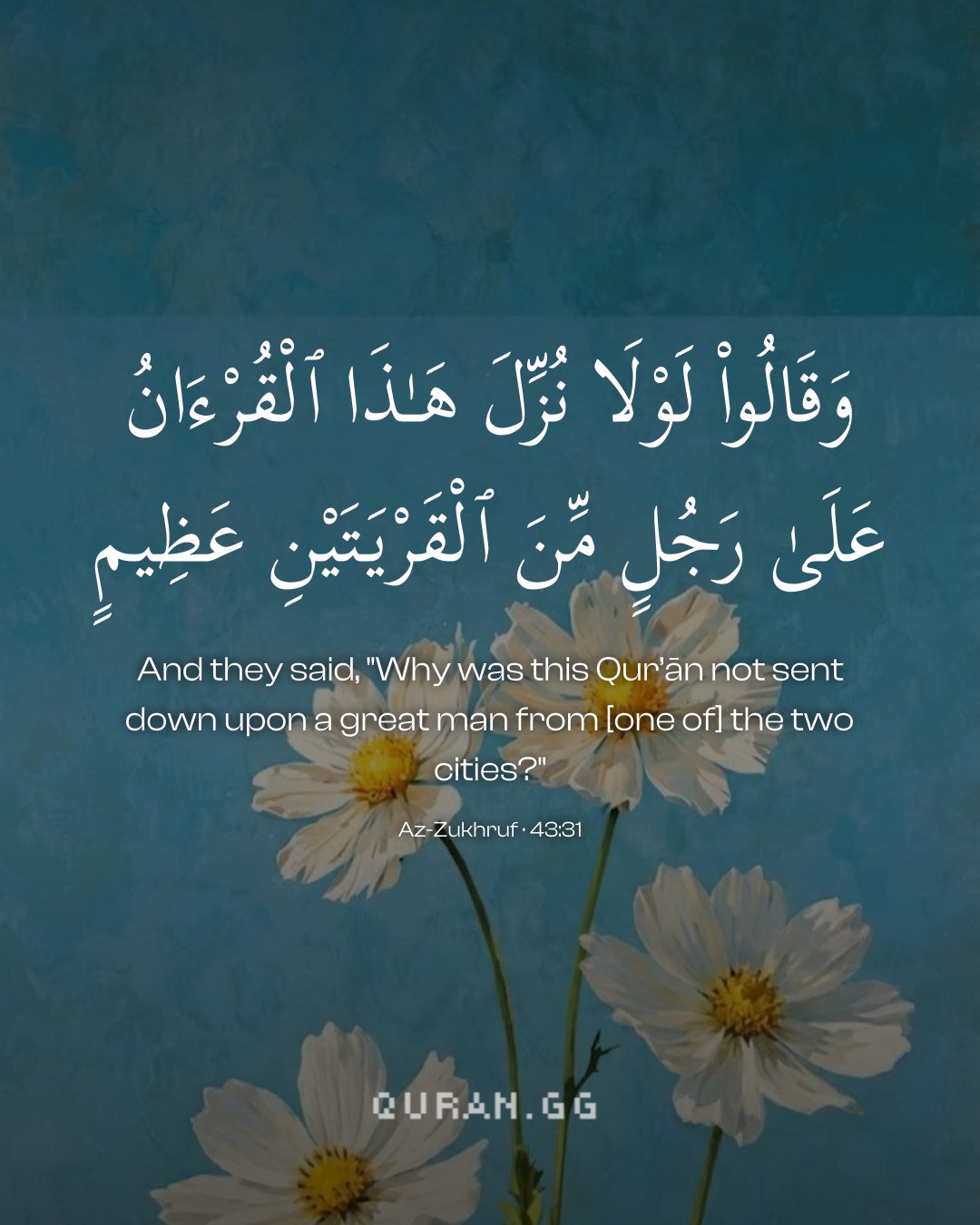
Allah Ta ala has in these verses, has replied to an objection of the pagans of Arabia used to be raised against the Holy Prophet صلی اللہ علیہ . Actually, they were not prepared to accept, at the first place, that a man could be a messenger of Allah Ta’ ala. The Holy Qur'an has referred, at many places, to their objection that they could not accept Sayyidna Muhammad ﷺ as a messenger of Allah, while he eats and drinks and walks about in the market places like any ordinary man. When it was clarified through many verses of the Qur'an that not only the Holy Prophet ﷺ ، but all the prophets who came to this world, were human beings, they started advancing another argument that if prophethood had to be bestowed upon a human being, why was it not given to some wealthy man of a high rank and position from Makkah or 'if instead of the Holy Prophet ﷺ who was not so wealthy? According to some narrations, they had proposed the names of Walid Ibn Mughirah and ` Utbah Ibn Rabi` ah from Makkah, and ` Urwah Ibn Masud Thaqafi, Habib Ibn ` Amr Thaqafi or Kinanah Ibn ` Abdiyalil from Ta'if. (Ruh-ul-Ma ani)
Allah Almighty has given two answers to this objection. The second answer is found in the next verses which will be explained there, while the present verse (32) has provided the first answer in the words, "Is it they who distribute the mercy of your Lord?" "Mercy of your Lord" refers here to 'prophethood' and the gist of the answer is that appointing someone as a prophet is a mercy from Allah which he bestows upon and allocates to human beings on the basis of His absolute wisdom, and according to His exclusive discretion for which He needs not to consult anyone, nor has anyone a right to interfere with it. You have no concern with distribution of prophethood so that your advice should be sought before anyone is made a prophet. Your intellect and understanding is too deficient to be entrusted with selecting suitable persons for the office of prophethood, or for the distribution of this divine mercy among people. How can you distribute among people an office as high as prophethood, while you have no ability to distribute something that is much lower and easier, that is, your economy. You are not good enough even to carry out the distribution of your wealth and means of sustenance. We know that if you are entrusted with this responsibility, you will not be able to manage it even for one day, and the whole system will simply collapse. That is why Allah Ta’ ala has not assigned the distribution of provisions in this world to you; rather He has kept it in His own hands. Since this comparatively ordinary work cannot be entrusted to you, how can a great job like distribution of prophethood be given in your hands?
This is what the above verses mean, but in the context of replying to the 'mushrikin', many economic principles are laid down and indications are given by Allah Ta’ ala regarding the economic system of the world; their brief explanation is necessary here.
Tazkirul Quran
Maulana Wahiduddin KhanOn ayahs 30–34
Abraham’s proclamation of the Unity of God as mentioned here was made by him during the last days of his mission. This was not simply a string of words: it was the sum and substance of a great history. When he attained the age of awareness, he discovered that the only Being worth worshipping by man was God. Except for Him, all other gods were false and without foundation. He built up his life solely on the basis of this belief and preached it among his family members and the people of his community. In complete disregard of personal or other considerations, he was steadfast in this belief for a very long time, so much so that his being a believer in the one God came to define his identity. After a lifetime spent in this way, when he left his native place and repeated the above-mentioned words, they naturally left a permanent impression. His words were such that people used to remember them whenever his name was mentioned. This strong tradition laid down by Abraham should have served as a milestone for the coming generations. But absorption in worldly interests made them neglectful of it and they became so careless and forgetful of it that in a later period, when one of God’s messengers came to remind them of this past lesson, they rejected him.
Uthmani text of the Madinah mushaf (King Fahd Complex). Translation: Saheeh International. Tafsir via Quran.com.