The Parable of Shirk
وَلَقَدْ ضَرَبْنَا لِلنَّاسِ فِى هَـذَا الْقُرْءَانِ مِن كُلِّ مَثَلٍ
(And indeed We have put forth for men, in this Qur'an every kind of parable) means, `We have explained things to mankind in it the Qur'an by setting forth examples and parables.'
لَعَلَّهُمْ يَتَذَكَّرُونَ
(in order that they may remember.) Because parables bring the meaning closer to people's minds. As Allah says:
ضَرَبَ لَكُمْ مَّثَلاً مِّنْ أَنفُسِكُمْ
(He sets forth for you a parable from yourselves) (30:28). meaning, `so that you may learn it from yourselves.' And Allah says:
وَتِلْكَ الاٌّمْثَالُ نَضْرِبُهَا لِلنَّاسِ وَمَا يَعْقِلُهَآ إِلاَّ الْعَـلِمُونَ
Continue reading the tafsir of ayahs 27–31Ma'arif al-Qur'an
Mufti Muhammad Shafi
Justice in the court of Resurrection: The form in which the right of the oppressed will be retrieved from the oppressor.
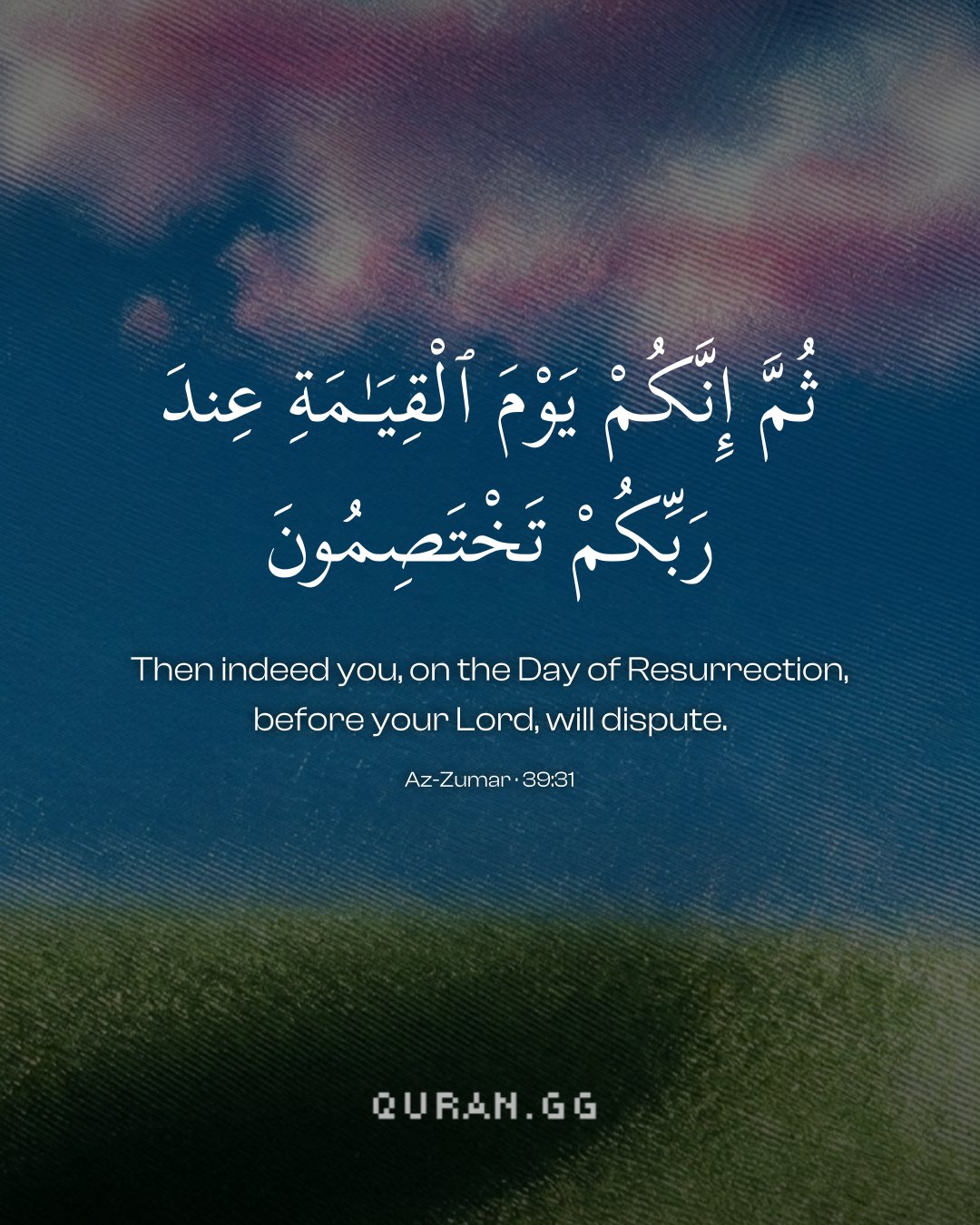
In verse 31, it was said: ثُمَّ إِنَّكُمْ يَوْمَ الْقِيَامَةِ عِندَ رَبِّكُمْ تَخْتَصِمُونَ (After that, on the Day of Doom, you will surely place your disputes before your Lord). Sayyidna Ibn ` Abbas ؓ says that the word:إِنَّكُمْ (innakum: surely you...) at this place includes - believers, disbelievers, Muslims - all of them, oppressor or oppressed. All of them will submit their cases in the court of their Lord, and He will have the right of the oppressed paid back by the oppressor whether a disbeliever, or believer. And the form in which these rights will be paid back will be what has mentioned in a narration of Sayyidna Abu Hurairah ؓ that appears in the Sahih of al-Bukhari. According to this, the Holy Prophet ﷺ ، said, 'a person who has a right of someone due against him should either pay it off, or have it forgiven right here in this world and become halal, that is, stand absolved of any responsibility on that count. The reason is that there are not going to be any currencies of dirhams and dinars (or any others found in the mortal world) in the universe of the Hereafter. If the oppressor has some good deeds in his account, then, these deeds will be taken from him to the measure of the oppression he did, and will be given to the oppressed. And in case he has no good deeds with him, bad deeds and sins of the oppressed will be taken from him and put into the account of the oppressor.
And there is a narration of Sayyidna Abu Hurairah ؓ in Sahih Muslim according to which the Holy Prophet ﷺ on a certain day asked his noble Sahabah, "Do you know who a pauper is?" The Sahabah said, ya rasulAllah, as for us, a pauper is one who has neither cash nor things needed (to run one's life).' He said, "The real pauper in my Ummah is a person who will come to the Day of Judgment with lots of good deeds, prayers, fasts, zakah and things like that, but such would the record (of his dealings with others) that he (in his mortal life) would have hurled invectives on someone, leveled false accusation against someone, devoured someone's property by unfair means, had someone killed, beaten or harassed. All those so oppressed will take their plaint before Allah, and the good deeds of the oppressor will be distributed over the oppressed. After that, when no good deeds are left, and the claims of the oppressed still remain to be settled, then, the sins of the oppressed will be passed on to the oppressor, and he will be thrown into the Jahannam. [ Hence, this person despite having everything, ended up being a pauper on the Day of Judgment - he is what a real pauper is!]
And Tabarani, citing a trustworthy authority, has reported from Sayyidna Abu Ayyub al-Ansari ؓ that the Holy Prophet ﷺ said, "The first case presented in the court of Allah will be that of man and his wife and, by God, the tongue will be silent there, instead, hands and feet of the woman will bear witness as to blames she used to impute to her husband. Similarly, the hands and feet of the man will bear witness as to how he used to cause pain to his wife. After that, servants will be brought before their respective masters, and redress will be provided for their complaints. After that, people from common markets with whom one had one or the other dealing will be presented, and if one of them has been subjected to some injustice, his right will be duly vacated.'
The Quran’s statements are in a language intelligible to man and within the sphere of his knowledge, so that nobody should have any difficulty in understanding them. Here, in symbolic language, it has been explained that the principle of the Unity of God as compared to polytheism is more rational and consistent with nature. Indeed, the functioning of the external universe is indicative of the fact that a single Will is operative in it. Had there been many intentions operative therein, the system of the universe could not have run so harmoniously. Moreover, man’s nature is also such that it prefers unity in loyalty. It is entirely against man’s nature to subscribe to different kinds of loyalties, as a result of which he is unable to do justice to any of them. All arguments and possibilities indicate that there is only one God, who is the Creator of man and who is worthy of being worshipped by him. In the present world, this fact is proclaimed through men like us. On the Day of Judgement, this will be declared by the Creator of the Universe Himself. At that time, denial of this fact will be impossible.
Uthmani text of the Madinah mushaf (King Fahd Complex). Translation: Saheeh International. Tafsir via Quran.com.