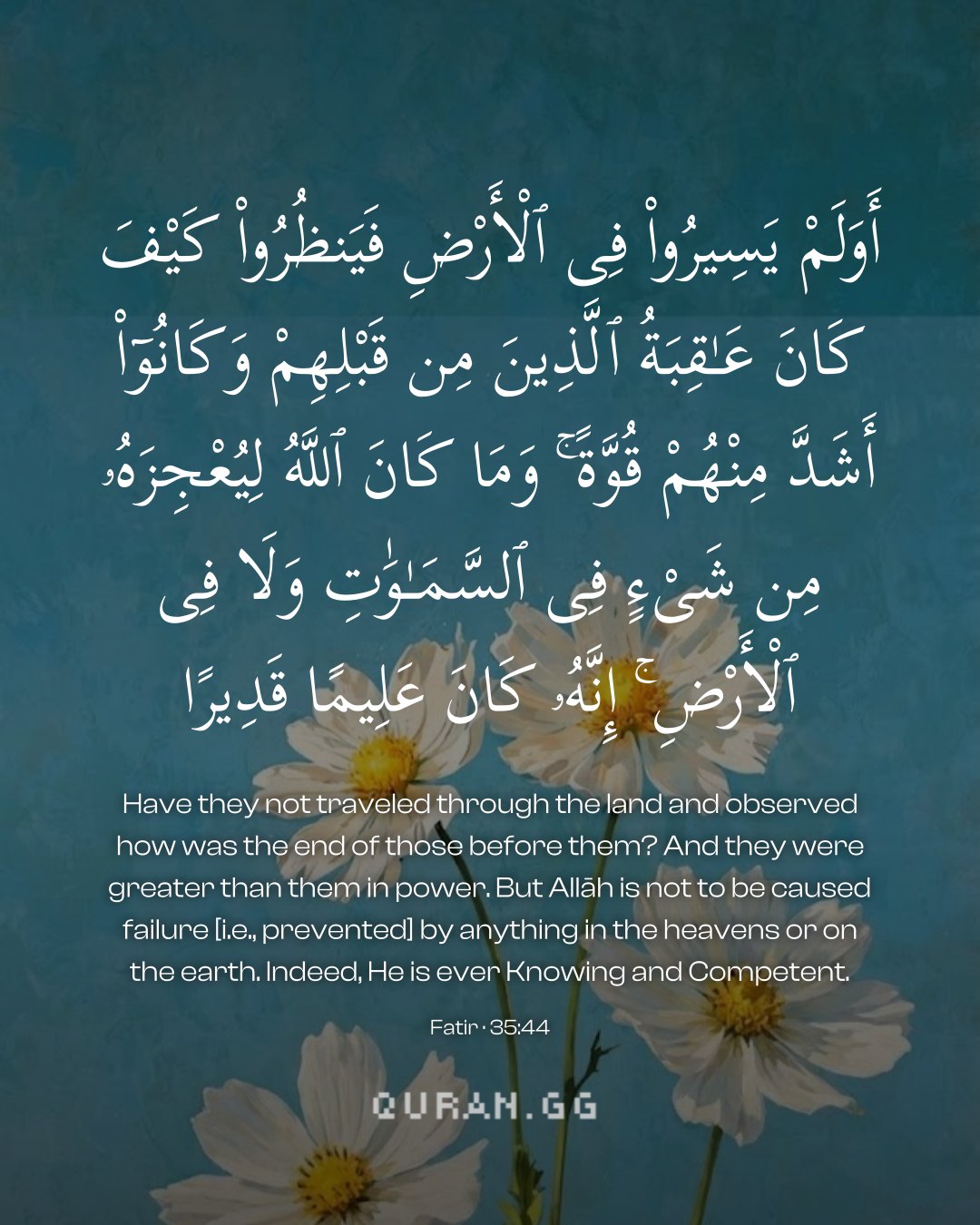
Remember the Bad Consequences of disbelieving in the Prophets
Allah says: `say, O Muhammad, to these people who disbelieve the Message you have brought: travel in the land and see what was the punishment of those who disbelieved the Messengers, how Allah destroyed them completely, and a similar (end awaits) the disbelievers. See how their homes were emptied of them and how they lost everything after living in luxury and being so numerous and so well equipped, and having so much wealth and so many children. All of that was of no avail to them and could not protect them in the slightest from the punishment of Allah when the command of the Lord came. Nothing is impossible for Him when He wants it to happen in the heavens or on earth.'
إِنَّهُ كَانَ عَلِيماً قَدِيراً
(Verily, He is All-Knowing, All-Able.) means, He knows all that exists and is able to do all things.
The Wisdom behind delaying the Punishment Then Allah says:
وَلَوْ يُؤَاخِذُ اللَّهُ النَّاسَ بِمَا كَسَبُواْ مَا تَرَكَ عَلَى ظَهْرِهَا مِن دَآبَّةٍ
(And if Allah were to punish men for that which they earned, He would not leave a moving creature on the surface of the earth;) meaning, if He were to punish them for all of their sins, He would destroy all the people of the earth and all that they own of livestock and crops. Sa`id bin Jubayr and As-Suddi commented on the Ayah:
مَا تَرَكَ عَلَى ظَهْرِهَا مِن دَآبَّةٍ
(He would not leave a moving creature on the surface of the earth;) "This means, He would have stopped sending rain to them, and all the animals would have died as a result."
وَلكِن يُؤَخِّرُهُمْ إلَى أَجَلٍ مُّسَمًّى
(but He gives them respite to an appointed term,) means, but He is delaying until the Day of Resurrection, when He will bring them to account and will reward or punish each one according to his deeds: He will reward those who obeyed Him and will punish those who disobeyed Him. He says:
فَإِذَا جَآءَ أَجَلُهُمْ فَإِنَّ اللَّهَ كَانَ بِعِبَادِهِ بَصِيراً
(and when their term comes, then verily, Allah is Ever All-Seer of His servants.) This is the end of the Tafsir of Surah Fatir. All praise and gratitude is due to Allah.
Commentary
The word: لَا يَحِيقُ (la yahiq) in verse 43: وَلَا يَحِيقُ الْمَكْرُ السَّيِّئُ إِلَّا بِأَهْلِهِ (And the evil plot envelops none but its own people ( who make it) carries the sense of: لَا یُحِیطُ (la yuhit: does not surround) or: لَا یُصیبُ (la usib: does not afflict). Thus, it comes to mean that the curse of making an evil plan falls on none but the one who makes it. In other words, a person who wishes evil for others, he himself falls a victim to it.
A doubt may arise at this point. It is commonly seen in this worldly life that someone with an evil plan gets away with it and the loss intended for anyone stands inflicted on him. The answer to this has been given by Maulana Ashraf Ali Thanavi (رح) by saying that the pain or loss inflicted on such a person was a loss limited to this mortal world, while the loss to be the fate of the maker of such evil plan in the Hereafter was not only heavier, but was more lasting too. So, if compared, his worldly loss amounts to nothing.
Continue reading the tafsir of ayahs 43–45 When the Arab people used to hear that the Jews and other people had flouted and disobeyed their prophets, they used to say enthusiastically that if any prophet appeared among them, they would accept him wholeheartedly and obey him. But, when their prophet did appear among them, they became his dire opponents. This mentality in some form or the other exists in all people. In this world, every man presents himself as a protagonist of Truth. He professes that whenever Truth appears before him, he will readily accept it. But, when the Truth emerges before him with clear supporting arguments, he ignores it and even opposes it. The denial of Truth therefore, is not the peculiarity of any particular community, but is an outcome of man’s psychology. The acceptance of Truth very often amounts to damaging one’s own importance, and naturally man does not want his stature to be diminished. That is why he refuses to accept the Truth. He forgets that although he has the option to reject the Truth, he has no power to save himself from the result of doing so.
Uthmani text of the Madinah mushaf (King Fahd Complex). Translation: Saheeh International. Tafsir via Quran.com.