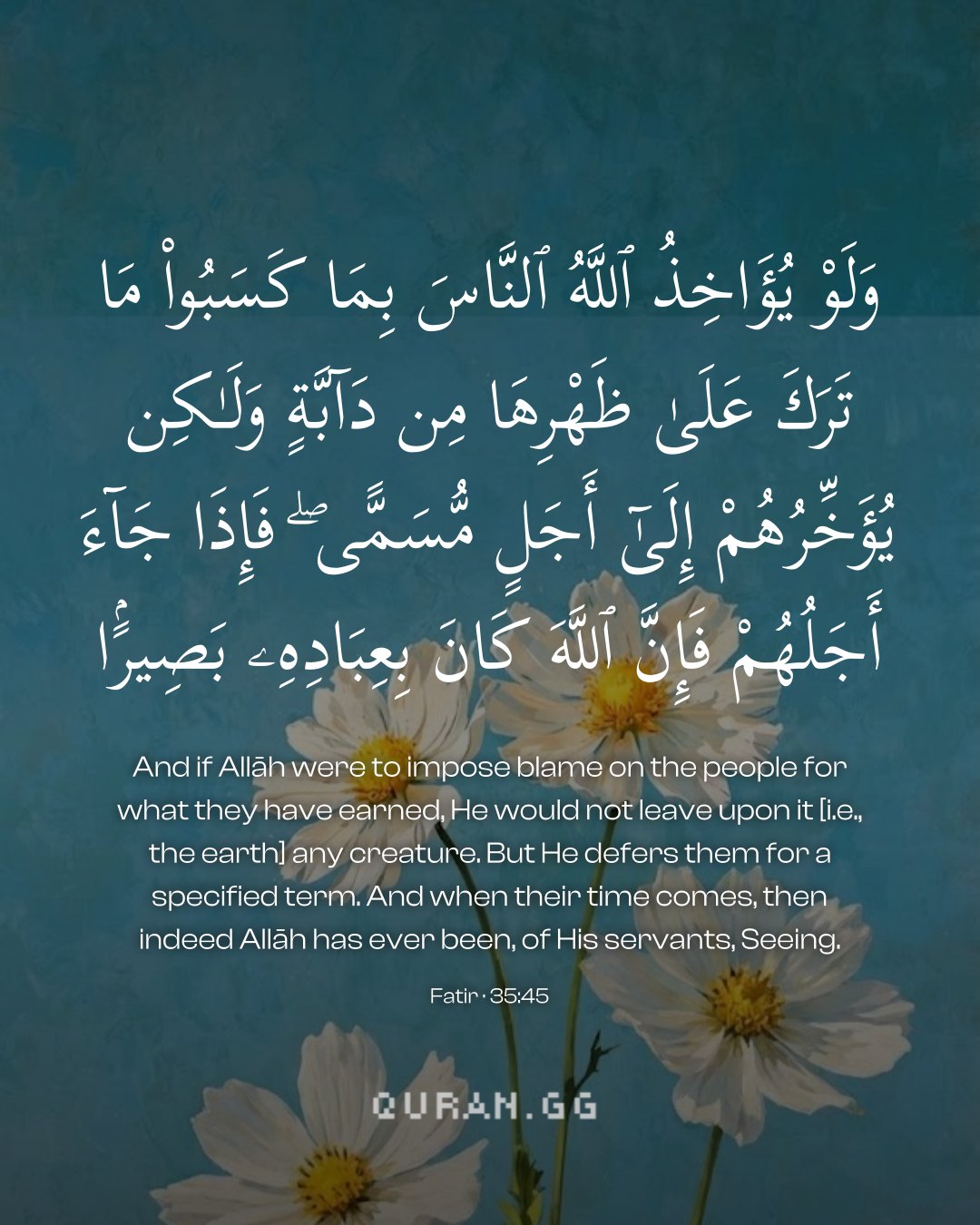
And if Allāh were to impose blame on the people for what they have earned, He would not leave upon it [i.e., the earth] any creature. But He defers them for a specified term. And when their time comes, then indeed Allāh has ever been, of His servants, Seeing.
Remember the Bad Consequences of disbelieving in the Prophets
Allah says: `say, O Muhammad, to these people who disbelieve the Message you have brought: travel in the land and see what was the punishment of those who disbelieved the Messengers, how Allah destroyed them completely, and a similar (end awaits) the disbelievers. See how their homes were emptied of them and how they lost everything after living in luxury and being so numerous and so well equipped, and having so much wealth and so many children. All of that was of no avail to them and could not protect them in the slightest from the punishment of Allah when the command of the Lord came. Nothing is impossible for Him when He wants it to happen in the heavens or on earth.'
The word: لَا يَحِيقُ (la yahiq) in verse 43: وَلَا يَحِيقُ الْمَكْرُ السَّيِّئُ إِلَّا بِأَهْلِهِ (And the evil plot envelops none but its own people ( who make it) carries the sense of: لَا یُحِیطُ (la yuhit: does not surround) or: لَا یُصیبُ (la usib: does not afflict). Thus, it comes to mean that the curse of making an evil plan falls on none but the one who makes it. In other words, a person who wishes evil for others, he himself falls a victim to it.
A doubt may arise at this point. It is commonly seen in this worldly life that someone with an evil plan gets away with it and the loss intended for anyone stands inflicted on him. The answer to this has been given by Maulana Ashraf Ali Thanavi (رح) by saying that the pain or loss inflicted on such a person was a loss limited to this mortal world, while the loss to be the fate of the maker of such evil plan in the Hereafter was not only heavier, but was more lasting too. So, if compared, his worldly loss amounts to nothing.
Man has been given freedom of action in the world, but he misuses it. His wrongs are so many that if he were caught hold of immediately for his wrongdoings, the entire human race would be wiped out from the world. But, human freedom is purely for the purpose of putting man to the test, and there is a period fixed for this. The period for an individual lasts till his death and the period fixed for humanity as a whole is till Doomsday. For this reason, the human race is still extant in the world. However, just as it is a fact that God does not seize hold of anybody before the expiry of the trial period, it must also be seriously considered that after the expiry of the trial period, He will definitely do so and nobody will escape the trial.
Uthmani text of the Madinah mushaf (King Fahd Complex). Translation: Saheeh International. Tafsir via Quran.com.