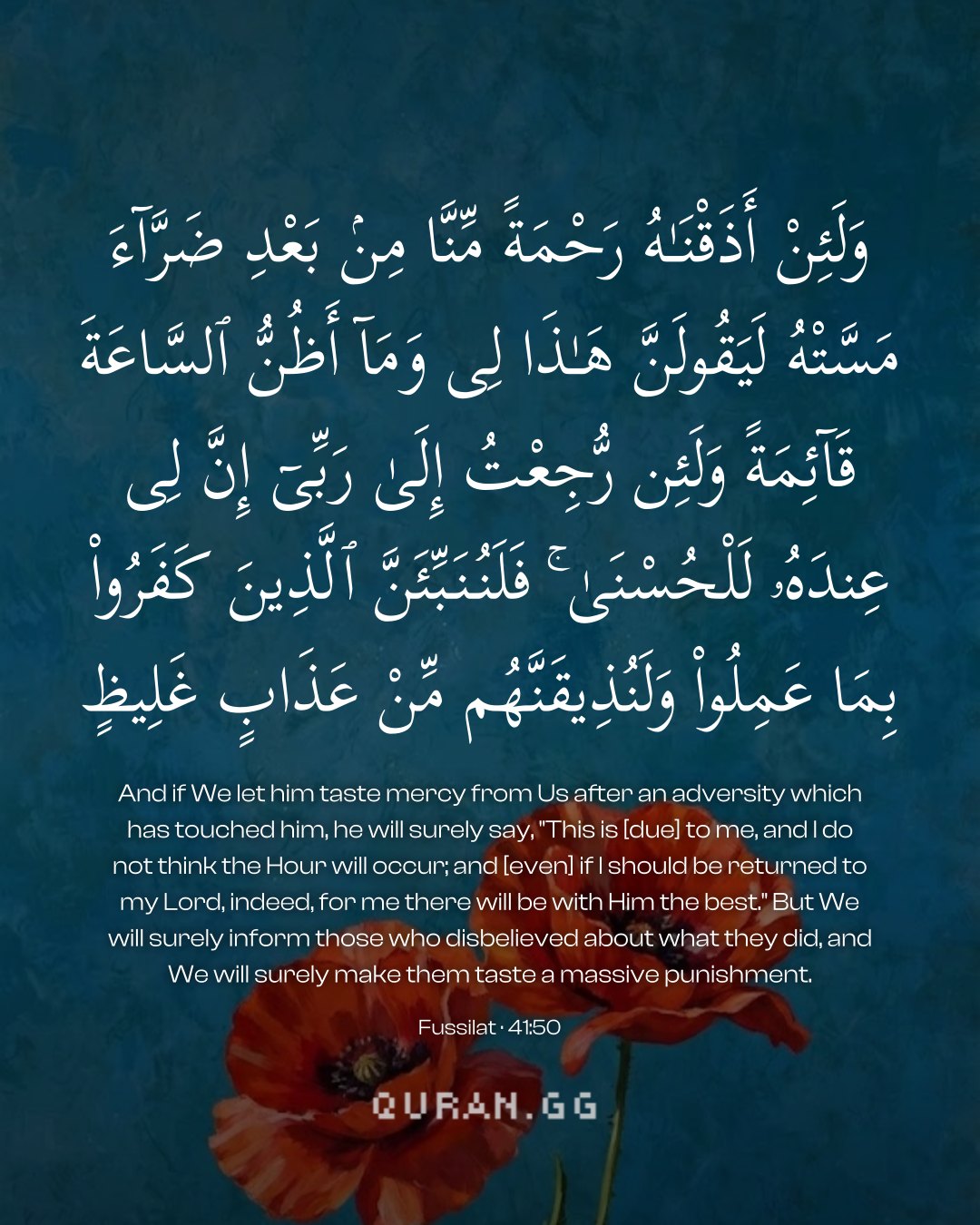
And if We let him taste mercy from Us after an adversity which has touched him, he will surely say, "This is [due] to me, and I do not think the Hour will occur; and [even] if I should be returned to my Lord, indeed, for me there will be with Him the best." But We will surely inform those who disbelieved about what they did, and We will surely make them taste a massive punishment.
Man is fickle when Ease comes to Him after Difficulty
Allah tells us that man never gets bored of asking his Lord for good things, such as wealth, physical health, etc., but if evil touches him -- i.e., trials and difficulties or poverty --
فَيَئُوسٌ قَنُوطٌ
(then he gives up all hope and is lost in despair.), i.e., he thinks that he will never experience anything good again.
(And truly, if We give him a taste of mercy from Us, after some adversity has touched him, he is sure to say: "This is due to my (merit)...") means, if something good happens to him or some provision comes to him after a period of difficulty, he says, `this is because of me, because I deserve this from my Lord.'
أَأَعْجَمِيٌّ وَعَرَبِيٌّ (Is it a non- Arabic [ book ] and an Arab [ messenger ]? - 44) The original word used for non-Arabic in the text is a'jamiyy (with hamza before the letter 'ain) which is an Arabic term for ` ineloquent speech', while ` ajam' (without hamzah in its beginning) means any nation other than Arabs. Therefore ` ajamiyy is a person who is non-Arab, even though he may speak eloquently, and a'jamiyy is a person who cannot speak eloquently (Qurtubi). The use of the word أَعْجَمِيٌّ ajamiyy in this verse means that if We had revealed the Qur'an in any language other than Arabic, then the Quraysh who are the first addressees of the Qur'an would have complained that they did not understand this Book and would have said wonderingly that the prophet is an ` Arab, but the book is ajamiyy which is ineloquent.
The moment of crisis for a man is the moment of self-discovery. So, when he is confronted with adversity, he forgets self-conceit and starts remembering God. At that time, he realises that he is the subject or servant of God and God is his Deity. But, when God gives him relief from his trouble and blesses him with amenities, he immediately forgets his earlier position. He links the grace of God bestowed upon him with the cause-and-effect chain and considers it to be result of his own devices and abilities. He develops a perverse mentality according to which he thinks that the only life is that of this world, and that there will be no reckoning in the Court of God. Furthermore, his prosperity leads him into the misunderstanding that since he is well-off here, he will definitely be well-off in the hereafter also.
Uthmani text of the Madinah mushaf (King Fahd Complex). Translation: Saheeh International. Tafsir via Quran.com.