Ibn `Abbas, may Allah be pleased with him, said, "Everything has an essence and the essence of the Qur'an is the family of Ha Mim," or he said, "the Ha Mims." Mis`ar bin Kidam said, "They used to be called `the brides'." All of this was recorded by the the Imam, great scholar, Abu `Ubayd Al-Qasim bin Sallam, may Allah have mercy upon him, in his book Fada'il Al-Qur'an. Humayd bin Zanjuyah narrated that `Abdullah, may Allah be pleased with him, said, "The parable of the Qur'an is that of a man who sets out to find a place for his family to stay, and he comes to a place where there is evidence of rainfall. While he is walking about, admiring it, he suddenly comes upon beautiful gardens. He says, `I liked the first traces of rainfall, but this is far better.' It was said to him, `The first place is like the Qur'an, and these beautiful gardens are like the splendor of family of Ha Mim in relation to the rest of the Qur'an'." This was recorded by Al-Baghawi. Ibn Mas`ud, may Allah be pleased with him, said, "When I reach the family of Ha Mim, it is like reaching a beautiful garden, so I take my time."
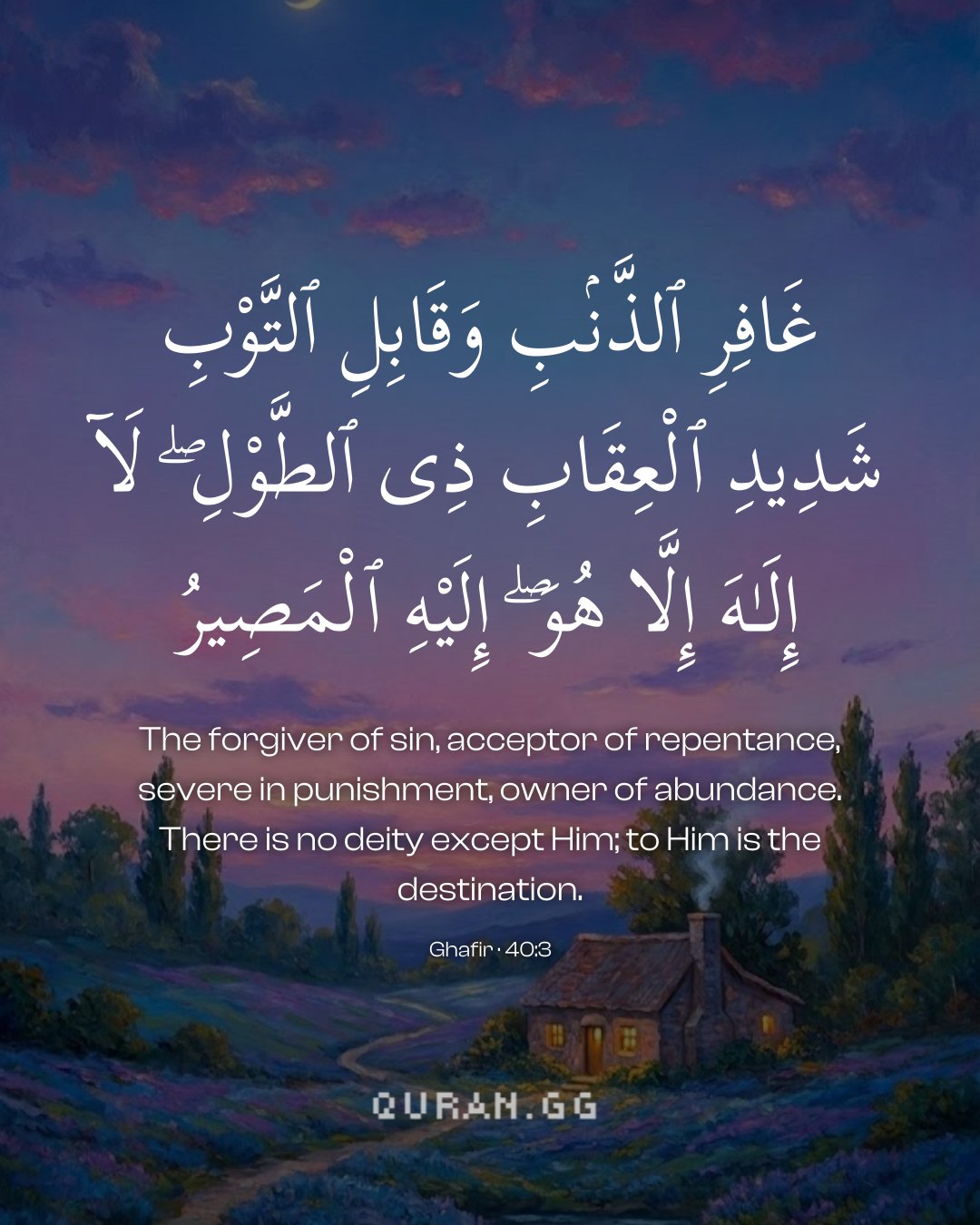
The expression: غَافِرِ الذَّنبِ وَقَابِلِ التَّوْبِ (ghafiridh-dhanb) in verse 3: all literally means the one who puts a cover on sins (in the sense that they are no more seen or known by anyone), and: قَابِلِ التَّوْبِ (gabilit-tawb) means: He who accepts taubah or repentance. These two expressions appear separately, though the sense of both appears to be almost the same. The reason is that by saying: غَافِرِ الذَّنبِ (ghafiridh-dhanb), the purpose is to indicate that Allah Ta’ ala does already possess the standing authority and power to forgive the sin of a servant even without taubah - while forgiving those who repent is yet another attribute of Allah. (Mazhari)
The word: طَول (tawl) which follows immediately in: ذِي الطَّوْلِ (dhit-tawl) literally means vastness and being need-free. Then, it could also mean power or favor. (Mazhari)
Tazkirul Quran
Maulana Wahiduddin KhanOn ayahs 3–5
The appellations, the Almighty and All Knowing (al-‘Aziz and al-‘Alim), have been used here by way of argument in support of the Quran. At the time the Quran was revealed, this was in the nature of a forecast. Today it is an established fact. The Quran was revealed before the age of science and in the most unfavourable of circumstances. But, exactly according to its claim, it won over its opponents. The polytheists of Arabia, the Jews and the great Roman and Iranian empires–all were its enemies. But, in a very short period, it overcame all of them. This is an event which amply proves that the Quran had been sent by the All-Powerful and Supreme God. The other quality of the Quran is that it is a book based on facts. Even after the passage of fifteen hundred years, no statement of the Quran has been found to be at variance with the discoveries of science. This is proof of the fact that the Being who revealed it is All Knowing and All Aware. No matter relating either to heaven or earth is hidden from Him. He is uniformly aware of the past, present and future. This is the very Almighty God who is truly worthy of worship by man. It befits His Power and Knowledge that He should gather all human beings and take stock of their deeds, and then decide everyone’s fate with perfect justice, pardon those who turned towards Him and punish for their misdeeds those who rebelled against Him.
Uthmani text of the Madinah mushaf (King Fahd Complex). Translation: Saheeh International. Tafsir via Quran.com.