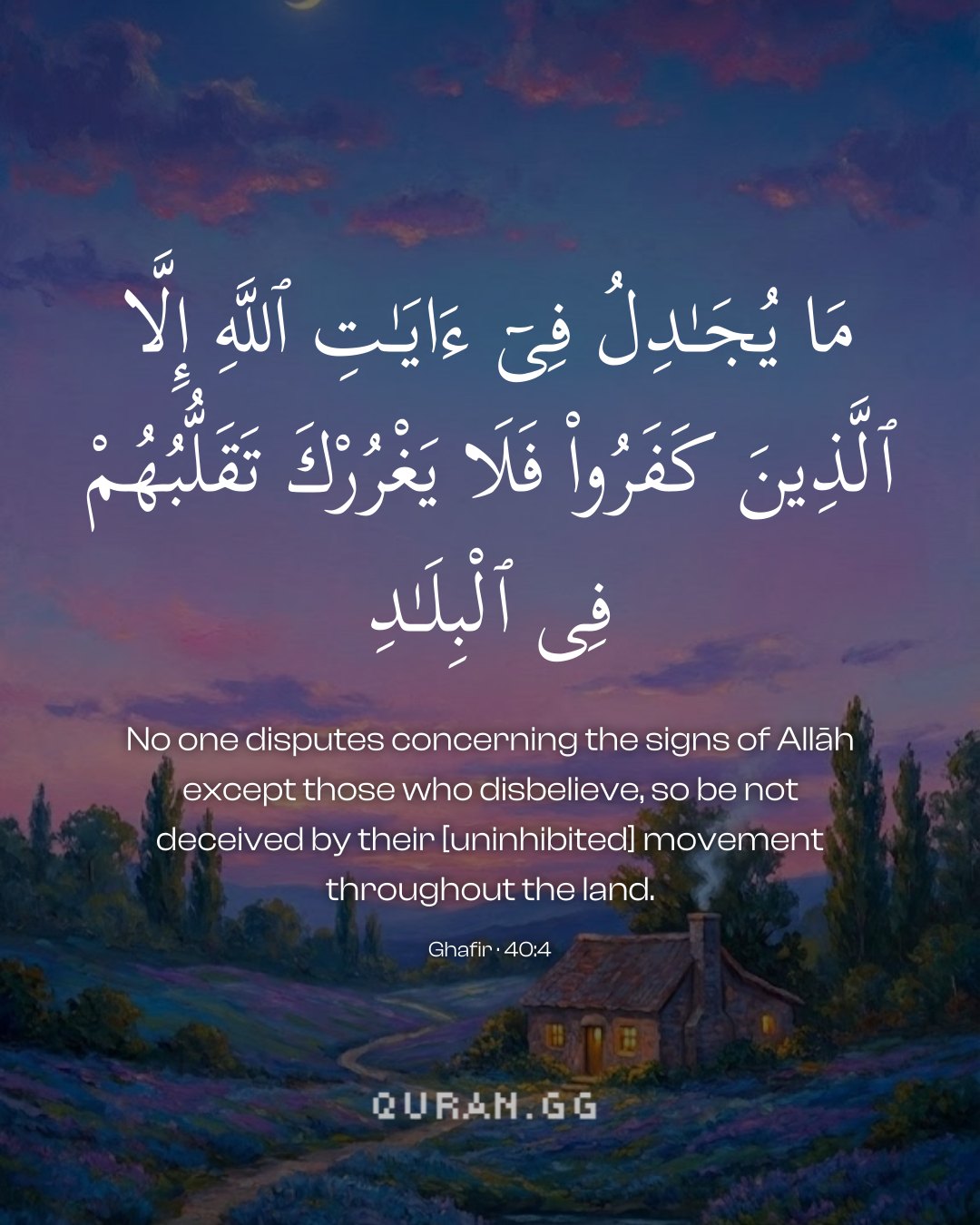
One of the Attributes of the Disbelievers is That they dispute theAyat of Allah -- and The Consequences of that Allah tells us that noone rejects or disputes His signs after clear proof has come,
إِلاَّ الَّذِينَ كَفَرُواْ
(but those who disbelieve), i.e., those who reject the signs of Allah and His proof and evidence.
فَلاَ يَغْرُرْكَ تَقَلُّبُهُمْ فِى الْبِلاَدِ
(So let not their ability of going about here and there through the land deceive you!) means, their wealth and luxurious life. This is like the Ayah:
لاَ يَغُرَّنَّكَ تَقَلُّبُ الَّذِينَ كَفَرُواْ فِى الْبِلَـدِ - مَتَـعٌ قَلِيلٌ ثُمَّ مَأْوَاهُمْ جَهَنَّمُ وَبِئْسَ الْمِهَادُ
(Let not the free disposal (and affluence) of the disbelievers throughout the land deceive you. A brief enjoyment; then, their ultimate abode is Hell; and worst indeed is that place for rest.) (3:196-197)
نُمَتِّعُهُمْ قَلِيلاً ثُمَّ نَضْطَرُّهُمْ إِلَى عَذَابٍ غَلِيظٍ
(We let them enjoy for a little while, then in the end We shall oblige them to (enter) a great torment.) (31:24). Then Allah consoles His Prophet Muhammad ﷺ for the rejection of his people. He tells him that he has an example in the Prophets who came before him, may the blessings and peace of Allah be upon them all, for their nations disbelieved them and opposed them, and only a few believed in them.
كَذَّبَتْ قَبْلَهُمْ قَوْمُ نُوحٍ
(The people of Nuh denied before these;) Nuh was the first Messenger whom Allah sent to denounce and forbid idol worship.
وَالاٌّحْزَابُ مِن بَعْدِهِمْ
(and the groups after them) means, from every nation.
وَهَمَّتْ كُـلُّ أُمَّةٍ بِرَسُولِهِمْ لِيَأْخُذُوهُ
(and every (disbelieving) nation plotted against their Messenger to seize him,) means, they wanted to kill him by any means possible, and some of them did kill their Messenger.
وَجَـدَلُوا بِالْبَـطِلِ لِيُدْحِضُواْ بِهِ الْحَقَّ
(and disputed by means of falsehood to refute therewith the truth.) means, they came up with specious arguments with which to dispute the truth which was so plain and clear.
فَأَخَذَتْهُمُ
(So I seized them) means, `I destroyed them, because of the sins they committed.'
فَكَيْفَ كَانَ عِقَابِ
(and how was My punishment!) means, `how have you heard that My punishment and vengeance was so severe and painful.' Qatadah said, "It was terrible, by Allah."
وَكَذَلِكَ حَقَّتْ كَلِمَةُ رَبِّكَ عَلَى الَّذِينَ كَفَرُواْ أَنَّهُمْ أَصْحَـبُ النَّارِ
(Thus has the Word of your Lord been justified against those who disbelieved, that they will be the dwellers of the Fire.) means, `just as the Word of punishment was justified against those of the past nations who disbelieved, so too is it justified against these disbelievers who have rejected you and gone against you, O Muhammad, and it is even more justified against them, because if they have disbelieved in you, there is no certainty that they will believe in any other Prophet.' And Allah knows best.
In verse 4, it was said: مَا يُجَادِلُ فِي آيَاتِ اللَّـهِ إِلَّا الَّذِينَ كَفَرُوا (No one quarrels about the verses of Allah, except those who disbelieve.). This verse declares quarreling in the matter of the Qur'an an act of kufr (disbelief). And the Holy Prophet ﷺ has said: اِنَّ جِدَالأ فِی القُراٰنِ کُفرُ (Surely, quarreling (jidal) in the Qur'an is kufr.' (Reported by al-Baghawi, al-Baihaqi in ash-Shu'ab from Sayyidna Abu Hurairah ؓ ; and reported by Abu Dawud and al-Hakim who has rated it as 'Sahib- Mazhari)
It appears in Hadith that, on a certain day, the Holy Prophet ﷺ heard two persons quarreling about some verse of the Qur'an. He got angry, and came out with his blessed face showing the signs of anger. He said, 'communities before you were ruined because they had started quarreling in the matter of the Book of Allah.' (Reported by Muslim from ` Abdullah Ibn ` Amr Ibn Shu'aib - Mazhari)
This جِدَال (jidal) declared as: کُفر (kufr) by the Qur'an, and Hadith, means throwing taunts, passing sarcastic remarks, engineering disputes over self-invented and absurd doubts, or to give such meaning of a verse of the Qur'an as is counter to other verses of the Qur'an and to the binding textual imperatives of Sunnah - something that amounts to alteration in the Qur'an. Otherwise, any honest inquiry about something ambiguous or vague, or trying to find a solution of a difficult word or expression, or to mutually investigate and discuss possibilities while deducing injunctions and rulings from the text of some verse are things not included under this jidal, in fact, it is an act of thawab (reward) in its own place (al-Qadi al-Baidawi, Qurtubi and Mazhari).
In the last sentence of verse 4, it was said: فَلَا يَغْرُرْكَ تَقَلُّبُهُمْ فِي الْبِلَادِ their [ prosperous ] movements in the cities should not deceive you.). The kuffar (disbelievers) from the tribe of Quraish used to travel to Yemen during winter and to Syria in summer with their trading caravans. They were held in esteem all over Arabia because of their services to Baytullah at Makkah, therefore, they remained safe during their travels and profited from their commercial ventures. This was the backbone of their wealth and territorial power. That this state of affairs with them kept continuing despite the challenge from Islam and the Holy Prophet ﷺ was a matter of pride for them - 'Had we been the culprits in the sight of Allah, all these blessings would have been taken away from us!' This situation could have made even some Muslims easy victims of doubt. Therefore, in this verse, it was said that Allah Ta’ ala had granted them a temporary respite in His wisdom and under His expedient consideration. So, let Muslims not be deceived by this leash given to them. Once this period of respite is over, they are going to be visited by a punishment, and this territorial power of theirs is going to be taken away from them. This started from the Battle of Badr, and up to the Conquest of Makkah, the foreboding manifested itself fully and conclusively within a span of six years.
The appellations, the Almighty and All Knowing (al-‘Aziz and al-‘Alim), have been used here by way of argument in support of the Quran. At the time the Quran was revealed, this was in the nature of a forecast. Today it is an established fact. The Quran was revealed before the age of science and in the most unfavourable of circumstances. But, exactly according to its claim, it won over its opponents. The polytheists of Arabia, the Jews and the great Roman and Iranian empires–all were its enemies. But, in a very short period, it overcame all of them. This is an event which amply proves that the Quran had been sent by the All-Powerful and Supreme God. The other quality of the Quran is that it is a book based on facts. Even after the passage of fifteen hundred years, no statement of the Quran has been found to be at variance with the discoveries of science. This is proof of the fact that the Being who revealed it is All Knowing and All Aware. No matter relating either to heaven or earth is hidden from Him. He is uniformly aware of the past, present and future. This is the very Almighty God who is truly worthy of worship by man. It befits His Power and Knowledge that He should gather all human beings and take stock of their deeds, and then decide everyone’s fate with perfect justice, pardon those who turned towards Him and punish for their misdeeds those who rebelled against Him.
Uthmani text of the Madinah mushaf (King Fahd Complex). Translation: Saheeh International. Tafsir via Quran.com.