Surah Hud Ayah 109 (11:109) — Meaning & Tafsir | Quran.GG

Surah Hud, Ayah 109

11:109 · Meaning and tafsir

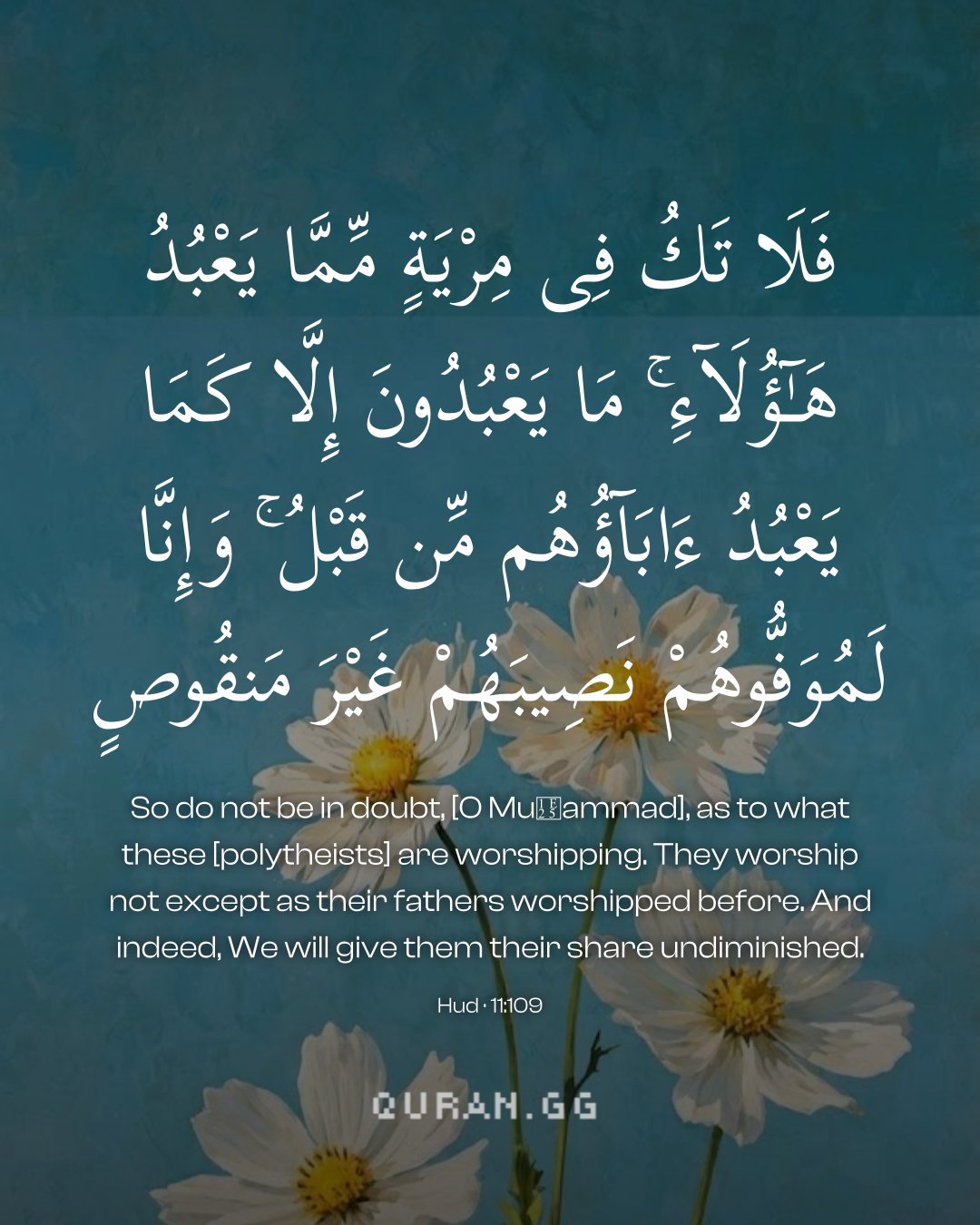
فَلَا تَكُ فِى مِرْيَةٍ مِّمَّا يَعْبُدُ هَـٰٓؤُلَآءِ ۚ مَا يَعْبُدُونَ إِلَّا كَمَا يَعْبُدُ ءَابَآؤُهُم مِّن قَبْلُ ۚ وَإِنَّا لَمُوَفُّوهُمْ نَصِيبَهُمْ غَيْرَ مَنقُوصٍ ١٠٩

So do not be in doubt, [O Muḥammad], as to what these [polytheists] are worshipping. They worship not except as their fathers worshipped before. And indeed, We will give them their share undiminished.

Surah Hud 11:109 in Arabic with its translation: “So do not be in doubt, [O Muḥammad], as to what these [polytheists] are worshipping. They worship not except…”

Make something with this ayah

Turn it into a video for Stories, Reels or TikTok, recited by the reciter you pick, or an image on a background you choose. Free, in your browser.

Download this image

Tafsir Ibn Kathir (abridged)

Associating Partners with Allah is no doubt Misguidance

Allah, the Exalted, says,

فَلاَ تَكُ فِى مِرْيَةٍ مِّمَّا يَعْبُدُ هَـؤُلاءِ

(So be not in doubt as to what these people worship.) This refers to the polytheists. Verily, what they are doing is falsehood, ignorance and misguidance. Verily, they are only worshipping what their fathers worshipped before. This means that they have no support for their Shirk. They are only mimicking their fathers in ignorance. Therefore, Allah will give them due recompense for that and He will punish them with a punishment the likes of which none can give besides Him. If they did any good deeds, then Allah will reward them for those good works in this life, before the life of the Hereafter. Concerning Allah's statement,

وَإِنَّا لَمُوَفُّوهُمْ نَصِيبَهُمْ غَيْرَ مَنقُوصٍ

(And verily, We shall repay them in full their portion without diminution.) `Abdur-Rahman bin Zayd bin Aslam said, "We will pay them in full their portion of punishment without diminution." Then, Allah mentions that He gave Musa the Book, but the people differed concerning it. Some believed in it and some disbelieved in it. Therefore, you, Muhammad, have an example in the Prophets who came before you. So do not grieve or be upset by their denial of you.

وَلَوْلاَ كَلِمَةٌ سَبَقَتْ مِن رَّبِّكَ لَقُضِيَ بَيْنَهُمْ

(and had it not been for a Word Kalimah that had gone forth before from your Lord, the case would have been judged between them,) Ibn Jarir said, "If it were not that the punishment had already been delayed until an appointed time, then Allah would have decided the matter between you now. The word Kalimah carries the meaning that Allah will not punish anyone until the proof has been established against him and a Messenger has been sent to him." This is similar to Allah's statement,

وَمَا كُنَّا مُعَذِّبِينَ حَتَّى نَبْعَثَ رَسُولاً

(And We never punish until We have sent a Messenger (to give warning).) 17:15 For verily, Allah says in another verse,

وَلَوْلاَ كَلِمَةٌ سَبَقَتْ مِن رَّبِّكَ لَكَانَ لِزَاماً وَأَجَلٌ مُّسَمًّى فَاصْبِرْ عَلَى مَا يَقُولُونَ

(And had it not been for a Word that went forth before from your Lord, and a term determined, (their punishment) must necessarily have come (in this world). So bear patiently what they say.)20:129-130 Then, Allah informs that He will gather the early generations and the later generations from all of the nations. He will then reward them based upon their deeds. If they did good deeds, their reward will be good, and if they did evil deeds, their reward will be bad. Allah says,

وَإِنَّ كُـلاًّ لَّمَّا لَيُوَفِّيَنَّهُمْ رَبُّكَ أَعْمَالَهُمْ إِنَّهُ بِمَا يَعْمَلُونَ خَبِيرٌ

(And verily, to each of them your Lord will repay their works in full. Surely, He is All-Aware of what they do.) This means that He is All-Knower of all of their deeds. This includes their honorable deeds and their despicable deeds, their small deeds and their great deeds. There are many different modes of recitation for this verse, yet all of their meanings agree with what we have mentioned. This is similar to Allah's statement,

وَإِن كُلٌّ لَّمَّا جَمِيعٌ لَّدَيْنَا مُحْضَرُونَ

(And surely, all - everyone of them will be brought before Us.)36:32

Ma'arif al-Qur'an

After having given this good counsel to them, he warned them of the punishment of Allah Ta` ala. He said:

وَيَا قَوْمِ لَا يَجْرِ‌مَنَّكُمْ شِقَاقِي أَن يُصِيبَكُم مِّثْلُ مَا أَصَابَ قَوْمَ نُوحٍ أَوْ قَوْمَ هُودٍ أَوْ قَوْمَ صَالِحٍ ۚ وَمَا قَوْمُ لُوطٍ مِّنكُم بِبَعِيدٍ

And 0 my people, let not your hostility towards me cause you to suffer what was suffered by the people of Nuh, or the people of Hud, or the people of Salih. And the people of Lut are not far from you.

The sense of the last sentence is that the overturned habitations of the people of Sayyidna Lut (علیہ السلام) were close to Madyan where they were. Then, in terms of time, the punishment that came upon them was very close. From this they could learn their lesson and leave their obstinacy.

Continue reading the tafsir of ayahs 89–111

Tazkirul Quran

What has been mentioned in the Quran as being of the utmost importance, and has been the most often repeated, is that human beings will not be spared the final reckoning, but after death will be presented in God’s court. There everybody will be consigned either to Paradise or to Hell, according to his performance in this world. The reason for giving this point so much importance and repeating it so often is the ‘doubts’ which people have. People see that there are countless individuals on the earth who do not carry out God’s instructions; there are countless individuals who act independently of God’s instructions; many persons live self-centred lives instead of God-oriented lives, without any loss to themselves; all of them are still successful. Here, apparently, it is nowhere to be seen that those loyal to God receive special rewards and those disobedient to God have to face punishment. For this reason, people start entertaining doubts. They are unable to believe that people are destined to meet any fate other than what they have gone on witnessing with their own eyes. Here the Quran states that people’s upholding of untruth is not because they had studied the problem from every aspect and had found untruth reasonable. It was rather because of their adherence to customs and tradition instead of being open to arguments and reasonableness. If, in spite of this, they are not faced with the result of their actions, it is because of the respite they are given for being tested; for the life on earth before death is a life of trial. So, to make the test valid, the opportunity is given to man here till the time of his death to say whatever he likes and to do whatever he likes. Death marks the end of this period. Death means that man is transported from the place of testing to the place of judgement. There everyone will receive whatever he actually deserves and everyone will lose whatever he had assembled around himself without deserving it.

Uthmani text of the Madinah mushaf (King Fahd Complex). Translation: Saheeh International. Tafsir via Quran.com.