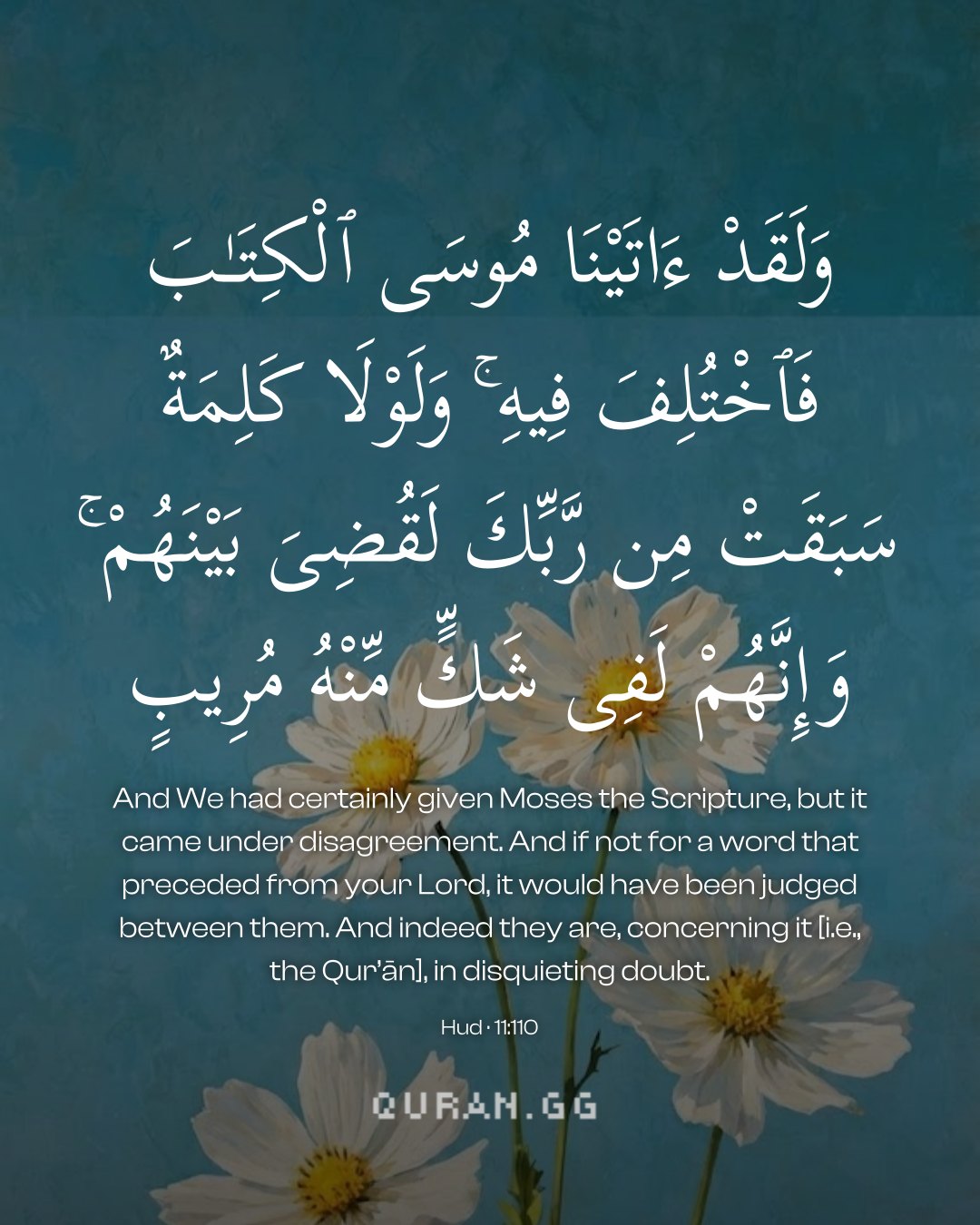
And We had certainly given Moses the Scripture, but it came under disagreement. And if not for a word that preceded from your Lord, it would have been judged between them. And indeed they are, concerning it [i.e., the Qur’ān], in disquieting doubt.
(So be not in doubt as to what these people worship.) This refers to the polytheists. Verily, what they are doing is falsehood, ignorance and misguidance. Verily, they are only worshipping what their fathers worshipped before. This means that they have no support for their Shirk. They are only mimicking their fathers in ignorance. Therefore, Allah will give them due recompense for that and He will punish them with a punishment the likes of which none can give besides Him. If they did any good deeds, then Allah will reward them for those good works in this life, before the life of the Hereafter. Concerning Allah's statement,
And 0 my people, let not your hostility towards me cause you to suffer what was suffered by the people of Nuh, or the people of Hud, or the people of Salih. And the people of Lut are not far from you.
The sense of the last sentence is that the overturned habitations of the people of Sayyidna Lut (علیہ السلام) were close to Madyan where they were. Then, in terms of time, the punishment that came upon them was very close. From this they could learn their lesson and leave their obstinacy.
This means that the addressees of the Book given by God to Moses had diverse opinions about its statements. Some of them rejected them and some of them accepted them. (at-Tabari). Whenever a statement is made, a man has two alternatives—one is to make the correct interpretation of it and the other is to make the wrong interpretation of it. If the hearers are really serious, they will inevitably arrive at the one correct interpretation. Their seriousness will guarantee their unity of opinion. On the contrary, if they are not serious, they will not give the statement any importance and will interpret it differently according to their own individual thinking. One will say this and the other will say that. In this way their levity will lead them to differences of opinion. This happened in the case of all the prophets. God has nevertheless tolerated this, because He has created the present world as a place for the performance of deeds and the coming world as a place for reward or retribution. That is the way of God. That is why people are given full respite here. The present state of affairs is entirely due to this respite being given so that human beings may be tested and not due to God being under any compulsion.
Uthmani text of the Madinah mushaf (King Fahd Complex). Translation: Saheeh International. Tafsir via Quran.com.