Allah created the Heavens and the Earth in Six Days
Allah, the Exalted, informs of His power over all things, and that He created the heavens and the earth in six days. He mentions that His Throne was over the water before that, just as Imam Ahmad recorded that `Imran bin Husayn said, "The Messenger of Allah ﷺ said,
«اقْبَلُوا الْبُشْرَى يَا بَنِي تَمِيم»
(Accept the glad tidings, O tribe of Tamim!) They said, `Verily you have brought us glad tidings and you have given us.' Then he said,
«اقْبَلُوا الْبُشْرَى يَا أَهْلَ الْيَمَن»
(Accept the glad tidings, O people of Yemen!) They said, `We accept. Therefore, inform us about the beginning of this matter and how it was.' He said,
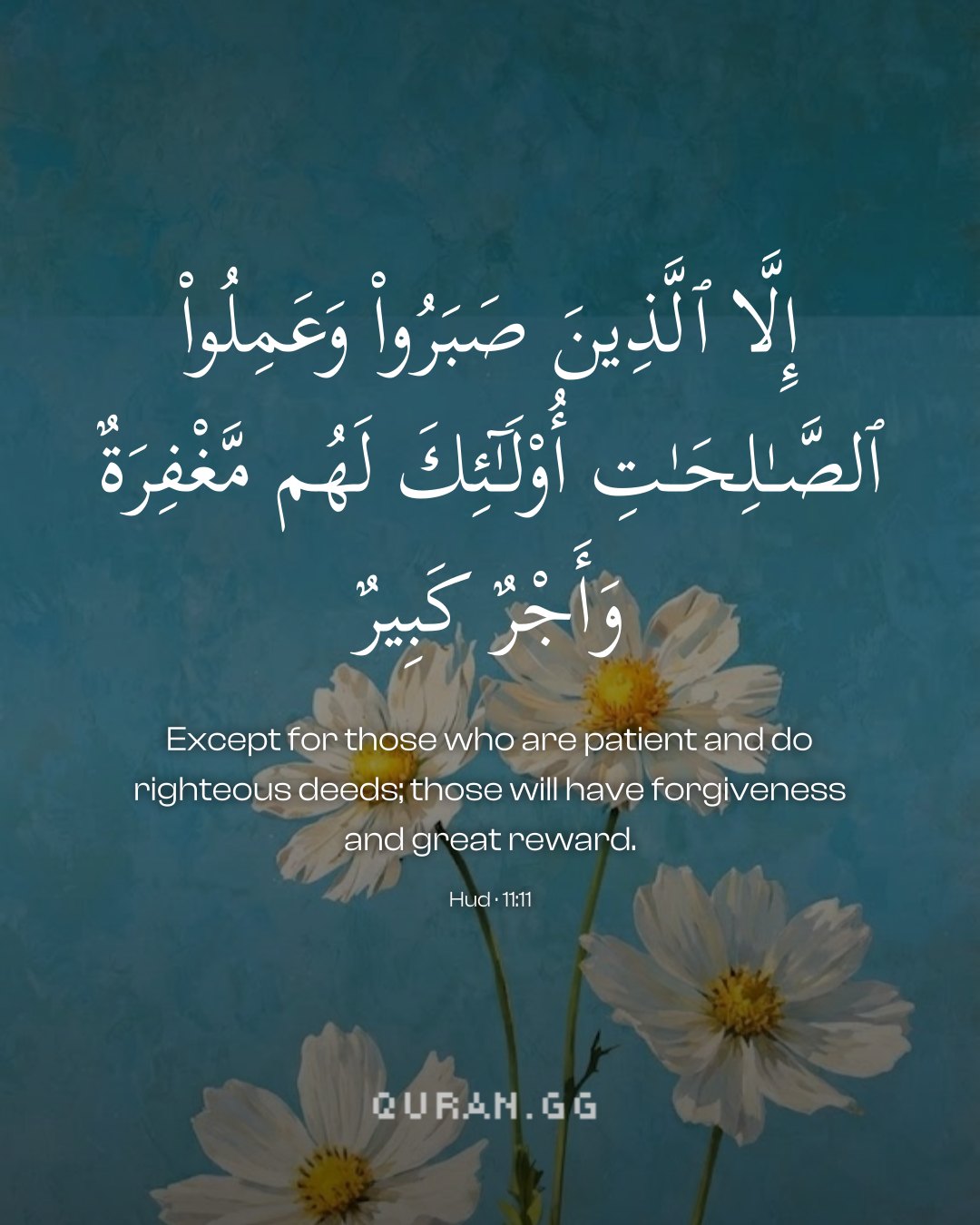
In order to make such perfect models of humanity distinct from those having common human temperament, it was said in the third verse (11): إِلَّا الَّذِينَ صَبَرُوا وَعَمِلُوا الصَّالِحَاتِ (except those who are patient and do good deeds). It means that people exempted from this common human frailty have two qualities: صَبر Sabr (patience) and al-Amal as-Salih (good deeds).
The word: صَبر (sabr) is used to convey a much wider range of meanings in the Arabic language, much wider than conveyed by its translation as ` patience' in English. The real meaning of صَبر Sabr is to tie, check, stop or hold back. In the terminology of the Qur'an and Sunnah, to hold the desiring human self back from going for the impermissible is Sabr. Therefore, the sense of صَبر Sabr (patience) includes abstention from all sins and doings counter to the dictates of the Shari` ah and al-Amal as-Salih (good deeds) covers all that is obligatory (fard), necessary (wajib), Sunnah and recommended (mustahabb). The verse now comes to mean that there are people who will not be affected by common human weaknesses. This will happen because they would have faith in Allah and they would fear the reckoning of the Last Day of Qiyamah. They will abstain from everything disliked by Allah and His Rasul and race towards every deed that brings their pleasure.
At the end of this very verse, also identified there is the recompense of these perfect human beings: أُولَـٰئِكَ لَهُم مَّغْفِرَةٌ وَأَجْرٌ كَبِير (Those are the people for whom there is forgiveness and a great reward - 11)
At this place, it should be noted that the Holy Qur'an uses the word: اَذَقنَا (adhaqna: We give them a taste of) for blessing and suffering both. By this device, it was indicated that real blessing and suffering is that of the Hereafter. Neither is the comfort of the mortal world the whole of it, nor is its suffering the whole of it. Instead of that, it should be taken at the level of tasting and sampling so that human beings could have some idea of the blessings and sufferings of the Hereafter. Therefore, neither are the comforts of this world something to be happy about unnecessarily, nor are its sufferings something to grieve about too much. If you were to think, this whole world is, to borrow a commercial term, only a showroom of the Hereafter with sample displays of comfort and suffering.
Tazkirul Quran
Maulana Wahiduddin KhanOn ayahs 11–13
In the present world, man is given ease and hardship by turns. But here, neither is comfort given as a reward nor is hardship imposed as a punishment. The purpose of both is to put human beings to the test. This world is a great examination hall. The purpose of whatever happens to man here is to see what sort of responses he offers to different testing conditions. That man is a failure whose behaviour is such that when he receives some worldly bounties from God, he becomes proud; he behaves with haughtiness towards those who appear to him of a lower status than himself. Similarly, that person is also a failure who displays ingratitude when some bounty is taken away from him or he becomes the victim of some affliction. Even after being deprived of something, a man still possesses many things granted to him by God. But man forgets them and becomes so desperate over that one loss, it is as if he had been robbed of everything. On the contrary, those who fully measure up to the standards of Faith are individuals who are patient and righteous in their deeds. That is, in spite of every setback, they keep their emotional balance and continue to exercise moderation; they continue to do whatever they are required to do as subjects of God. What is patience? It is a man’s conduct being shaped by principles and not by the conditions and situations in which he finds himself. Whatever may be the condition, he should rise above them and formulate his views purely in the light of Truth. He should have the courage to live on the level of his Faith and moral awareness, unaffected by the prevailing conditions. This sort of life is one of piety. Those who establish their piety in this way will be the ones who will share God’s bounties in the future life and have a place in God’s eternal Gardens.
Uthmani text of the Madinah mushaf (King Fahd Complex). Translation: Saheeh International. Tafsir via Quran.com.