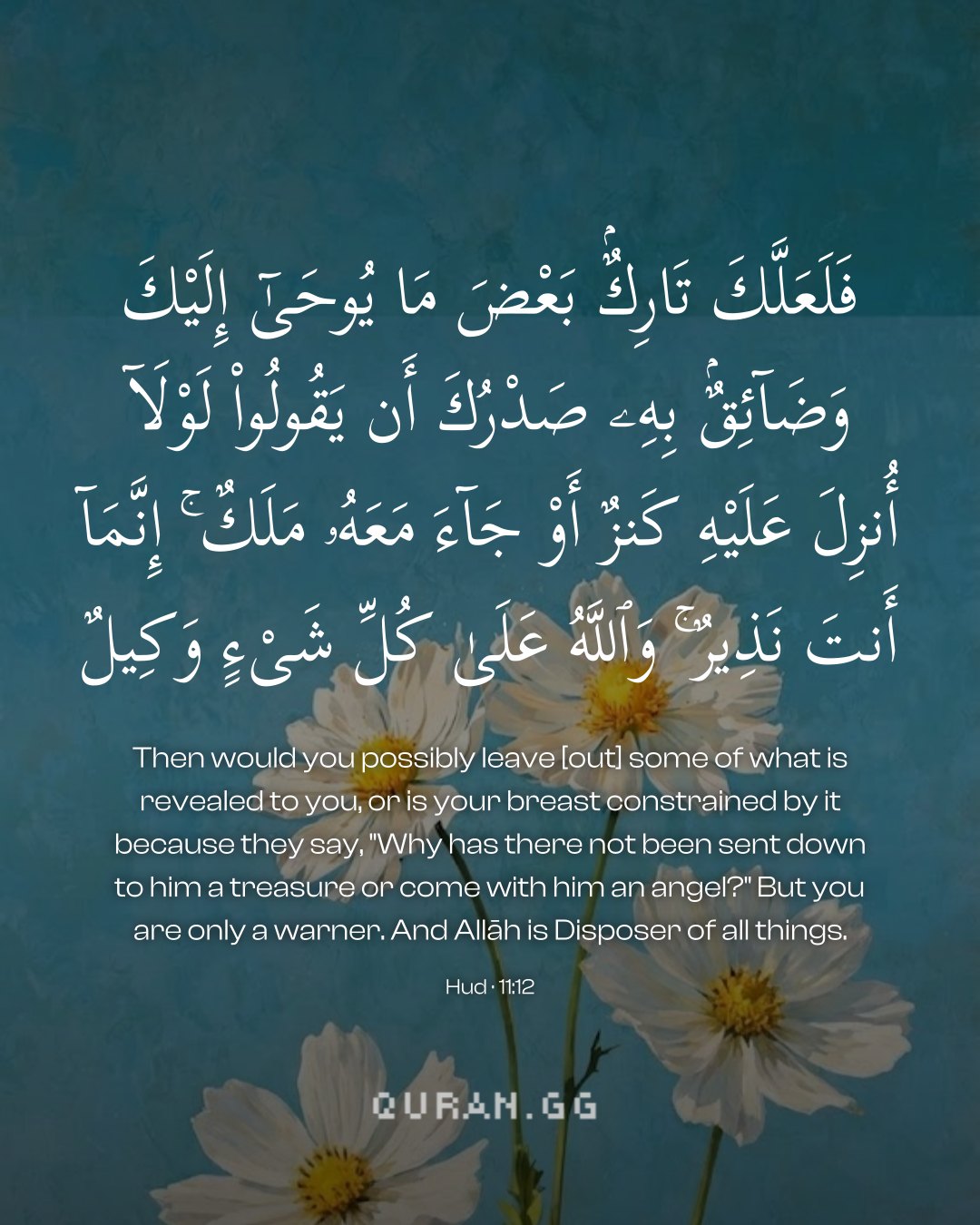
Then would you possibly leave [out] some of what is revealed to you, or is your breast constrained by it because they say, "Why has there not been sent down to him a treasure or come with him an angel?" But you are only a warner. And Allāh is Disposer of all things.
The Messenger grieving by the Statements of the Polytheists, and His Gratification
This statement of Allah, the Exalted, to His Messenger comforted the worries that the polytheists were causing him due to their statements directed towards him. This is just as Allah says about them,
(And they say: "Why does this Messenger eat food, and walk about in the markets. Why is not an angel sent down to him to be a warner with him" Or; "(why) has not a treasure been granted to him, or why has he not a garden whereof he may eat" And the wrongdoers say: "You follow none but a man bewitched.") 25:7-8 Thus, Allah commanded His Messenger and guided him to not let these statements of theirs grieve his heart. Allah directed him to not let these statements prevent him, or deter him from calling them to Allah, both day and night. This is as Allah said,
(So perchance you may give up a part of what is revealed unto you, and that your breast feels straitened for it because they say...) The meaning here is that he (the Prophet ) may be compelled to give up the Message due to what they (the polytheists) say about him. However, Allah goes on to explain: "You (Muhammad) are only a warner and you have an example in your brothers of the Messengers who came before you. For verily, the previous Messengers were rejected and harmed, yet they were patient until the help of Allah came to them."
An Explanation concerning the Miracle of the Qur'an
Then Allah, the Exalted, explains the miracle of the Qur'an, and that no one is able to produce its like, or even bring ten chapters, or one chapter like it. The reason for this is that the Speech of the Lord of all that exists is not like the speech of the created beings, just as His attributes are not like the attributes of the creation. Nothing resembles His existence. Exalted is He, the Most Holy, and the Sublime. There is no deity worthy of worship except He and there is no true Lord other than He. Then Allah goes on to say,
فَإِلَّمْ يَسْتَجِيبُواْ لَكُمْ
(If then they answer you not,) Meaning, that if they do not come with a reply to that which you have challenged them with (to the reproduction of ten chapters like the Qur'an), then know that it is due to their inability to do so. Know (that this is a proof) that this is the speech revealed from Allah. It contains His knowledge, His commands and His prohibitions. Then Allah continues by saying,
(and that there is no God besides Him! Will you then be Muslims)
Ma'arif al-Qur'an
Mufti Muhammad Shafi
The fourth verse (12) has been revealed about a particular event. What happened was that the Mushriks of Makkah placed a host of demands before the Holy Prophet One of these was, ` our idols have been maligned in this Qur'an, therefore, we cannot believe in it. So, you should either bring some other Qur'an, or improve it by making alterations in it:;i ائْتِ بِقُرْآنٍ غَيْرِ هَـٰذَا أَوْ بَدِّلْ (Bring a Qur'an other than this, or change it - Yunus, 10:15) '. (Al-Baghawi, Mazhari)
Another demand they came up with was, ` we are to believe in your prophesy only when some treasure, like the treasures of the kings of the world, is sent down for you and which you dole out to everyone around. Or that some angel descends from the heavens and hangs out with you everywhere testifying that you were a Messenger of Allah in all certainty.'
The Holy Prophet ﷺ felt the pinch of these absurd, even disrespectfully audacious demands in his heart. The reason was that he was mercy for all the worlds. It was not possible for him to leave them to their fate and take out the hope that they might someday believe from his heart. Nor was it possible for him to fulfill their absurd demands. To begin with, these demands were based on bland irrationality. If idols, idol-worship and things like that are not called what they are, what would become of right guidance and how would it be done? And then this brain wave of demanding a treasure from a prophet was a loud miss-match with his mission. They had simply taken the station of a prophet on the analogy of the status of a king. Similarly, it is not the practice of Allah Ta'ala that He would create conditions under which people were materially compelled to start professing the Faith. Otherwise, the whole world is within His power and control. Who could dare profess a belief, and act according to it, against the will of Allah Ta` ala? But, it is in His infinite wisdom that He has made this world a place of test. No material means are used here to compel people to do something good or to abstain from something bad. Certainly, what is done here is through Scriptures and Apostles. Lines are drawn between virtue and vice. Good and bad are separated. The outcome of each is explained. That is how people are invited and exhorted to do what is right and abstain from what is evil. And if some angel were to be miraculously attached to a prophet to attest to the veracity of his word, it would have posed problems. When no one believed it, he would have faced cash punishment on the spot. In that case, this would have been a modality of compelling people to believe. This kind of belief would have not been believing without seeing which is the essence of belief and faith, nor would there be any choice left for man to make which is the essence of his deed. As for the demands of those people, they were, no doubt, absurd and audacious. But, there is another aspect to it. The very act of making such demands proved that these people were grossly unaware of the status and reality of a messenger and prophet of Allah. They saw no difference between Allah and His Messenger. They even took the messenger to be absolutely powerful like Allah, therefore, they demanded that he should do for them what could not be done by anyone other than Allah.
In brief, when the Holy Prophet ﷺ became very sad because of such demands, this verse was revealed to comfort him and to revitalize his thinking. Addressing him first, it was said: Would you - surrendering to the pressure of these people - leave out some part of the Qur'an, sent by Allah, which they do not like, such as a part where it talks about the utter helplessness of idols? Would you, then, still be disturbed in the face of such demands? The introduction of the statement in verse 12 with the word: aW (la'allaka: Is it then expected of you) does not mean that something like that could be expected of him actually. Instead, the purpose is to establish that he was free from such things. He would not leave out any part of the Qur'an in consideration of their insistence, nor does he have to be sad, concerned and straitened over their demands. The reason is that he has been sent from Allah as nadhir, as one who warns people against what is harmful for them, then, Allah takes care of the rest for He is powerful over everything. Nadhir has been mentioned here particularly because those being addressed were kafirs, and kafirs deserve nothing but warning against the consequences of their deeds. Otherwise, the Holy Prophet ﷺ is not simply nadhir, one who warns, he is bashir too, one who announces glad tidings for people who do good deeds. In addition to what has been said here about the mission of a nadhir, we should understand that, in reality, nadhir is a person who warns out of love and affection against what is evil and harmful. Therefore, in a way, the sense of bashir, a giver of glad tidings, is included in the sense of nadhir, a giver of warning.
Tazkirul Quran
Maulana Wahiduddin KhanOn ayahs 11–13
In the present world, man is given ease and hardship by turns. But here, neither is comfort given as a reward nor is hardship imposed as a punishment. The purpose of both is to put human beings to the test. This world is a great examination hall. The purpose of whatever happens to man here is to see what sort of responses he offers to different testing conditions. That man is a failure whose behaviour is such that when he receives some worldly bounties from God, he becomes proud; he behaves with haughtiness towards those who appear to him of a lower status than himself. Similarly, that person is also a failure who displays ingratitude when some bounty is taken away from him or he becomes the victim of some affliction. Even after being deprived of something, a man still possesses many things granted to him by God. But man forgets them and becomes so desperate over that one loss, it is as if he had been robbed of everything. On the contrary, those who fully measure up to the standards of Faith are individuals who are patient and righteous in their deeds. That is, in spite of every setback, they keep their emotional balance and continue to exercise moderation; they continue to do whatever they are required to do as subjects of God. What is patience? It is a man’s conduct being shaped by principles and not by the conditions and situations in which he finds himself. Whatever may be the condition, he should rise above them and formulate his views purely in the light of Truth. He should have the courage to live on the level of his Faith and moral awareness, unaffected by the prevailing conditions. This sort of life is one of piety. Those who establish their piety in this way will be the ones who will share God’s bounties in the future life and have a place in God’s eternal Gardens.