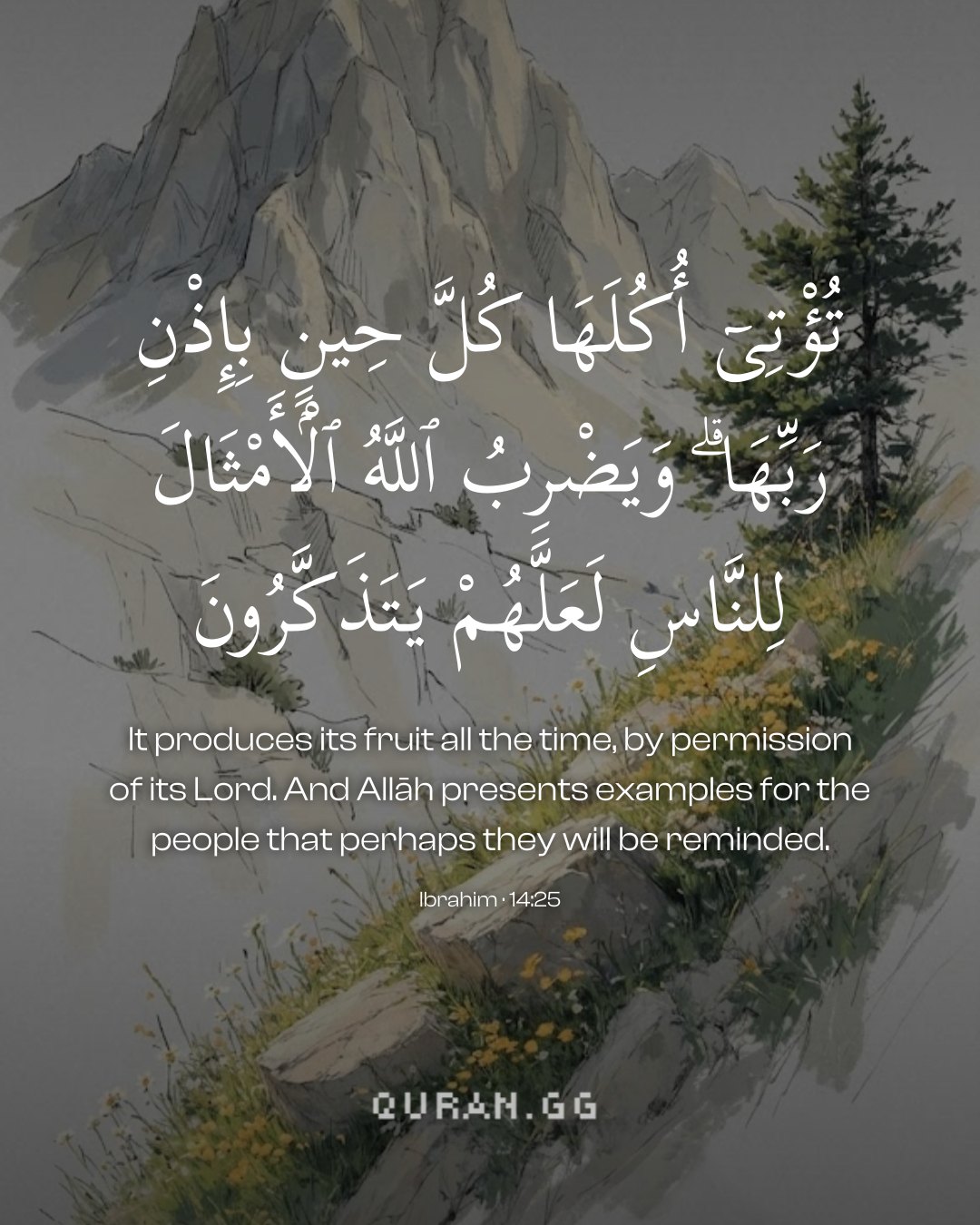
The Parable of the Word of Islam and the Word of Kufr
`Ali bin Abi Talhah reported that `Abdullah bin `Abbas commented that Allah's statement,
مَثَلاً كَلِمَةً طَيِّبَةً
(a parable: a goodly word), refers to testifying to La ilaha illallah, (none has the right to be worshipped but Allah) while,
كَشَجَرةٍ طَيِّبَةٍ
(as a goodly tree), refers to the believer, and that,
أَصْلُهَا ثَابِتٌ
(whose root is firmly fixed), indicates that La ilaha illallah, (none has the right to be worshipped but Allah) is firm in the believers' heart,
وَفَرْعُهَا فِى السَّمَآءِ
(and its branches (reach) to the sky.) with which the believer's works are ascended to heaven. Similar is said by Ad-Dahhak, Sa'id bin Jubayr, `Ikrimah, Mujahid and several others. They stated that this parable describes the believer's deeds, good statements and good actions. The believer is just like the beneficial date tree, always having good actions ascending at all times, by day and by night. Al-Bukhari recorded that `Abdullah bin `Umar said, "We were with the Messenger of Allah ﷺ when he asked,
In the last verse here (8), it was said: قَالَ مُوسَىٰ إِن تَكْفُرُوا أَنتُمْ وَمَن فِي الْأَرْضِ جَمِيعًا (And Musa said, "If you are ungrateful, you and all those on earth, then, Allah is free of all needs, worthy of every praise.) " This was said by Sayyidna Musa (علیہ السلام) to his people. He is telling them that should they or, for that matter, all inhabitants of the earth become ungrateful to Allah Ta’ ala, it is not going to cause any loss to Allah Ta’ ala. As for Him, He needs no praise or gratitude for Himself. He is Independent. He is beyond that. He is intrinsically Praised and deserving of praise. If you do not praise Him, the angels do, all of them, and so does every particle of this universe.
So, whatever good there is in gratitude, that is for you alone. There-fore, when you are asked to be grateful by Allah Ta’ ala, there is no gain for Him in doing so. In fact, it is His infinite mercy reaching out to you in your interest.
Tazkirul Quran
Maulana Wahiduddin KhanOn ayahs 23–25
To say assalamu alaykum or ‘peace be with you’ at the time of meeting is not simply a formal social custom. This is in fact an outward symbol of a heartfelt connection. Those who have lived their lives in this world with feelings of benevolence towards others, who have known how to forget their grievances and love others wholeheartedly, who have always spoken of others with respect, who have chosen for others what they desired for themselves, who have always longed in their heart of hearts for the well-being of others and who have rejoiced in seeing others in a state of well-being—such will be the people who will be entitled to take up their abode in the splendid world of paradise. The greeting assalamu alaykum has always given expression to their feelings of love and well-wishing whenever they met their brothers; in the Hereafter, when they greet their heavenly neighbours, this salutation will assume a powerful and more aesthetic form.
Uthmani text of the Madinah mushaf (King Fahd Complex). Translation: Saheeh International. Tafsir via Quran.com.