(O our Lord! Certainly, You know what we conceal and what we reveal.) meaning, `You know the intention behind my supplication for the people of this town, seeking Your pleasure in sincerity to You. You know all things, apparent and hidden, and nothing escapes Your knowledge on the earth or in heaven."' He next praised and thanked his Lord the Exalted and Most Honored for granting him offspring after he became old,
(All praise is due to Allah, Who has given me in old age Isma'il (Ishmael) and Ishaq (Isaac). Verily, my Lord is indeed the All-Hearer of invocations.) `He accepts the supplication of those who invoke Him, and has accepted my invocation when I asked Him to grant me offspring. ' Ibrahim said next,
Brimming with wisdom, there is another prayer of Sayyidna Ibrahim (علیہ السلام) which appears in the third verse (37) as follows: رَّبَّنَا إِنِّي أَسْكَنتُ مِن ذُرِّيَّتِي بِوَادٍ غَيْرِ ذِي زَرْعٍ عِندَ بَيْتِكَ الْمُحَرَّمِ رَبَّنَا لِيُقِيمُوا الصَّلَاةَ فَاجْعَلْ أَفْئِدَةً مِّنَ النَّاسِ تَهْوِي إِلَيْهِمْ وَارْزُقْهُم مِّنَ الثَّمَرَاتِ لَعَلَّهُمْ يَشْكُرُونَ : 'Our Lord, I have settled some of my children in a valley of no vegetation [ nor any other obvious life support system ] close to Your sanctified House, so that, Our Lord, they may establish Salah. So, make hearts of a number of people yearn towards them [ to make them familiar with each other ], and provide them with fruits, so that they may be grateful.'
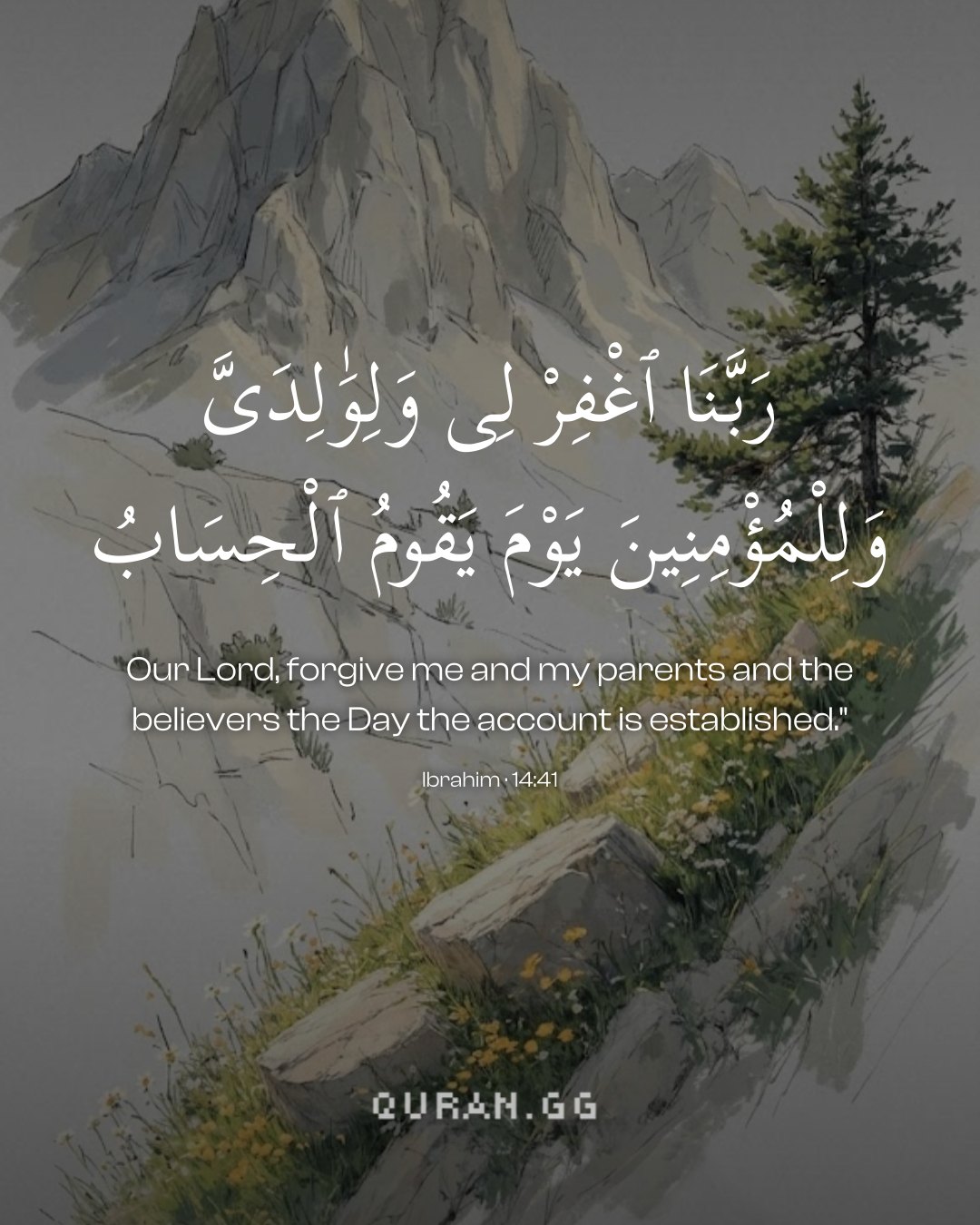
In this prayer of Abraham, one sees glimpses of all those emotions which emerge in the heart of a true subject of God while addressing a prayer to Him. His submissive attitude compels him to admit his humility before God; whatever he requests is on the basis of his being needy and not on the basis of any entitlement; on the one hand, he admits to the bounties already available to him and, on the other, presents his request with all due respect. He admits that God is the Giver and man the beneficiary. He prays to God to make him live in the world as His worshipper. He makes this request for himself, for his family members and for all believers also. At the time of prayer, the greatest problem before him should not be that of the world but that of the Hereafter, where a man has to live forever. The prayer then made is prophetic in nature, and if such a prayer comes from a true heart, it will necessarily be accepted by God.
Uthmani text of the Madinah mushaf (King Fahd Complex). Translation: Saheeh International. Tafsir via Quran.com.