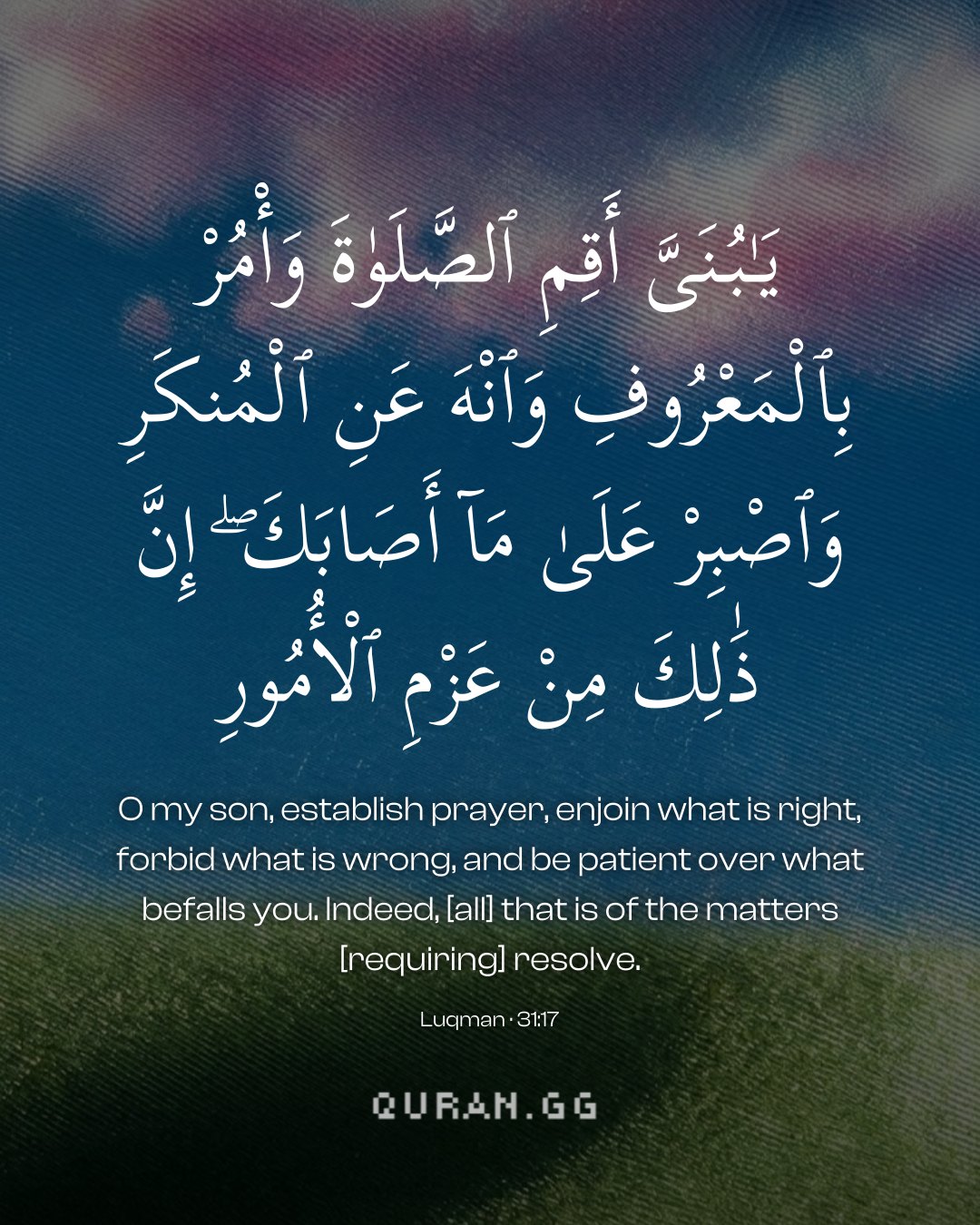
O my son, establish prayer, enjoin what is right, forbid what is wrong, and be patient over what befalls you. Indeed, [all] that is of the matters [requiring] resolve.
This is useful advice which Allah tells us Luqman gave, so that people may follow it and take it as"See the full heading "This is useful advice which Allah tells us Luqman gave, so thatpeople may follow it and take it as a good example
(O my son! If it be (anything) equal to the weight of a grain of mustard seed, ) means, if a wrong action or a sin be equal to the size of a grain of mustard seed.
يَأْتِ بِهَا اللَّهُ
(Allah will bring it forth.) means, He will bring it forth on the Day of Resurrection, when it is placed in the Scales of justice and everyone is rewarded or punished for his actions -- if they are good, he will be rewarded and if they are bad he will be punished. This is like the Ayat:
The Third Bequest of Luqman (علیہ السلام) about the Correction of Deed
There are many obligatory deeds, but the greatest and the most important of these is Salah - and not simply that it is important by itself, it also happens to be the master deed that becomes the catalyst changing other deeds towards the better as was pointed out in the Holy Qur'an about it: إِنَّ الصَّلَاةَ تَنْهَىٰ عَنِ الْفَحْشَاءِ وَالْمُنكَرِ (Surely Salah restrains from shamelessness and evil A1-` Ankabut, 29:45). Therefore, out of the obligatory good deeds, the mention of Salah was considered sufficient when it was. said: يَا بُنَيَّ أَقِمِ الصَّلَاةَ (My dear son, establish Salah - 17). And as it has been explained earlier, the expression denoting the 'iqamah' of salah does not simply suggest the 'making' or 'saying' or 'doing' it. Instead of that, this term translated as 'establish' (in the absence of an exact equivalent) includes all attending considerations, such as performing it with due respect to its essentials and manners fully and faithfully, observing punctuality in its timings and being consistent in fulfilling its requisites.
The Fourth Bequest of Luqman about the Betterment of People
Islam is a collective religion. Betterment of the community, along with the betterment of the individual, is an important part of its social system. Therefore, the duty of Bidding the Fair and Forbidding the Unfair (amr bi 'l-ma` ruf and nahy 'ani 'l-munkar) was mentioned along with as important a duty as the Salah. It was said: وَأْمُرْ بِالْمَعْرُوفِ وَانْهَ عَنِ الْمُنكَرِ (and bid the Fair and forbid the Unfair -17). Here are two duties: (1) Make yourself better and (2) make others better. Both need a lot of restraint and hard work. Facing these difficulties and remaining firm is no easy task. Particularly so, when those who stand to serve people by telling them what is good for them receive nothing but opposition and hostility in return. Therefore, while making this recommendation, it was also recommended: وَاصْبِرْ عَلَىٰ مَا أَصَابَكَ ۖ إِنَّ ذَٰلِكَ مِنْ عَزْمِ الْأُمُورِ (and observe patience on what befalls you. Surely, this is among the matters of determination - 17).
Tazkirul Quran
Maulana Wahiduddin KhanOn ayahs 15–18
After God, a man’s parents have the first claim upon his loyalty. But, if the parents’ desire clashes with God’s will, then preference has to be given to God’s will and the parents’ wishes have to be accorded the second place. However, it is necessary even then to continue to serve the parents as usual. Striking this balance between two different requirements is the highest example of wisdom of Islam, and the secret of all successes is hidden in this wisdom.
Uthmani text of the Madinah mushaf (King Fahd Complex). Translation: Saheeh International. Tafsir via Quran.com.