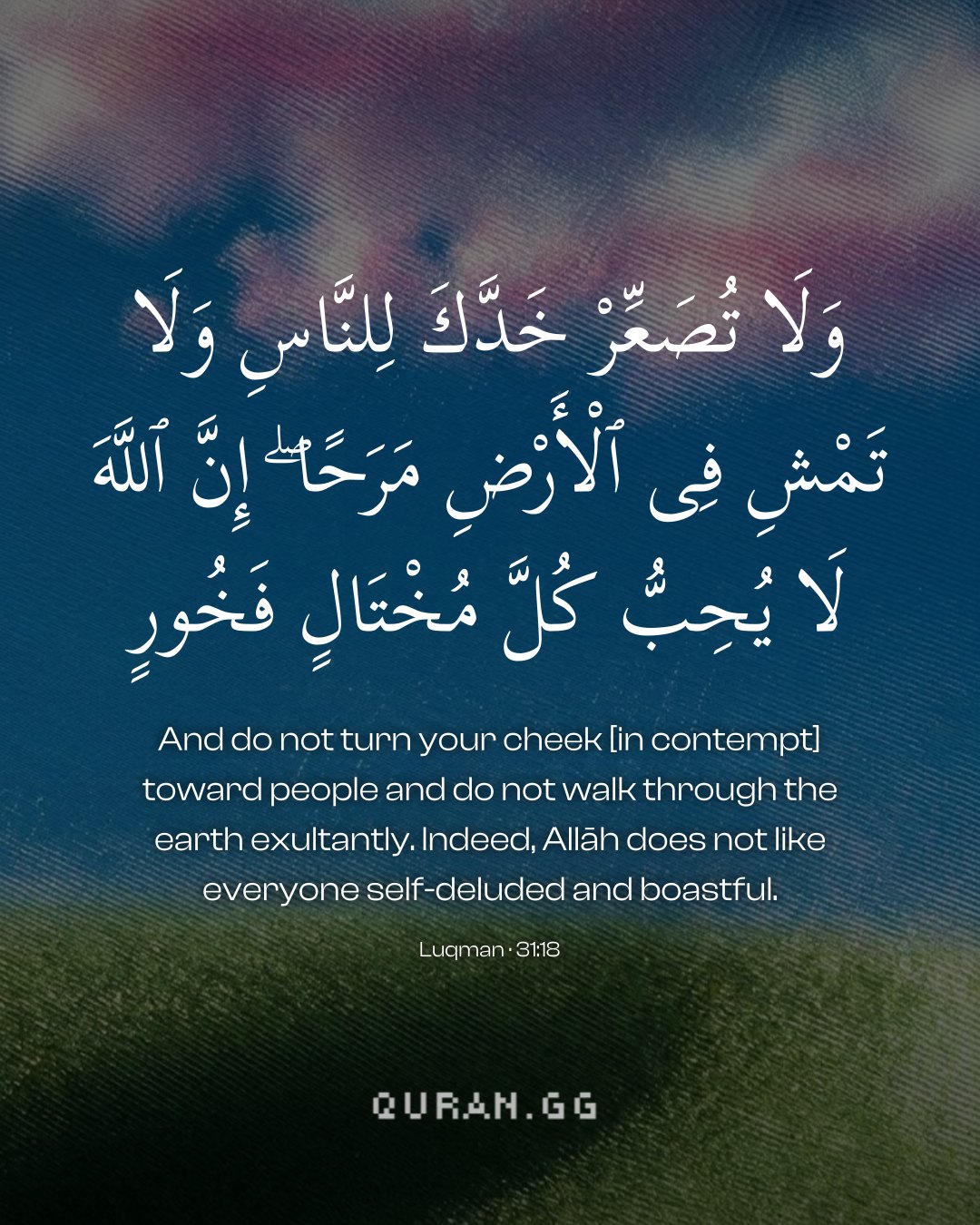
And do not turn your cheek [in contempt] toward people and do not walk through the earth exultantly. Indeed, Allāh does not like everyone self-deluded and boastful.
This is useful advice which Allah tells us Luqman gave, so that people may follow it and take it as"See the full heading "This is useful advice which Allah tells us Luqman gave, so thatpeople may follow it and take it as a good example
(O my son! If it be (anything) equal to the weight of a grain of mustard seed, ) means, if a wrong action or a sin be equal to the size of a grain of mustard seed.
يَأْتِ بِهَا اللَّهُ
(Allah will bring it forth.) means, He will bring it forth on the Day of Resurrection, when it is placed in the Scales of justice and everyone is rewarded or punished for his actions -- if they are good, he will be rewarded and if they are bad he will be punished. This is like the Ayat:
In verse 18, it was said: وَلَا تُصَعِّرْ خَدَّكَ لِلنَّاسِ (And do not turn your cheek away from people). The expression: لَا تُصَعِّرْ (la tusa"ir) is a derivation from: صَعَرَ (sa’ ara) which is a disease among camels that causes a tilt in the neck similar to the stroke among human beings that makes the face become crooked. It carries the sense of turning one's face away (in disdain). Thus, the verse means: 'do not turn your face away from people when you meet them and talk to them for it is a sign of avoidance and arrogance and very much against the norms of gentle manners.'
In the next sentence of the verse, it was said: وَلَا تَمْشِ فِي الْأَرْضِ مَرَحًا (and do not walk on the earth haughtily - 18). The last word: مَرَحًا (maraha) denotes walking proudly with assumed airs. The sense of the statement is that Allah Ta’ ala has given this earth the lowest profile from among the entire range of elements He created. Is it not that you were born from it and on it you walk around? Know your reality and do not walk haughtily. This is the way of the arrogant. Therefore, after that, it was said: إِنَّ اللَّـهَ لَا يُحِبُّ كُلَّ مُخْتَالٍ فَخُورٍ (Surely, Allah does not like anyone arrogant, proud - 18).
Tazkirul Quran
Maulana Wahiduddin KhanOn ayahs 15–18
After God, a man’s parents have the first claim upon his loyalty. But, if the parents’ desire clashes with God’s will, then preference has to be given to God’s will and the parents’ wishes have to be accorded the second place. However, it is necessary even then to continue to serve the parents as usual. Striking this balance between two different requirements is the highest example of wisdom of Islam, and the secret of all successes is hidden in this wisdom.
Uthmani text of the Madinah mushaf (King Fahd Complex). Translation: Saheeh International. Tafsir via Quran.com.