This is useful advice which Allah tells us Luqman gave, so that people may follow it and take it as"See the full heading "This is useful advice which Allah tells us Luqman gave, so thatpeople may follow it and take it as a good example
He said:
يبُنَىَّ إِنَّهَآ إِن تَكُ مِثْقَالَ حَبَّةٍ مِّنْ خَرْدَلٍ
(O my son! If it be (anything) equal to the weight of a grain of mustard seed, ) means, if a wrong action or a sin be equal to the size of a grain of mustard seed.
يَأْتِ بِهَا اللَّهُ
(Allah will bring it forth.) means, He will bring it forth on the Day of Resurrection, when it is placed in the Scales of justice and everyone is rewarded or punished for his actions -- if they are good, he will be rewarded and if they are bad he will be punished. This is like the Ayat:
وَنَضَعُ الْمَوَزِينَ الْقِسْطَ لِيَوْمِ الْقِيَـمَةِ فَلاَ تُظْلَمُ نَفْسٌ شَيْئاً
Continue reading the tafsir of ayahs 16–19Ma'arif al-Qur'an
Mufti Muhammad Shafi
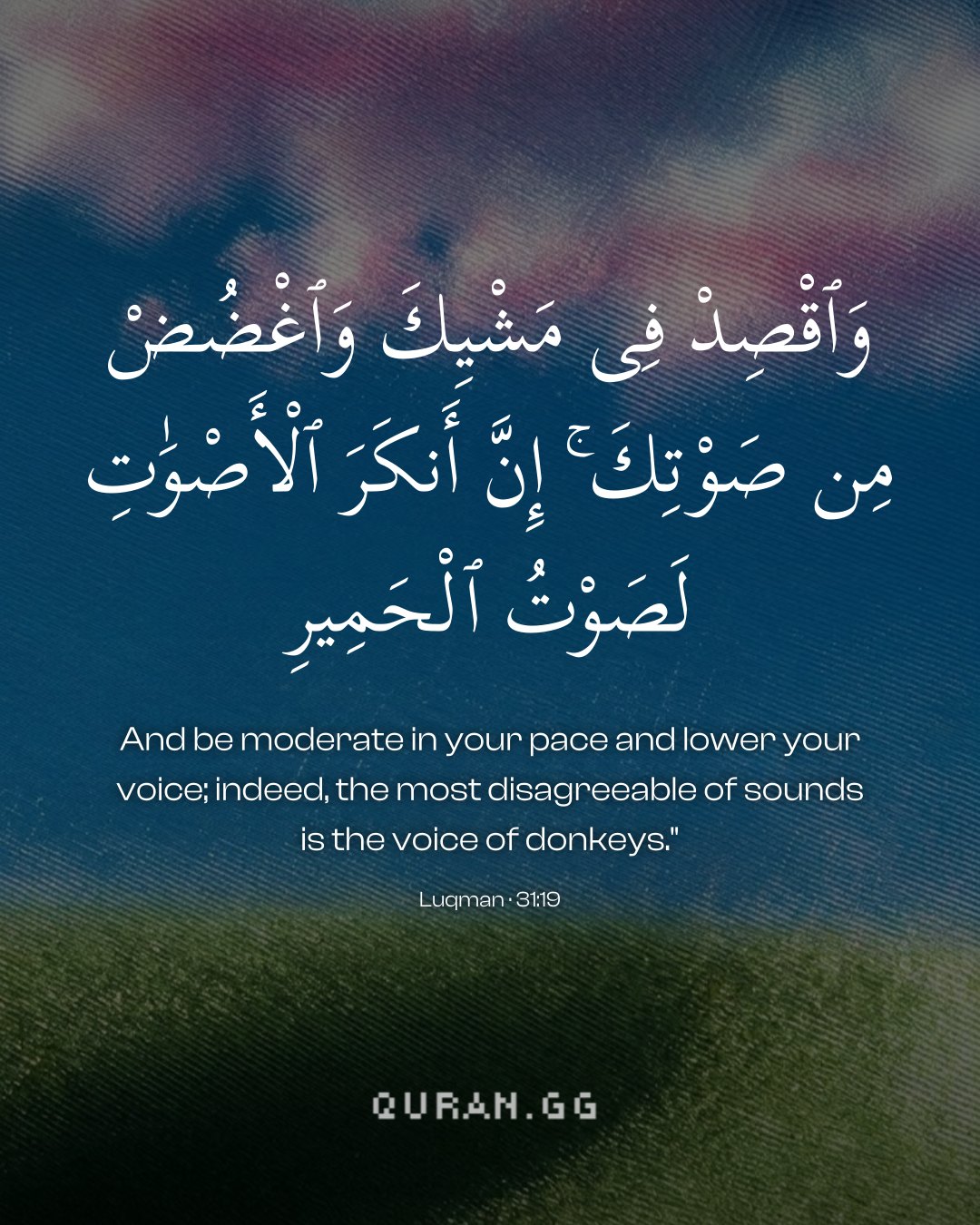
Verse 19 begins with the statement: وَاقْصِدْ فِي مَشْيِكَ (And be moderate in your walk). When done otherwise, in haste or helter-skelter, it goes against decorum and dignity. Says the Hadith: "Making too much haste in walking ruins the radiance of the believer (al-Jami' as-Saghir from Sayyidna Abu Hurairah ؓ . Then, in a manner of walking such as this, there remains the likelihood of hurting one's own self or someone else as well. And being moderate in walking also tells us that one should not walk very slowly either. This is the habit of the arrogant and the ostentatious who like to impress people with their distinct class. Or, it is the habit of women who do not walk fast due to their natural modesty. Or, it is the habit of the sick in need of urgent medical attention who would do so out of compulsion. The first mode is haram, and the second too, for it is not permissible if the intention is to strike a semblance with women. And when no such intention is there, the thing remains, after all, a defect for men. Finally, in the third mode, it is ungratefulness to Allah in that one stoops to feign the looks of the sick despite being all too healthy.
Sayyidna ` Abdullah Ibn Masud ؓ ' said: 'The noble Sahabah were prohibited from walking hurriedly (as if running) like the Jews and also from walking very slowly (as if crawling) like the Christians. The order given to them was that they should take to a moderate gait in between the two.'
When Sayyidah ` A'ishah ؓ saw a person walking very slowly as if he was going to fall dead, she asked the people around, 'Why does he have to walk like that?' They told her, 'He is one of the Qurra'.' The word: قُرَّاء (qurra' ) is the plural of: القاری (al-qari : one trained to recite the Qur'an in accordance with its Phonetics). In those days, someone who combined the twin mastery of reciting the Qur'an with authenticity and observance of due etiquette as well as being a perfect scholar of the Qur'an was also called a Qari'. So, by saying what they did, they meant that he was some big Qari' and ` Alim, therefore, he walked like that. Thereupon, Sayyidah ` A'ishah ؓ said, "Umar Ibn ul-Khattab, may Allah be pleased with him, was a lot more Qari' than he is. But, his habit was to walk swiftly when he walked (not in the sense of post-haste walking which is prohibited, rather meaning a functional swiftness in it). And when he talked, he talked in a manner that people would hear him well (not speaking at a pitch so low as would compel his audience to ask: Beg your pardon, what did you say)?
At the end of the fifth recommendation it was said: وَاغْضُضْ مِن صَوْتِكَ (and lower your voice - 19). 'Lowering' means: Do not wise your voice any more than necessary. And do not shout - as it appeared in the case of Sayyidna ` Umar ؓ immediately earlier. He talked in a manner that his audience would hear him without having to put any strain on their ears. Thereafter, it was said: إِنَّ أَنكَرَ الْأَصْوَاتِ لَصَوْتُ الْحَمِيرِ (Surely, the ugliest of voices is the voice of the donkeys - 19).
Regarding social manners, four prohibitions were mentioned here: (1) The prohibition of talking to and meeting with people face turned arrogantly; (2) the prohibition of walking haughtily on God's earth; (3) the instruction to be moderate in one's walking; and (4) the prohibition of talking very loudly.
All these virtues were already part of the habits and traits of the Holy Prophet ﷺ . As in the Shama'il of Tirmidhi, Sayyidna Husain ؓ says that he asked his father, Sayyidna Ali al-Murtada ؓ about the manner in which he interacted with people he sat with. He said:
کان دایٔم البشر سھل الخلق لیّن الجانب لیس بفظِّ ولاغلیظ ولا صخاب فی الاسواق و لا فحّاش ولا عیّاب و لا مشاح ہتغافل عمَّا لا یشتھی و لا یؤیس منہ و لا یجیب فیہ قد ترک نفسہ من ثلاث المراء و الاکبار ومالا یعنیہ
"He was always cheerful, naturally obliging, gentle. Neither impolite, nor rude, he was not clamorous or immodest and no faultfinder and no miser. He would remain indifferent to what he did not like, yet would not make others become distracted from it (if halal and desirable to have) and would not say anything that would stop others from having what he did not want (instead, would observe silence). There were three things he had left out for good: (1) Disputation, (2) Arrogance and (3) Indulgence with what was unnecessary, not worth doing.
Uthmani text of the Madinah mushaf (King Fahd Complex). Translation: Saheeh International. Tafsir via Quran.com.