The Situation of the True Believer and the Sick-Hearted when the Command for Jihad was revealed
Allah mentions that the believers were hoping that Jihad would be legislated. But when Allah ordained it, many of the people turned back, as Allah says,
أَلَمْ تَرَ إِلَى الَّذِينَ قِيلَ لَهُمْ كُفُّواْ أَيْدِيَكُمْ وَأَقِيمُواْ الصَّلَوةَ وَءَاتُواْ الزَّكَوةَ فَلَمَّا كُتِبَ عَلَيْهِمُ الْقِتَالُ إِذَا فَرِيقٌ مِّنْهُمْ يَخْشَوْنَ النَّاسَ كَخَشْيَةِ اللَّهِ أَوْ أَشَدَّ خَشْيَةً وَقَالُواْ رَبَّنَا لِمَ كَتَبْتَ عَلَيْنَا الْقِتَالَ لَوْلا أَخَّرْتَنَا إِلَى أَجَلٍ قَرِيبٍ قُلْ مَتَـعُ الدُّنْيَا قَلِيلٌ وَالاٌّخِرَةُ خَيْرٌ لِّمَنِ اتَّقَى وَلاَ تُظْلَمُونَ فَتِيلاً
(Have you not seen those who were told: "Restrain your hands (from fighting), establish the Salah, and give Zakah." But then when fighting was ordained for them, you find a party of them fearing the people as they fear Allah or more. They said: "Our Lord! Why have You decreed fighting upon us If only You have postponed us for a short period." Say: "The enjoyment of this world is little. The Hereafter is far better for him who had Taqwa of (Allah), and you will not be dealt with unjustly, even as much as a thin thread (inside a date's pit).")(4:77) Similarly, Allah says here,
Continue reading the tafsir of ayahs 20–23Ma'arif al-Qur'an
Mufti Muhammad Shafi
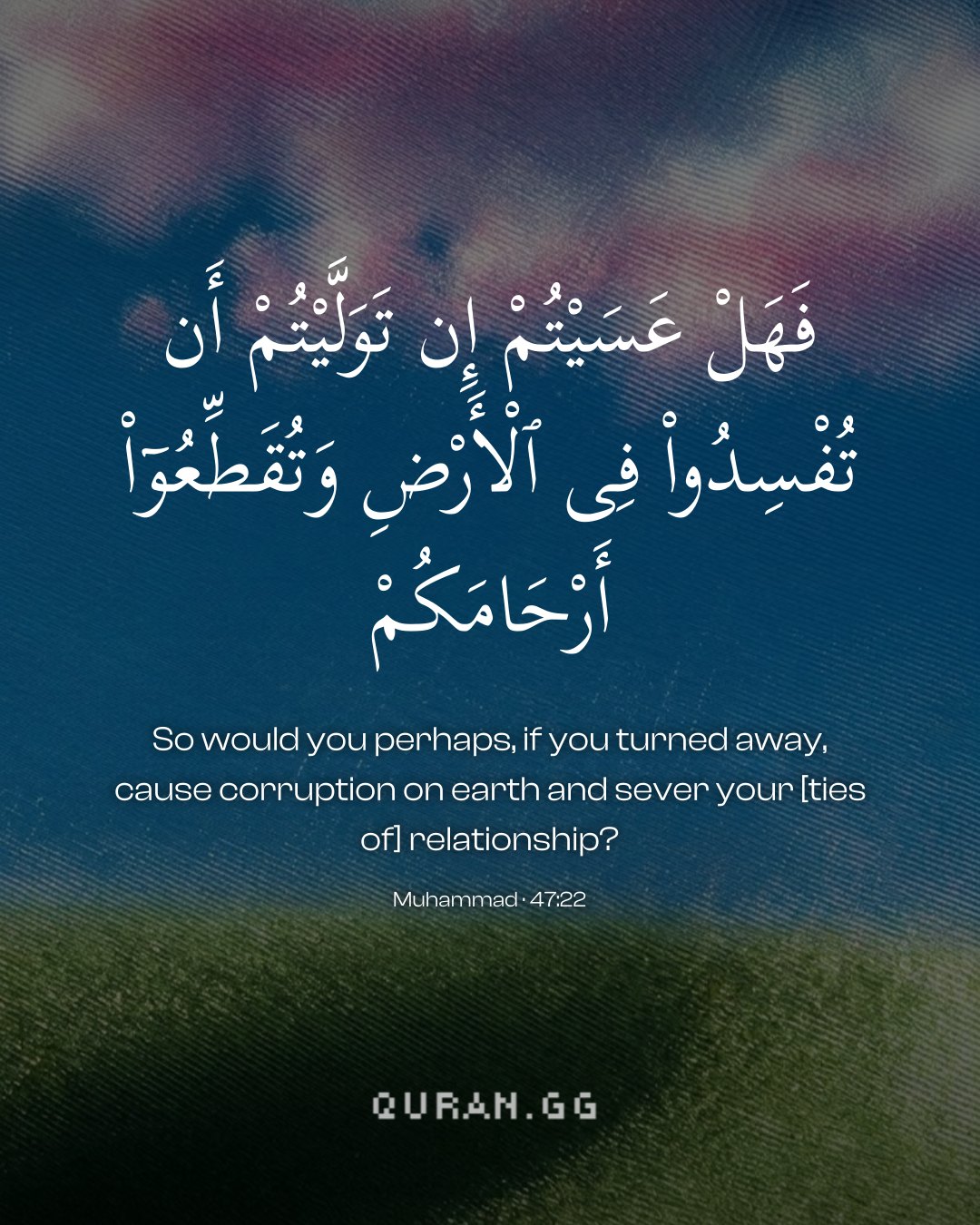
فَهَلْ عَسَيْتُمْ إِن تَوَلَّيْتُمْ أَن تُفْسِدُوا فِي الْأَرْضِ وَتُقَطِّعُوا أَرْحَامَكُمْ (So, [ O hypocrites,] do you not apprehend that, in case you turn away (from Jihad), you will spread disorder in the land, and will sever your ties of kinship? 47:22). The word تَوَلّیٰ 'tawalla' used in the text lexically has two senses: it could mean I'rad that is, "turning away" and it could also mean to be placed in authority over the people. Some of the commentators of the Qur'an assigned the first meaning to this word in the context of this verse, and Abu Hayyan in his Al-Bahr-ul-Muhit prefers this interpretation, (and the translation given above is based on it.) From this point of view the meaning of the verse would be: If you turned away from Jihad [ struggling in the cause of Allah ] and other injunctions of Shari` ah, you would return to the ancient system of ignorance which Islam has abolished. In the Pre-Islamic Days, according to the practices of jahiliyyah, corruption and severed ties of kinship. For example, they practised injustice; they cut each other's throat; one tribe attacked another tribe; they committed carnage and massacre; and they buried alive their daughters with their own hands. Islam abolished and wiped out all these and other heinous practices of the Days of ignorance. In these heinous crimes of those days, Islam enjoined Jihad which apparently seems to be bloodshed, but in reality it is analogous to amputation of the diseased limb of a body, so that the rest of the body may remain healthy. Jihad establishes justice and equity and maintains ties of kinship and relationship.
Ruh-ul-Ma’ ani, Qurtubi and others take the second meaning of the word tawalli in this context, that is, to be placed in authority over people. From this point of view, the meaning of the verse would be: if your ambitions of being placed in authority over people and the affairs of the world are entrusted to you whilst you are morally unhealthy, you would cause corruption in the land and cut off ties of kinship and relationship.
Strict Maintenance of Kinship Ties
The word اَرحَام 'arham' is the plural of رَحَم 'rahim' (womb). This is a receptacle or repository in the mother where the young humans are conceived, held, protected and developed before birth. Because that is the source of all relationships and kinship, it is idiomatically used in the sense of human relationship and kinship. Tafsir Ruh-ul-Ma’ ani, on this occasion, has explained in detail the relations covered by the term dhawil arham or arham. Islam has laid great stress on fulfilling the rights of relationship. Bukhari records a Hadith on the authority of Sayyidna Abu Hurairah ؓ and two other Companions ؓ to the effect that whoever maintains good relations with the kith and kin Allah will keep good relations with him, but whoever severs his bonds of kinship, Allah too will sever His relations with him. This Hadith indicates how important it is to treat relatives kindly in terms of words, deeds and wealth. In the same Hadith, Abu Hurairah ؓ refers to the verse under discussion [ 47:22] and says "Read it if you wish to". In another Tradition, the Holy Prophet is reported to have said that there is a sin for which one will be punished, not only in the Hereafter, but also in this world, that is, ... breaking kinship bonds. In Thawban ؓ Hadith, the Holy Prophet ﷺ is reported to have said: "Whoever wishes to have his life prolonged and his sustenance blessed should treat his relatives kindly." We come across the following Hadith in Bukhari:
لیس الواصل بالمکافی ولٰکِنّ الواصل الذی قطعت رحمہ وصلھا
"The person who perfectly maintains the ties of kinship is not the one who does it because he gets recompensed by his relatives for being kind and good to them, but the one who truly maintains the bonds of kinship is he who treats his kinsmen fairly, even though others have severed the ties of kinship with him." (Ibn Kathir)
One who refuses to be on the alert on receipt of advance information about an earthquake, is in fact courting disaster, because every ensuing moment is bringing the earthquake closer to him. Similarly, man does not take warning from the portents of Doomsday. But when Doomsday breaks upon him, he will resort to pious avowals. But such avowals at that stage will be of no use, because only that testament to the truth has value which is made before the curtain rises. After the rising of the curtain, it has no value. Begging God’s pardon is, in fact, an expression of the feeling of one’s humbleness. Firm belief in the horror of Doomsday, in God’s power and the realisation of His being aware of everything, creates a psychological upheaval in man. This is evinced at every moment in the shape of sublime utterances. These take the shape of remembrance of God, prayer and the seeking of God’s pardon.
Uthmani text of the Madinah mushaf (King Fahd Complex). Translation: Saheeh International. Tafsir via Quran.com.