Nullifying the Disbelievers' Deeds and the Command to chase Them
Allah then informs about those who disbelieve, obstruct others from the path of Allah, oppose the Messenger and contend with him, and revert from the faith after guidance has become clear to them. He indicates that those people can never harm Allah in the least, and rather they only harm themselves and become losers on the Day of Resurrection. He will nullify their deeds. Allah will not reward them even the weight of a mosquito (i.e., the smallest thing) for any good that they did before their apostasy, but would instead totally invalidate and destroy it. Their apostasy wipes away their good deeds entirely, just as the good deeds would normally wipe away the evil deeds. Imam Ahmad Ibn Nasr Al-Marwazi reported in Kitab As-Salah (the Book of Prayer) that Abu Al-`Aliyah said, "The Prophet's Companions used to think that no sin would harm a person who says `La ilaha illallah,' just as no good deed would benefit a person who joins partners with Allah. So Allah revealed,
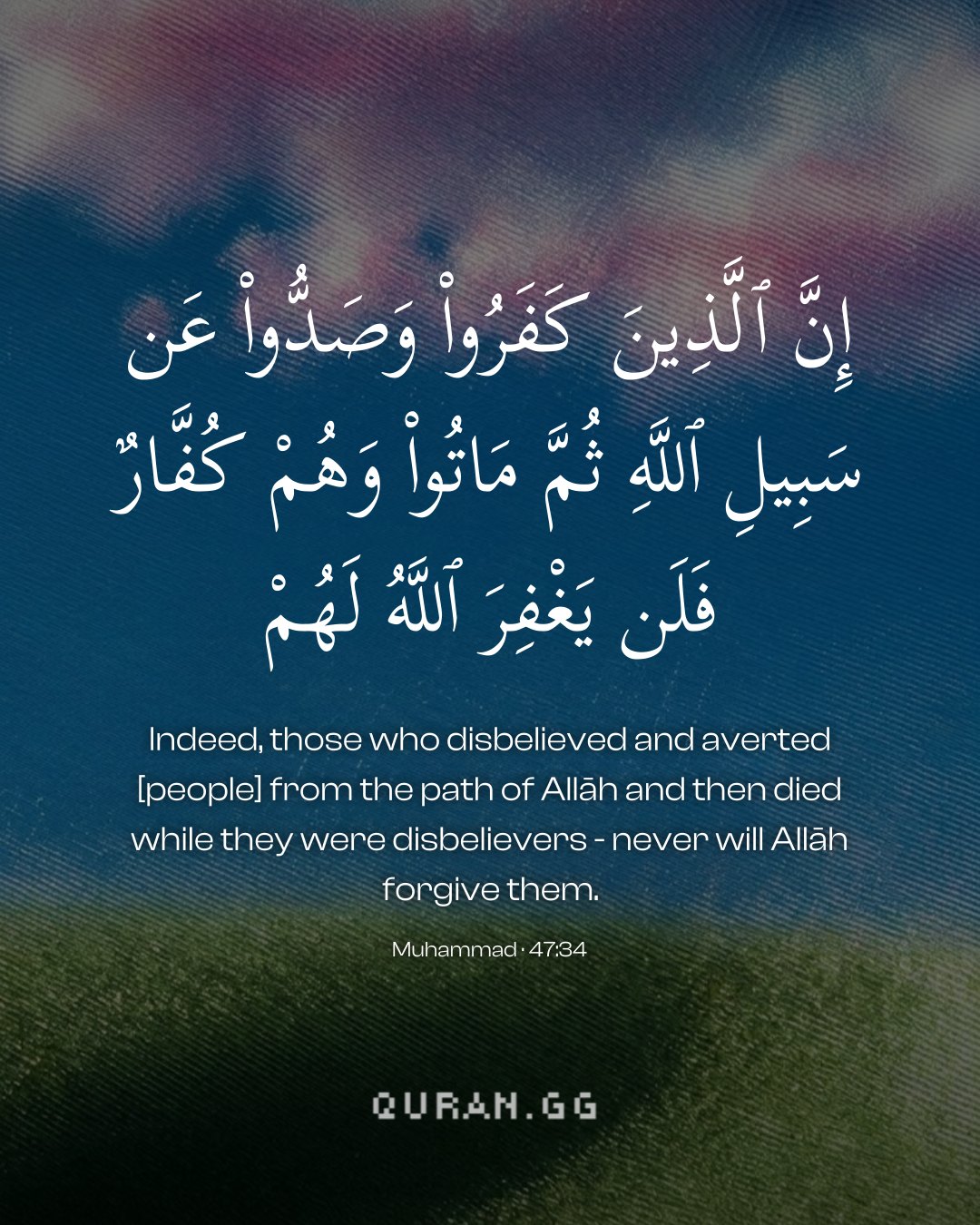
إِنَّ الَّذِينَ كَفَرُوا وَصَدُّوا عَن سَبِيلِ اللَّـهِ ثُمَّ مَاتُوا وَهُمْ كُفَّارٌ (Those who disbelieve and prevent (others) from Allah's way, Allah will never forgive them...- 47:34): verse [ 32] has a similar warning in similar words. The present verse [ 34] seems to repeat almost the same warning. But the difference is probably that verse 32 describes the loss of the infidels in this world, and the current verse describes their loss in the next world as indicated in the commentary. It is also possible that in the earlier verse the reference was to infidels in general which included those people who embraced Islam later on. The ruling regarding them was that all the good works which they had done in the state of disbelief would go to waste. Even after embracing Islam they would not be rewarded for them. The current verse refers in particular to those infidels who persisted in their disbelief and idolatry until their dying day. The ruling regarding them is that Allah will never forgive them in the next world. Allah knows best.
Tazkirul Quran
Maulana Wahiduddin KhanOn ayahs 32–34
When a man struggles for the cause of religion, he has to undergo different experiences, which are a test of his Faith: he must prove his steadfastness of belief by making sacrifices, crush his self, ignore his material interests, tolerate harassment; and remain steadfast in his devotion to God, even at the cost of his life and property. In order to place the believer in such circumstances, it is necessary for non-believers to have full freedom, so that they may indulge in all sorts of activities against the people of Faith. These activities, on the one hand, establish the guilt of opponents beyond doubt and, on the other, give the opportunity to the people of Faith to show that, by being steadfast in their Faith under the most trying circumstances, they are real believers and are entitled to be selected for the eternal afterlife in God’s ideal world.
Uthmani text of the Madinah mushaf (King Fahd Complex). Translation: Saheeh International. Tafsir via Quran.com.