Nullifying the Disbelievers' Deeds and the Command to chase Them
Allah then informs about those who disbelieve, obstruct others from the path of Allah, oppose the Messenger and contend with him, and revert from the faith after guidance has become clear to them. He indicates that those people can never harm Allah in the least, and rather they only harm themselves and become losers on the Day of Resurrection. He will nullify their deeds. Allah will not reward them even the weight of a mosquito (i.e., the smallest thing) for any good that they did before their apostasy, but would instead totally invalidate and destroy it. Their apostasy wipes away their good deeds entirely, just as the good deeds would normally wipe away the evil deeds. Imam Ahmad Ibn Nasr Al-Marwazi reported in Kitab As-Salah (the Book of Prayer) that Abu Al-`Aliyah said, "The Prophet's Companions used to think that no sin would harm a person who says `La ilaha illallah,' just as no good deed would benefit a person who joins partners with Allah. So Allah revealed,
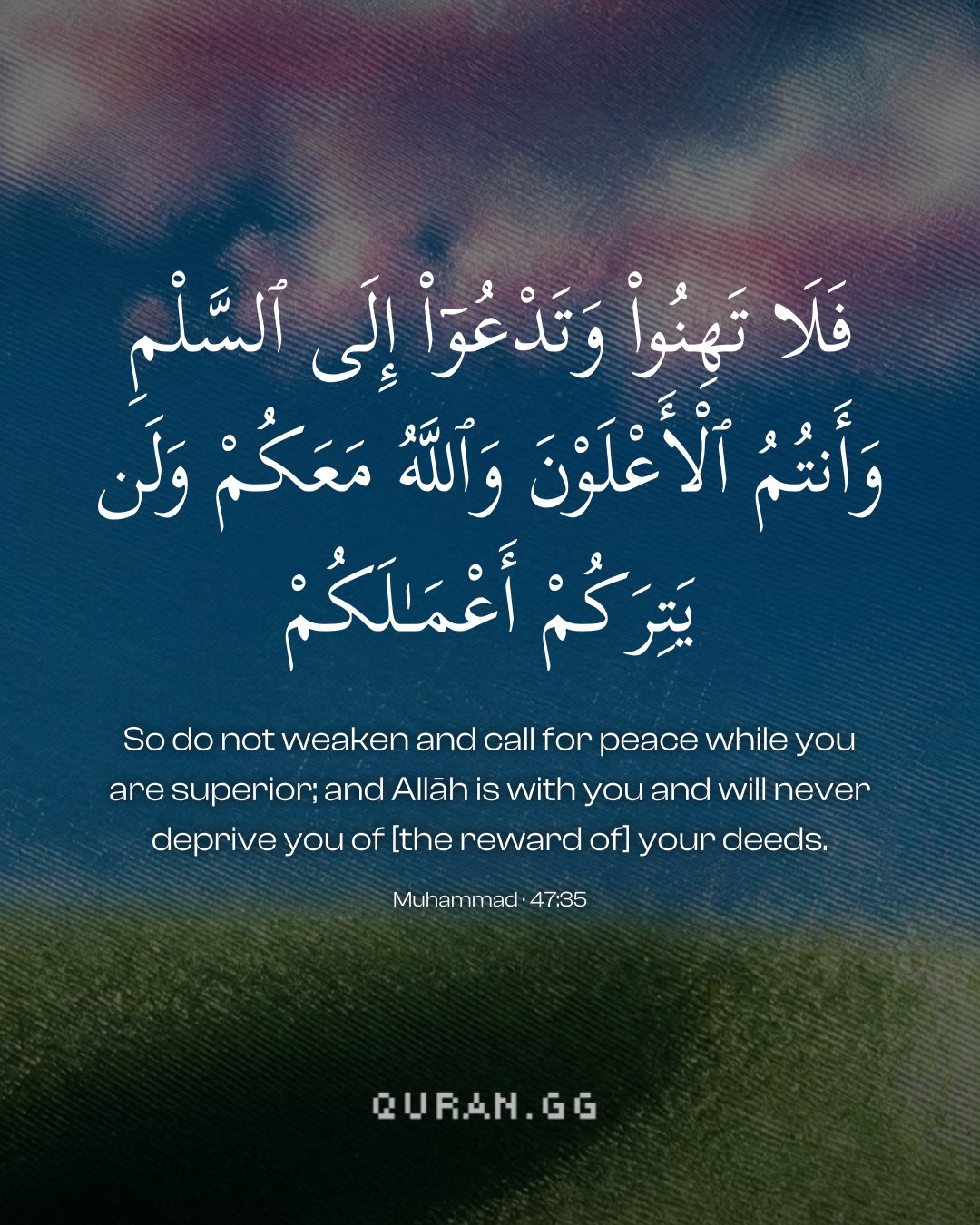
فَلَا تَهِنُوا وَتَدْعُوا إِلَى السَّلْمِ (So, do not lose heart, and do not appeal - 47:35". This verse prohibits the Muslims to invite the infidels to enter into peace treaty. But on another occasion in the Qur'an such a treaty is allowed: وَإِن جَنَحُوا لِلسَّلْمِ فَاجْنَحْ لَهَا And if they tilt towards peace, towards it..." (8:61). This verse indicates that if the infidels want peace, it is permissible to enter into peace agreement with them. Therefore, some scholars think that the permission in this verse is conditional upon the assumption that the infidels take initiative for peace negotiations. The current verse prohibits the Muslims from taking initiative for peace. Thus there is no conflict between the two verses. However, the authentic ruling is that it is permissible for Muslims even to take initiative in negotiating peace with the infidels if it could be in the best interest of the Muslims - not by reason of cowardice and involvement in a life of luxury. The Qur’ an by the employment of the imperative sentence fala-tahinu [ do not lose heart ] in this verse indicates that the prohibition is meant for such an appeal for peace that is based on cowardice and escaping from Jihad. In this case too there is no conflict between the two verses, because the direction of tending to peace in verse 9:61 is restricted to a situation where it is based on the interest of the Muslims, and not on cowardice or leisure. Allah knows best.
وَلَن يَتِرَكُمْ أَعْمَالَكُمْ (...and He will never deprive you of your deeds...47:35) It means that Allah will not diminish the reward of the believers. This indicates that if they were to suffer any pain or loss in this world, they wi11 receive a huge reward in the next world. Thus a believer is never unsuccessful even in the face of pain or difficulty.
Tazkirul Quran
Maulana Wahiduddin KhanOn ayahs 35–37
It is mentioned in a tradition that, during the period of the Prophet Muhammad, certain Muslims opined that if they professed, ‘la ilaha illallah’ (there is nobody worth worshipping except God), they would come to no harm by any sin. In that connection, this verse 33 was revealed. In this light the verse means that a man should combine obedience with Faith. He should carry out not only the harmless commandments but also those commandments for which he has to crush his self and jeopardize his interests. If he does not do so, his earlier deeds will be of no avail. The position of weak Muslims is that they will support the Truth on the condition that they should not have to incur the displeasure of the great men of their day. When they see that supporting the Truth is becoming a cause of displeasure to them, they tilt towards them even if these great men are rejecters of the Truth or stubbornly resistant to it. Those who reject the Truth or set themselves up as its opponents can never receive the grace of God. Then how can those who side with such rejecters of Truth meet with any other fate? In Islam there is war as well as peace. But that war is not Islamic which is fought under provocation. In Islam only defensive war is permitted. Such a war should not be the consequence of an emotional reaction, but one which results from a proper decision, and is defensive by nature.
Uthmani text of the Madinah mushaf (King Fahd Complex). Translation: Saheeh International. Tafsir via Quran.com.