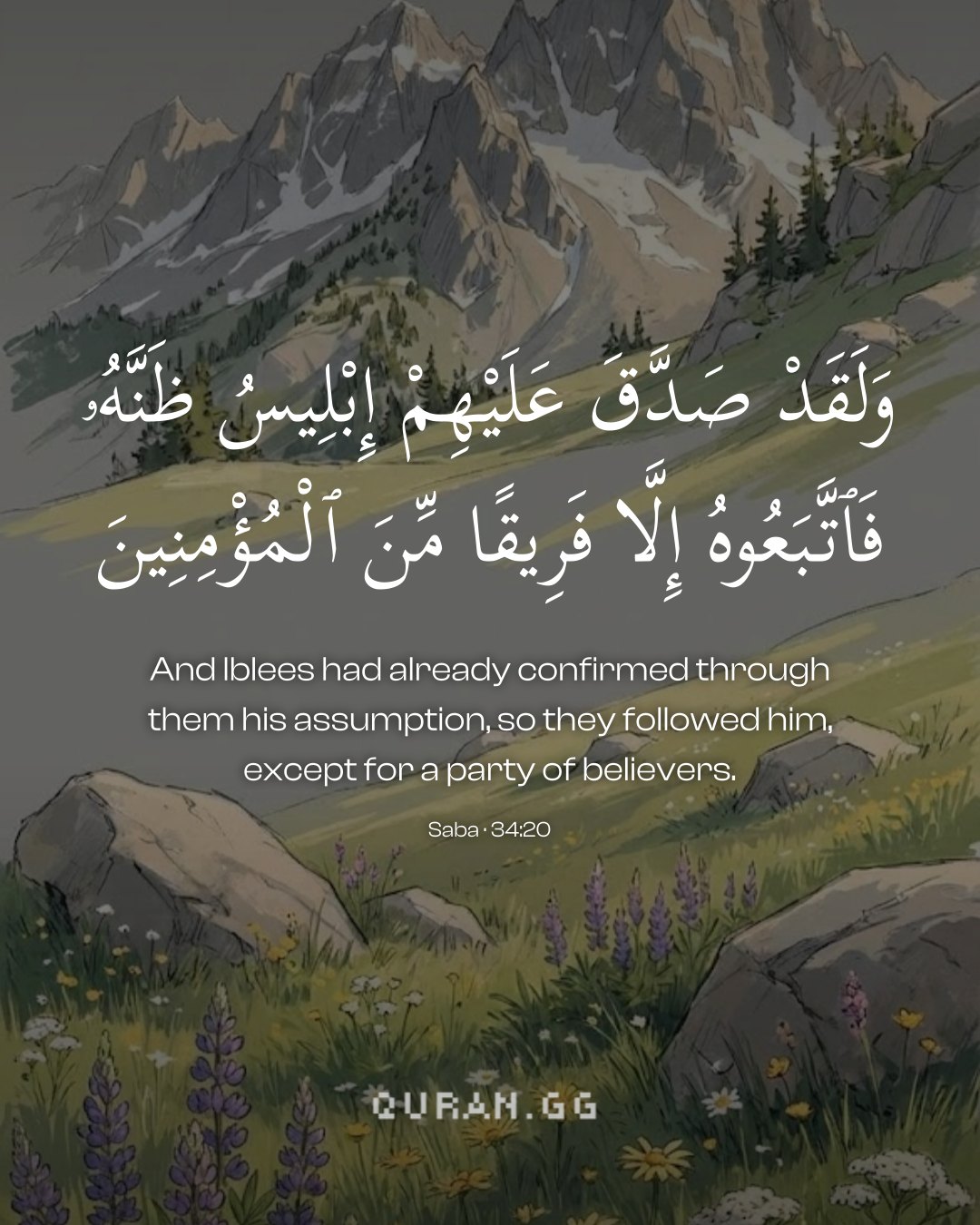
How Iblis' thought about the Disbeliever proved True
Having mentioned Saba' and how they followed their desires, and the Shaytan, Allah tells us about their counterparts among those who follow Iblis and their own desires, and who go against wisdom and true guidance. Allah says:
وَلَقَدْ صَدَّقَ عَلَيْهِمْ إِبْلِيسُ ظَنَّهُ
(And indeed Iblis did prove true his thought about them,) Ibn `Abbas, may Allah be pleased with him, and others said that this Ayah is like the Ayah where Allah tells us about how Iblis refused to prostrate to Adam, peace be upon him, then said:
أَرَءَيْتَكَ هَـذَا الَّذِى كَرَّمْتَ عَلَىَّ لَئِنْ أَخَّرْتَنِ إِلَى يَوْمِ الْقِيَـمَةِ لأَحْتَنِكَنَّ ذُرِّيَّتَهُ إَلاَّ قَلِيلاً
(See this one whom You have honored above me, if You give me respite to the Day of Resurrection, I will surely seize and mislead his offspring all but a few!) (17:62)
ثُمَّ لآتِيَنَّهُم مِّن بَيْنِ أَيْدِيهِمْ وَمِنْ خَلْفِهِمْ وَعَنْ أَيْمَـنِهِمْ وَعَن شَمَآئِلِهِمْ وَلاَ تَجِدُ أَكْثَرَهُمْ شَـكِرِينَ
(Then I will come to them from before them and behind them, from their right and from their left, and You will not find most of them as thankful ones.) (7:17) And there are many Ayat which refer to this matter.
وَمَا كَانَ لَهُ عَلَيْهِمْ مِّن سُلْطَـنٍ
(And he (Iblis) had no authority over them, ) Ibn `Abbas, may Allah be pleased with him said, "This means, he had no proof."
إِلاَّ لِنَعْلَمَ مَن يُؤْمِنُ بِالاٌّخِرَةِ مِمَّنْ هُوَ مِنْهَا فِى شَكٍّ
(except that We might test him who believes in the Hereafter, from him who is in doubt about it.) means, `We gave him power over them only to show who believes in the Hereafter and that it will come to pass.' The people will be brought to account and rewarded or punished accordingly, so that he will worship his Lord properly in this world -- and to distinguish these believers from those who are in doubt about the Hereafter.
وَرَبُّكَ عَلَى كُلِّ شَىْءٍ حَفُيظٌ
(And your Lord is a Watchful over everything.) means, despite His watching, those who follow Iblis go astray, but by His watching and care, the believers who follow the Messengers are saved.
Verse 19 opens with the statement: فَقَالُوا رَبَّنَا بَاعِدْ بَيْنَ أَسْفَارِنَا وَظَلَمُوا أَنفُسَهُمْ فَجَعَلْنَاهُمْ أَحَادِيثَ وَمَزَّقْنَاهُمْ كُلَّ مُمَزَّقٍ (Then they said," Our Lord, make (the phases of) our journeys more distant." And they wronged themselves, therefore We turned them into stories and tore them into pieces - 34:19). It means that so unjust were these people that they would go to the extent of dismissing the very blessing of Allah placed there to eliminate the hardships of travel, rather went deeper into their lack of recognition and straight ungratefulness by coming forward to pray that their Lord makes the distances they cover in travel longer - hoping that the habitations do not appear at such close distances, and wishing to see some hard areas of a forest or wilderness which ask for some rough traversing as well. Their case was similar to that of the Bani Isra'il. They used to get the excellent sustenance of mann and salwa, all free of cost. Bored with it, they asked Allah to replace it with vegetables and greens. In return for their ungratefulness and lack of recognition for blessings, Allah Ta’ ala released the punishment on them that has been called the flood of the dam earlier. The ultimate consequence of this very punishment has been stated in this verse in strong words, that is, they were virtually expunged from this world leaving nothing but idle tales of their wealth and luxury.
Continue reading the tafsir of ayahs 19–21 ‘The town that We had blessed’ refers to the green and fertile area of Syria. In this lush green area from Yemen to Syria, there were rows of beautiful townships. Travelling in this area was a pleasant experience, enough to kindle the spirit of thankfulness and devotion in man. It was as if God had put up a signpost there to say: ‘Go ahead without any fear and thank your Lord!’ But the unheeding people of Sheba were unable to read this inscription of God. On account of their improper behaviour, they lost their right to avail of these divine blessings. They were so totally destroyed that it was as if they had never existed. After the destruction of their homeland, the various tribes of Sheba scattered and migrated to far-off places. These incidents are known facts of history. But the real assessor of these events is one who learns the lesson that if he achieves prosperity, he should not be vainglorious. On the contrary, he should treat everything that he receives as a gift from God and be grateful to Him.
Uthmani text of the Madinah mushaf (King Fahd Complex). Translation: Saheeh International. Tafsir via Quran.com.