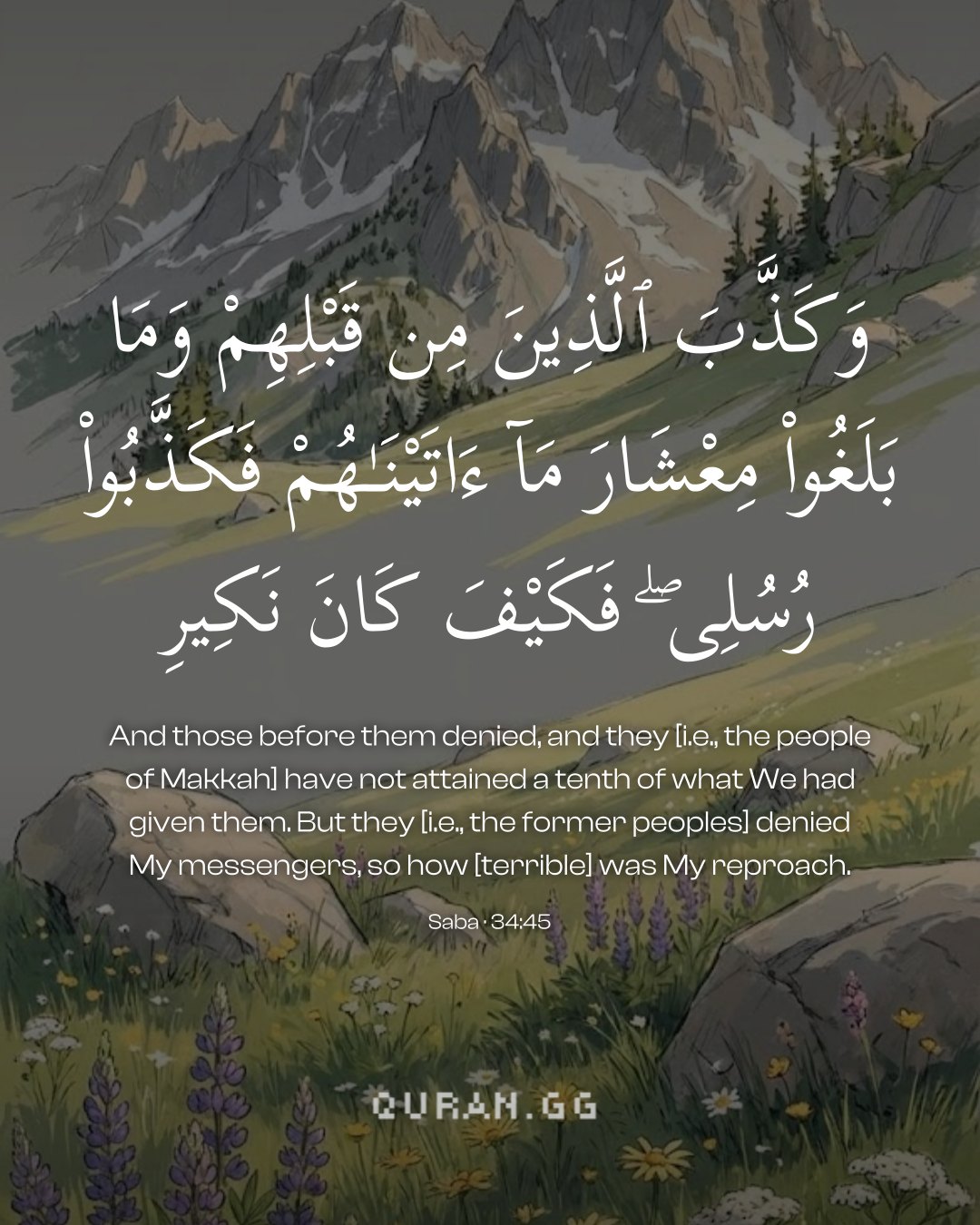
And those before them denied, and they [i.e., the people of Makkah] have not attained a tenth of what We had given them. But they [i.e., the former peoples] denied My messengers, so how [terrible] was My reproach.
The Saying of the Disbelievers about the Prophets, and its refutation
Allah tells us that the disbeliever deserve to be severely punished by Him, because when His clear Verses were recited to them, and they heard them fresh from the lips of His Messenger , they said:
(They say: "This is naught but a man who wishes to hinder you from that which your fathers used to worship.") meaning, that the religion of their fathers was the truth and that what the Messenger brought to them was false -- may the curse of Allah be upon them and their fathers!
The word: مِعْشَارَ (mi'shar) in verse 45: وَمَا بَلَغُوا مِعْشَارَ مَا آتَيْنَاهُمْ (while these (infidels of Makkah) have not reached even one tenth of what We gave to those (before them) has been taken to mean: عُشُر ('ushr: a tenth) by some early commentators. Some scholars have interpreted it as: عُشرُ العُشر (ushr-ul-` ushr: a hundredth) while others call it: عُشرُ العَشِیر (` ushr-ul ` ashir: a thousandth). Obviously, the later has a higher degree of exaggeration as compared to 'ushr or ten. The sense of the verse is that not even a tenth, rather a thousandth, of the worldly wealth, power, blessings of age and health given to earlier communities was received by the people of Makkah. Therefore, they should take lesson from what happened to past communities and the evil end they faced. These were people who invited upon themselves the wrath of Allah when they rejected prophets and messengers and, consequently, when came the actual punishment, their power, bravery, wealth and fortified fortresses could do nothing for them.
Tazkirul Quran
Maulana Wahiduddin KhanOn ayahs 45–46
The Quran presented clear arguments to its opponents which they were unable to counter. In spite of this, they were successful in dissuading the common people from accepting the truth. The sole reason for this success was that the disbelievers played on the sentiments of the common people and stirred them up by saying that it (the Quran’s message) was against the traditions of their forefathers. The miraculous literary value of the Quran was undeniable, and therefore, attempts were made to convince people that its supposed greatness depended solely on magical feats of expression which had nothing to do with divine revelation; it was only a miracle of penmanship and not the result of the knowledge of reality. It is most interesting that as a matter of historical record, for people of every period, prejudice has proved stronger than rational arguments. The Quran’s addressees could have put forward rational arguments to reject it or they could have referred to any other divine scriptures from which a contradiction to the Quran could have been produced. But none took recourse to either of these possibilities. If people so blatantly deny the call for Truth, it is due to nothing but stubbornness.
Uthmani text of the Madinah mushaf (King Fahd Complex). Translation: Saheeh International. Tafsir via Quran.com.