This was a proof from Allah for Musa and a great miracle. This was something that broke through the boundaries of what is considered normal, thus, it was a brilliant evidence that none but Allah could do. It was also a proof that no one could come with the likes of this (from mankind) except a Prophet who was sent (by Allah). Concerning Allah's statement,
وَمَا تِلْكَ بِيَمِينِكَ يمُوسَى
(And what is that in your right hand, O Musa) Some of the scholars of Tafsir have said, "He (Allah) only said this to him in order to draw his attention to it." It has also been said, "He only said this to him in order to affirm for him what was in his hand. In other words, that which is in your right hand is a stick that you are familiar with. You will see what We are about to do to it now."
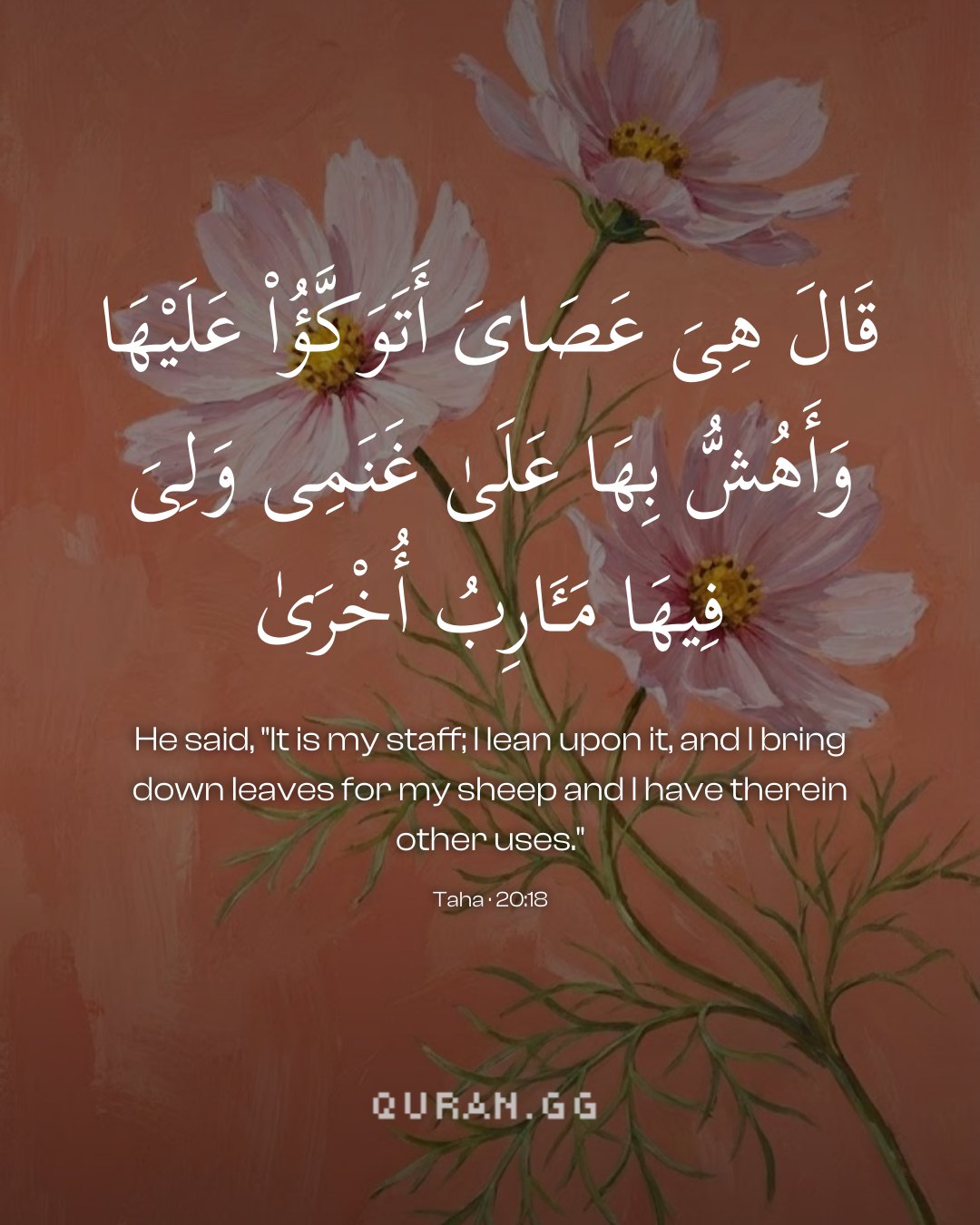
قَالَ هِيَ عَصَايَ (He said, “ It is my staff” – 20:18. The simple question which was put to Sayyidna Musa (علیہ السلام) i.e. "What is in your hand?" called for an equally brief answer, such as, "It is a staff'. But he volunteered additional information which was outside the scope of the question put to him. First, he said that the staff belonged to him; second, that it served him many purposes, namely that he often reclined on it, and also beat down leaves from trees for his goats; third, that he put it to many other uses. This long and detailed reply is a perfect combination of extreme love and adoration on the one hand and profound reverence on the other. It is a natural human instinct that when a person finds the object of his adoration to be kind and attentive, he wishes to prolong the conversation in order to get the best advantage. At the same time the dictates of extreme respect require that the conversation should remain within proper limits and not become too lengthy. For this reason he ended his reply with a brief statement وَلِيَ فِيهَا مَآرِبُ أُخْرَىٰ i.e. "And for me it has many other uses", but he did not give any detail of those "other uses". (Ruh and Mazhari)
From this verse Qurtubi has deduced in his Tafsir that when needed, it is permissible, while answering a question, to include matters which are not specifically covered in the question.
Rule
This verse also shows that carrying a staff is a practice followed by the prophets. The Holy Prophet ﷺ also used to carry a staff in his hand and this practice has numerous religious as well as mundane advantages.
Tazkirul Quran
Maulana Wahiduddin KhanOn ayahs 16–21
The fire seen by Moses was not an ordinary fire, but the glowing manifestation of God’s glory. Therefore, when he reached there, he was made to realise the importance of the audience he was having. He was asked to remove his shoes in order that, in all humility, he should be fully attentive. Then came the voice informing him that he was in the presence of God and that He (God) had chosen him as His messenger. At that time, the instructions given to Moses were the same as were always given to all God’s prophets, namely, to hold worthy of worship the one and only God, to pray to Him alone and to remember Him on all occasions. Then, Moses was informed of the fact that the present world was a world of trial, and that for a certain period God had kept the realities hidden in the realms of the unseen. On the Day of Judgement, this curtain would be torn asunder. Thereafter, the second phase of man’s life would start, when everybody would be judged according to his deeds in the present world. When emotions and desires get the better of a man, he becomes unmindful of the Hereafter and starts pursuing the ways of this world. To justify his misdeeds, he masks the true nature of the course of his action in beautiful and charming words. Others are impressed. On hearing this, they too become forgetful of the Hereafter. Under these circumstances, a man of faith needs to be extremely watchful about his own attitude and actions. He needs to save himself from being influenced by those who are unmindful of God and forgetful of the Hereafter.
Uthmani text of the Madinah mushaf (King Fahd Complex). Translation: Saheeh International. Tafsir via Quran.com.