Surah Taha Ayah 17 (20:17) — Meaning & Tafsir | Quran.GG

Surah Taha, Ayah 17

20:17 · Meaning and tafsir

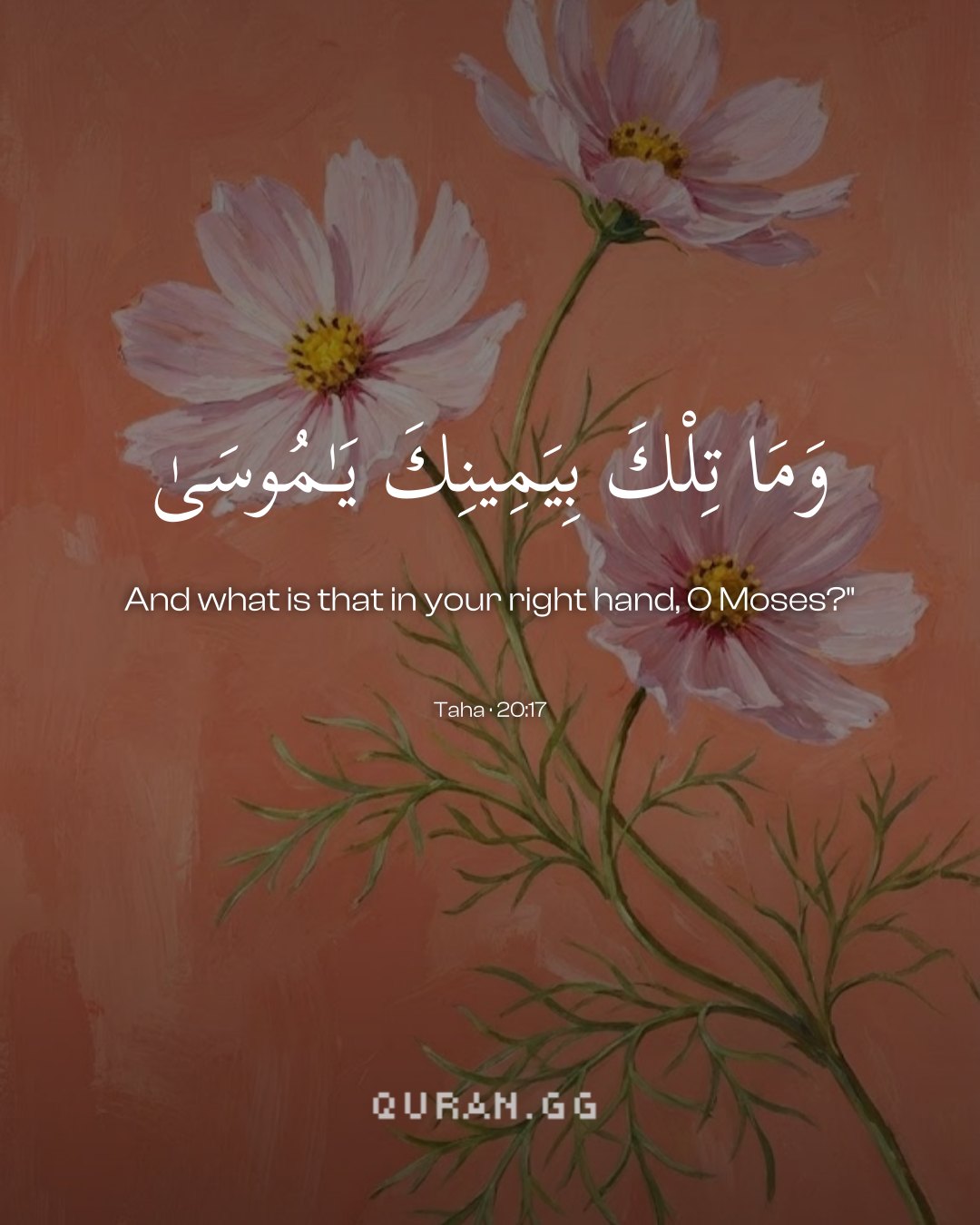
وَمَا تِلْكَ بِيَمِينِكَ يَـٰمُوسَىٰ ١٧

And what is that in your right hand, O Moses?"

Surah Taha 20:17 in Arabic with its translation: “And what is that in your right hand, O Moses?"”

Make something with this ayah

Turn it into a video for Stories, Reels or TikTok, recited by the reciter you pick, or an image on a background you choose. Free, in your browser.

Download this image

Tafsir Ibn Kathir (abridged)

The Stick of Musa turned into a Snake

This was a proof from Allah for Musa and a great miracle. This was something that broke through the boundaries of what is considered normal, thus, it was a brilliant evidence that none but Allah could do. It was also a proof that no one could come with the likes of this (from mankind) except a Prophet who was sent (by Allah). Concerning Allah's statement,

وَمَا تِلْكَ بِيَمِينِكَ يمُوسَى

(And what is that in your right hand, O Musa) Some of the scholars of Tafsir have said, "He (Allah) only said this to him in order to draw his attention to it." It has also been said, "He only said this to him in order to affirm for him what was in his hand. In other words, that which is in your right hand is a stick that you are familiar with. You will see what We are about to do to it now."

وَمَا تِلْكَ بِيَمِينِكَ يمُوسَى

(And what is that in your right hand, O Musa) This is an interrogative phrase for the purpose of affirmation.

قَالَ هِىَ عَصَاىَ أَتَوَكَّؤُا عَلَيْهَا

(He said: "This is my stick, whereon I lean...") I lean on it while I am walking.

وَأَهُشُّ بِهَا عَلَى غَنَمِى

(and wherewith I beat down branches for my sheep,) This means, `I use it to shake the branches of trees so that the leaves will fall for my sheep to eat them. ' `Abdur-Rahman bin Al-Qasim reported from Imam Malik that he said, "It is when a man places his staff into a branch and shakes it so that its leaves and fruit will fall without breaking the stick. It is not the same as striking or beating." Maymun bin Mahran also said the same. Concerning his statement,

وَلِىَ فِيهَا مَأَرِبُ أُخْرَى

(and wherein I find other uses.) This means other benefits, services and needs besides this. Some of the scholars took upon themselves the burden of mentioning many of these obscure uses. Concerning Allah's statement,

قَالَ أَلْقِهَا يمُوسَى

((Allah) said: "Cast it down, O Musa!") "Throw down this stick that is in your right hand, O Musa."

فَأَلْقَـهَا فَإِذَا هِىَ حَيَّةٌ تَسْعَى

(He cast it down, and behold! It was a snake, moving quickly.) This means that the stick changed into a huge snake, like a long python, and it moved with rapid movements. It moved as if it were the fastest type of small snake. Yet, it was in the form of the largest snake, while still having the fastest of movements.

تَسْعَى

(moving quickly.) moving restlessly. Concerning Allah's statement,

سَنُعِيدُهَا سِيَرتَهَا الاٍّولَى

(We shall return it to its former state. ) the form that it was in, as you recognized it before.

Ma'arif al-Qur'an

Commentary

وَمَا تِلْكَ بِيَمِينِكَ يَا مُوسَىٰ The question: "What is in your right hand, 0 Musa"? - 20:17 marks the beginning of the special favour which Allah Ta` ala showed towards Sayyidna Musa (علیہ السلام) in order to dispel the fear created by the unusual sights that he had seen and the Divine Word that he had heard. The style in which Allah Ta` ala addressed him was friendly, inquiring from him what he held in his hand. Besides there was a subtle purpose in the question, namely to make him aware that what he held in his hand was a staff made of wood and nothing more. And when he had satisfied himself again that it was indeed a wooden staff, then the miracle of turning it into a serpent was revealed, thus precluding any doubt in his mind that in the darkness of the night he might have picked up a serpent instead of his staff.

Tazkirul Quran

The fire seen by Moses was not an ordinary fire, but the glowing manifestation of God’s glory. Therefore, when he reached there, he was made to realise the importance of the audience he was having. He was asked to remove his shoes in order that, in all humility, he should be fully attentive. Then came the voice informing him that he was in the presence of God and that He (God) had chosen him as His messenger. At that time, the instructions given to Moses were the same as were always given to all God’s prophets, namely, to hold worthy of worship the one and only God, to pray to Him alone and to remember Him on all occasions. Then, Moses was informed of the fact that the present world was a world of trial, and that for a certain period God had kept the realities hidden in the realms of the unseen. On the Day of Judgement, this curtain would be torn asunder. Thereafter, the second phase of man’s life would start, when everybody would be judged according to his deeds in the present world. When emotions and desires get the better of a man, he becomes unmindful of the Hereafter and starts pursuing the ways of this world. To justify his misdeeds, he masks the true nature of the course of his action in beautiful and charming words. Others are impressed. On hearing this, they too become forgetful of the Hereafter. Under these circumstances, a man of faith needs to be extremely watchful about his own attitude and actions. He needs to save himself from being influenced by those who are unmindful of God and forgetful of the Hereafter.

Uthmani text of the Madinah mushaf (King Fahd Complex). Translation: Saheeh International. Tafsir via Quran.com.