Allah, the Exalted, informs about Fir`awn that he said to Musa, in his rejection of the existence of a Supreme Maker and Creator, Who is the God of everything and his own Lord and Owner:
فَمَن رَّبُّكُمَا يمُوسَى
(Who then, O Musa, is the Lord of you two) meaning "Who is the one who called you forth and sent you For verily, I do not know him and I have not given you any god other than myself."
((Musa) said: "Our Lord is He Who gave to each thing its form and nature, then guided it aright.") `Ali bin Abi Talhah related that Ibn `Abbas said, "He is saying that He created a mate for everything." Ad-Dahhak said that Ibn `Abbas said, "He made the man a man, and the donkey a donkey and the sheep a sheep." Layth bin Abi Sulaym reported from Mujahid that he said, "He gave everything its form." Ibn Abi Najih said that Mujahid said, "He fashioned the creation of every moving creature." Sa`id bin Jubayr said concerning His statement,
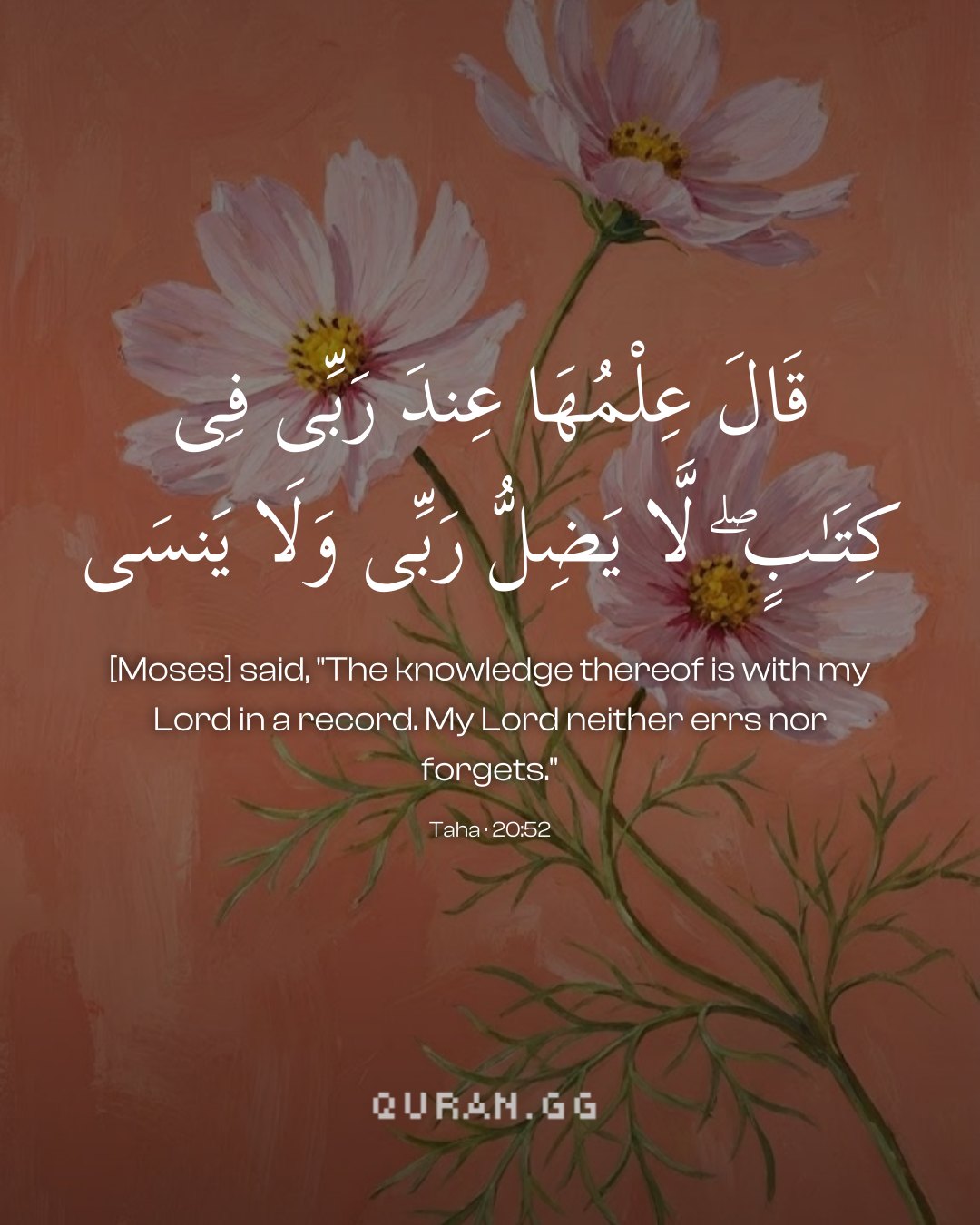
Verse 51 tells us that the Pharaoh had asked the question regarding the end of earlier people. If Sayyidna Musa (علیہ السلام) had given a straightforward answer that they were misled and will go to Jahannam, then the Pharaoh would have got a chance to scorn that it was not just him whom Sayyidna Musa (علیہ السلام) was blaming but all their ancestors as well. Naturally such a situation would have created doubts in the minds of people. Therefore Sayyidna Musa (علیہ السلام) gave such an answer which was full of wisdom and did not give any chance to the Pharaoh for misleading the people. He said (as mentioned in verse 52) that only Allah knows their end. He never makes a mistake nor does He forget things. The words "My Lord does neither err" mean that it is inconceivable that Allah wills one thing and something different should happen.
Tazkirul Quran
Maulana Wahiduddin KhanOn ayahs 52–54
Pharaoh’s question, ‘Who is your Lord?’ did not mean that he was not aware of any god besides himself, or that he quite finally denied the existence of a superior god. All it showed, in fact, was contempt for Moses’ utterance, rather than being a straight denial. In Egypt, Joseph had preached the oneness of God. Moreover, hundreds of thousands of Israelites were still living there and they professed faith in the one God. In this way, belief in one superior God existed in Egypt, but the power, pomp and glory were Pharaoh’s. According to the belief of the Egyptians, Pharaoh was the worldly manifestation of their greatest god, the sun. He was Egypt’s god-king and idols and statues of him had become objects of worship throughout Egypt. Moses, in stark contrast to this, belonged to the Israelite community—a community held in low esteem because of its slave-labour status. Against this background, his faith could have no public significance in Egypt. In this world there are innumerable things, each one of which has its peculiar structure and its own method of working. Everything functions according to immutable laws. Even an arrogant king like Pharaoh was not exempt from this system—which clearly proves the existence of a Superior Creator. When Moses made this statement, Pharaoh felt that he had no direct reply to it; so he gave the matter a new turn. Finding himself weak in the field of reasoning and arguments, he wanted to incite prejudicial feelings and thus maintain his own superiority among his people. Therefore, he asked Moses—if whatever he said was true—what had happened to the great ones of the past, who, according to Moses, had died while in a misguided condition. Moses did not answer this question directly. Instead he said, ‘You had better leave this matter to God and think about yourself.’
Uthmani text of the Madinah mushaf (King Fahd Complex). Translation: Saheeh International. Tafsir via Quran.com.