Surah Taha Ayah 53 (20:53) — Meaning & Tafsir | Quran.GG

Surah Taha, Ayah 53

20:53 · Meaning and tafsir

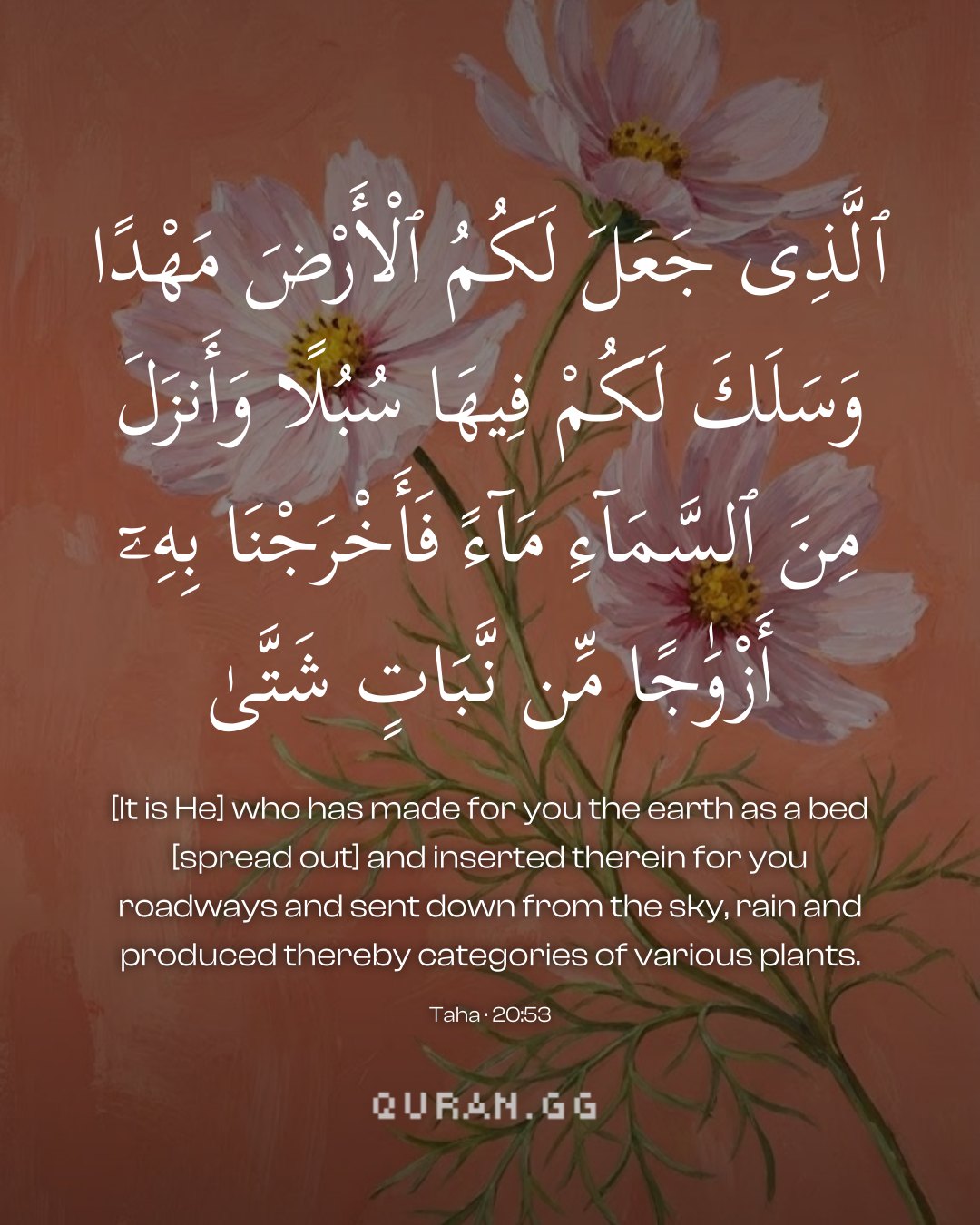
ٱلَّذِى جَعَلَ لَكُمُ ٱلْأَرْضَ مَهْدًا وَسَلَكَ لَكُمْ فِيهَا سُبُلًا وَأَنزَلَ مِنَ ٱلسَّمَآءِ مَآءً فَأَخْرَجْنَا بِهِۦٓ أَزْوَٰجًا مِّن نَّبَاتٍ شَتَّىٰ ٥٣

[It is He] who has made for you the earth as a bed [spread out] and inserted therein for you roadways and sent down from the sky, rain and produced thereby categories of various plants.

Surah Taha 20:53 in Arabic with its translation: “[It is He] who has made for you the earth as a bed [spread out] and inserted therein for you roadways and…”

Make something with this ayah

Turn it into a video for Stories, Reels or TikTok, recited by the reciter you pick, or an image on a background you choose. Free, in your browser.

Download this image

Tafsir Ibn Kathir (abridged)

The Completion of Musa's Reply to Fir`awn

This is from the completion of Musa's speech concerning the description of His Lord when Fir`awn asked him about Him. He (Musa) said,

الَّذِى أَعْطَى كُلَّ شَىءٍ خَلْقَهُ ثُمَّ هَدَى

(He Who gave to each thing its form and nature, then guided it aright.) Then, Fir`awn attempted to present some argumentative rebuttal during Musa's reply. Yet, Musa continued by saying, "He is the One Who made the earth as a bed for you." Some recited the word as Mihadan and others recited it as Mahdan, which means `a place of rest that you settle down upon.' It also may mean `that which you stand upon, sleep upon or travel upon its back.'

وَسَلَكَ لَكُمْ فِيهَا سُبُلاً

(and has opened ways for you therein.) This means, `He made roads for you to walk upon their shoulders.' This is just as He, the Exalted, said,

وَجَعَلْنَا فِيهَا فِجَاجاً سُبُلاً لَّعَلَّهُمْ يَهْتَدُونَ

(And placed therein broad highways for them to pass through, that they may be guided.) 21:31

وَأَنزَلَ مِنَ السَّمَآءِ مَآءً فَأَخْرَجْنَا بِهِ أَزْوَاجاً مِّن نَّبَـتٍ شَتَّى

(and has sent down water from the sky. And We have brought forth with it various kinds of vegetation.) referring to the various species of plants, such as vegetation and fruits. Some are sour, some are sweet, some are bitter and there are other kinds as well.

كُلُواْ وَارْعَوْا أَنْعَـمَكُمْ

(Eat and pasture your cattle (therein);) meaning, `something that is food for you and a palatable fruit for you, and something that is for your cattle as fodder for them, both green and dry.'

إِنَّ فِى ذلِكَ لأيَـتٍ

(Verily, in this are Ayat.) This means proofs, signs and evidences.

لاٌّوْلِى النُّهَى

(for men of understanding.) meaning those who possess correct and upright intelligence realizing that there is no god worthy of worship except Allah, and there is no true Lord other than Him.

مِنْهَا خَلَقْنَـكُمْ وَفِيهَا نُعِيدُكُمْ وَمِنْهَا نُخْرِجُكُمْ تَارَةً أُخْرَى

(Thereof We created you, and into it we shall return you, and from it We shall bring you out once again.) meaning, `the earth is your beginning. For your father, Adam, was created with dirt from the surface of the earth. You also will be returned to the earth. This means that you will become dirt when you die and decay.' The statement, "And from it We shall bring you out once again," means,

يَوْمَ يَدْعُوكُمْ فَتَسْتَجِيبُونَ بِحَمْدِهِ وَتَظُنُّونَ إِن لَّبِثْتُمْ إِلاَّ قَلِيلاً

(On the Day when He will call you, and you will answer with His praise and obedience, and you will think that you have stayed (in this world) but a little while!) 17:52 This Ayah is similar to Allah's statement,

قَالَ فِيهَا تَحْيَوْنَ وَفِيهَا تَمُوتُونَ وَمِنْهَا تُخْرَجُونَ

(He said: "Therein you shall live, and therein you shall die, and from it you shall be brought out.") 7:25

Musa showed Fir`awn all of the Signs but He did not believe Concerning Allah's statement,

وَلَقَدْ أَرَيْنَـهُ ءَايَـتِنَا كُلَّهَا فَكَذَّبَ وَأَبَى

(And indeed We showed him (Fir`awn) all Our Ayat, but he denied and refused.) This means that the proofs, signs and evi- dences were establi- shed against Fir`awn and he saw them with his own eyes, but he still denied and rejec- ted them due to his disbelief, abstinence and transgression. This is as Allah, the Exalted, says,

وَجَحَدُواْ بِهَا وَاسْتَيْقَنَتْهَآ أَنفُسُهُمْ ظُلْماً وَعُلُوّاً

(And they belied them wrongfully and arrogantly, though they themselves were convinced thereof.) 27:14

Ma'arif al-Qur'an

The word ازواج (pairs) used in verse 53 is used here in the sense of "Kinds" or "Species", and the word is the plural of the word which means "different" or "diverse". The verse means that Allah has created so many kinds of plants that they are beyond human reckoning and each of them contains special properties which make them invaluable to man for his well-being. It is impossible for man to comprehend completely all the properties and uses of all the plants created by Allah Ta` ala. For centuries scientists have been working to find out all about them and researches have revealed a great deal about their properties. However it is impossible to claim that whatever we know at present is the last word.

Tazkirul Quran

Pharaoh’s question, ‘Who is your Lord?’ did not mean that he was not aware of any god besides himself, or that he quite finally denied the existence of a superior god. All it showed, in fact, was contempt for Moses’ utterance, rather than being a straight denial. In Egypt, Joseph had preached the oneness of God. Moreover, hundreds of thousands of Israelites were still living there and they professed faith in the one God. In this way, belief in one superior God existed in Egypt, but the power, pomp and glory were Pharaoh’s. According to the belief of the Egyptians, Pharaoh was the worldly manifestation of their greatest god, the sun. He was Egypt’s god-king and idols and statues of him had become objects of worship throughout Egypt. Moses, in stark contrast to this, belonged to the Israelite community—a community held in low esteem because of its slave-labour status. Against this background, his faith could have no public significance in Egypt. In this world there are innumerable things, each one of which has its peculiar structure and its own method of working. Everything functions according to immutable laws. Even an arrogant king like Pharaoh was not exempt from this system—which clearly proves the existence of a Superior Creator. When Moses made this statement, Pharaoh felt that he had no direct reply to it; so he gave the matter a new turn. Finding himself weak in the field of reasoning and arguments, he wanted to incite prejudicial feelings and thus maintain his own superiority among his people. Therefore, he asked Moses—if whatever he said was true—what had happened to the great ones of the past, who, according to Moses, had died while in a misguided condition. Moses did not answer this question directly. Instead he said, ‘You had better leave this matter to God and think about yourself.’

Continue reading the tafsir of ayahs 52–54

Uthmani text of the Madinah mushaf (King Fahd Complex). Translation: Saheeh International. Tafsir via Quran.com.