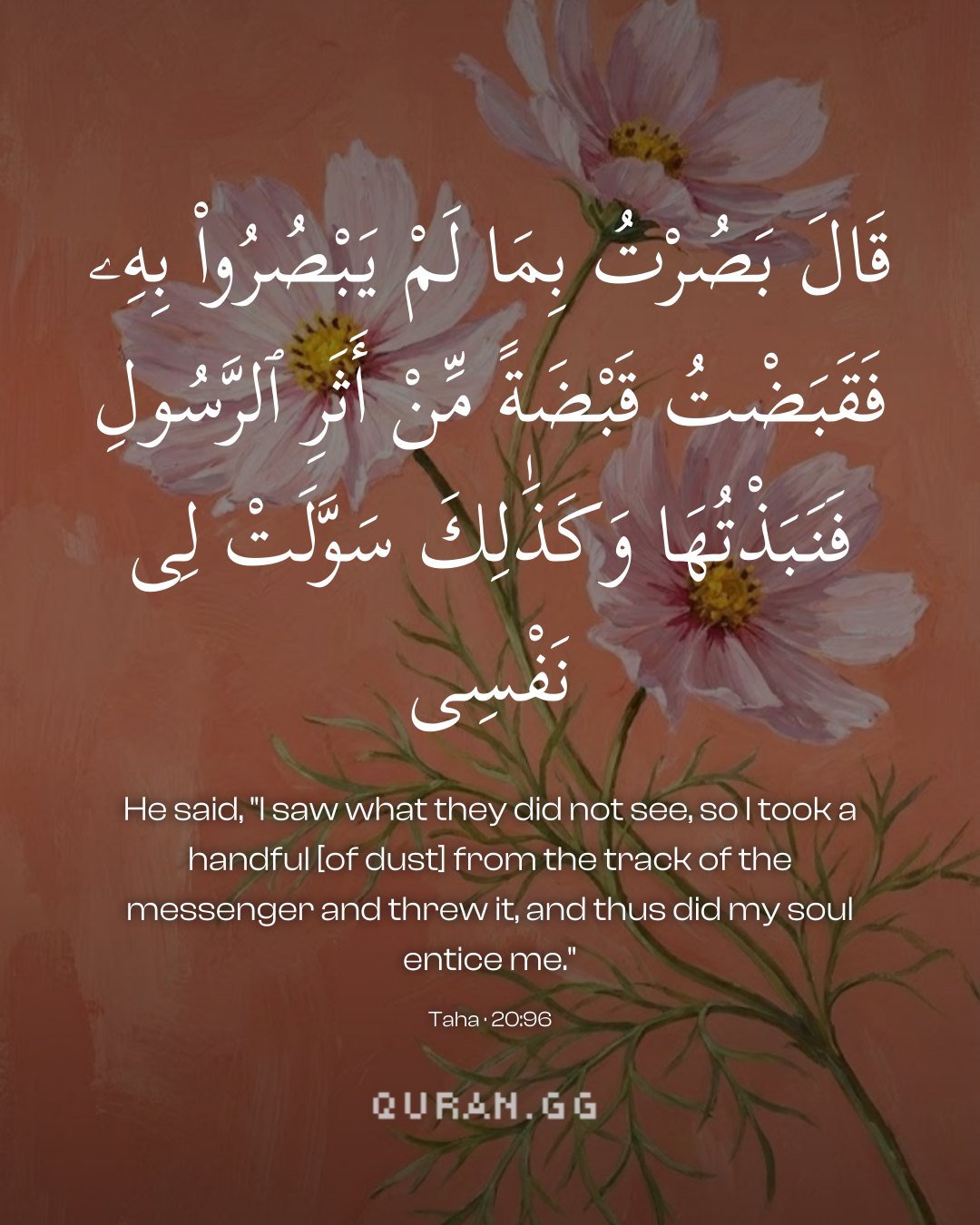
Musa said to As-Samiri, "What caused you to do what you did What presented such an idea to you causing you to do this" Muhammad bin Ishaq reported from Ibn `Abbas that he said, "As-Samiri was a man from the people of Bajarma, a people who worshipped cows. He still had the love of cow worshipping in his soul. However, he acted as though he had accepted Islam with the Children of Israel. His name was Musa bin Zafar." Qatadah said, "He was from the village of Samarra."
قَالَ بَصُرْتُ بِمَا لَمْ يَبْصُرُواْ بِهِ
((Samiri) said: "I saw what they saw not.") This means, "I saw Jibril when he came to destroy Fir`awn."
بَصُرْتُ بِمَا لَمْ يَبْصُرُوا بِهِ (I perceived something they perceived not - 20:96) The reference here is to Jibra'il (علیہ السلام) . There is a tradition that he was present on his horse at the river crossing when, the Bani Isra'il having crossed it safely to the other side, the Pharaoh and his army entered the river in pursuit of the fugitives. There is another tradition that after Sayyidna Musa (علیہ السلام) had crossed the river Sayyidna Jibra'il came to him riding a horse to invite him to go to the Tur mountain. At that time Samiri alone, and no one else, saw him and the reason, according to a tradition of Sayyidna Ibn ` Abbas ؓ ، was that he was nourished by Jibra'il when his mother had left him in the cave, and knew him well. (Bayan ul-Qur’ an)
فَقَبَضْتُ قَبْضَةً مِّنْ أَثَرِ الرَّسُولِ (So I picked up a handful of dust from under the foot of the messenger.- 20:96) The رَسُول word (messenger) refers to Jibra'il (علیہ السلام) The Shaitan planted the idea in the heart of Samiri that the earth under the hoofs of the mount of Jibra'il must somehow contain signs of life and he should pick up some of it - which he did. According to the tradition of Sayyidna Ibn ` Abbas ؓ
القی فی روعہٖ انَّہ ، لا یلقیھا علی شییء فہقُول کن کذا، الَّا کان
(The thought occurred to Samiri was that if he sprinkled this earth on something and uttered the words, "You become so and so", it will change its original form and become "so and so." )
It is also related by some exegetes that Samiri observed that grass sprouted unfailingly in the earth under the hoofs of the horse of Jibra'il (علیہ السلام) from which he deduced that it contained traces of life. (کذا فی الکمالین). The same explanation is adopted by Ruh ul-Ma` ani on the authority of Tabi'in and majority of commentators, and it includes comments on doubts expressed by some skeptics فَجِزَاہُ اللہ خیر الجزاء . (Bayanul-Qur۔ an)
Later on he moulded the ornaments, which the Bani Isra'il had thrown in the pit, in the shape of a calf and sprinkled the earth on it. By a miracle of Allah it developed signs of life and could even make a sound. The detailed story of Samiri and his calf has been given in (hadith ul-futun) in earlier pages of this volume.
Tazkirul Quran
Maulana Wahiduddin KhanOn ayahs 94–97
Moses took his brother severely to task. Aaron explained that it was not that he had not tried to reform the people, or that he had reconciled himself to their ignorance. On the contrary, he had tried with all the force at his command to dissuade them from adopting such idolatrous practices. However, the problem was that the majority of the people had been influenced by Samiri’s guile and had become his supporters. When Aaron persisted, they were ready to fight and shed blood. Therefore, he was afraid that if he continued his efforts, there would be strife and bloodshed within the community. Aaron said that when matters had reached this stage, he had to choose between two alternatives: either internal strife or postponement of the issue till Moses’ return. Aaron adopted the second alternative as being the more advisable. In many instances, to avoid bloodshed, remaining non-commital is a better option, for the other option may prove to be greater evil.
Uthmani text of the Madinah mushaf (King Fahd Complex). Translation: Saheeh International. Tafsir via Quran.com.