The Children of Israel were saved and Fir`awn's People drowned
Allah tells us how He caused Fir`awn and his soldiers to drown. The Children of Israel left Egypt in the company of Musa. It was said that there were six hundred thousand soldiers, plus offspring. They borrowed a lot of ornaments from the Coptics and took that with them. Fir`awn became very angry with them. So he sent heralds to all the cities to send their soldiers. He embarked, following behind them, filled with great pride and with massive armies. Allah wanted this to happen for He had a plan for them. No one that had any authority or power remained behind in Fir`awn's kingdom. They were all together and caught the Children of Israel at sunrise.
Continue reading the tafsir of ayahs 90–92Ma'arif al-Qur'an
Mufti Muhammad Shafi
The answer to this appearing in the fifth verse (91) came from Allah Almighty Himself. It says:
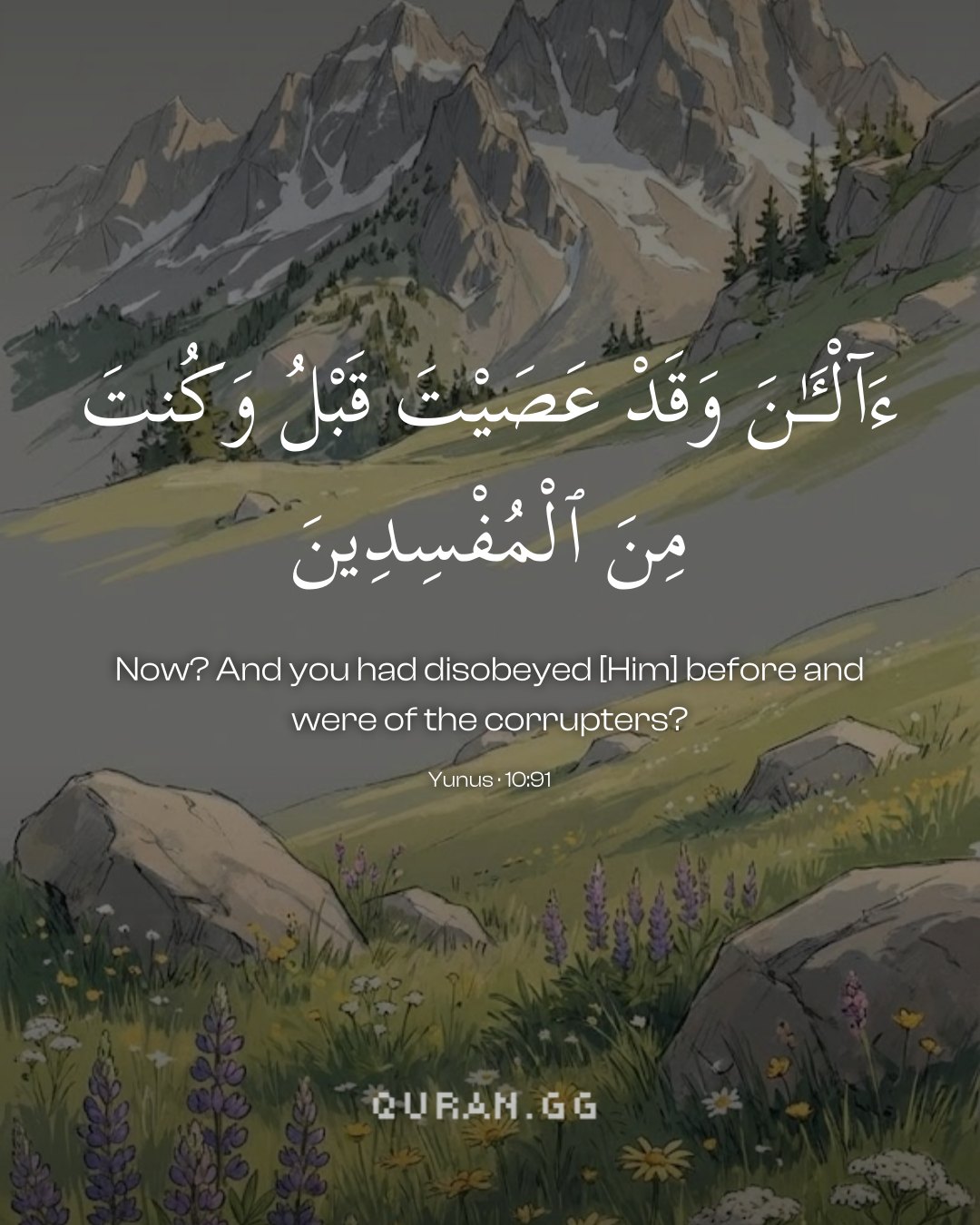
آلْآنَ وَقَدْ عَصَيْتَ قَبْلُ وَكُنتَ مِنَ الْمُفْسِدِينَ ﴿91﴾
Is it now [ that you come to believe ] while you were rebellious before and you were among the mischief-makers?
This proves that the profession of faith exactly at the time of death is not legally trustworthy. It is further clarified by the Hadith in which the Holy Prophet ﷺ said, 'Allah Ta'ala keeps accepting the Taubah (repentance) of a servant until comes the time of the ghargharah of death. (Tirmidhi)
The ghargharah of death means the time the soul or spirit is drawn out or extracted from the body and it is a time when angels appear face to face. At that time, life in this world, the home of deeds, is all over and the laws of the Hereafter come into force. Therefore, nothing done at that time is acceptable, neither belief, nor disbelief. Whoever believes at such a time will not be called a believer. He will not be treated as a believer while shrouding and burying him. This stands proved from the fate of Pharaoh. There is a consensus that he died a disbeliever. This is also what the text of the Qur'an says. In case, someone is reported to have called the belief of the Pharaoh as valid, it will either be suitably interpreted, otherwise the statement would be considered false. (Ruh al-Ma` ani)
Similarly, if someone were to utter (God forbid) a word of disbelief (kufr) in a state when the soul is being drawn out of the body, he will not be called a kafir (disbeliever). Instead, a Salah of Janazah (Muslim funeral prayers) will be offered for him and he would be buried like Muslims, and the word of disbelief uttered by him would be interpreted (in his favor). This finds confirmation in what happened in the case of some Auliya' of Allah, specially when that which they uttered bothered people as if what they were uttering was nothing short of kufr (disbelief). However, when they became conscious and explained, it gave relief to everyone and they realized that it was nothing but a declaration of true belief.
In short, when the soul is being drawn out and the certain knock of death is on, that time is not counted in the life one lives in this world. Nothing done at that time is valid in terms of the Shari'ah. However, everything is, if done before that. But, those who see this transition from one world to the other have to be very cautious. It is possible to make a mistake in determining the correct situation. Is this the time of the drawing of the soul from the body (naz'atu'r-ruh)? Or, is it the last rattle of death (ghargharatu 'l-maut)? Or, is it that which prevails earlier (usually referred to in English as being in the throes of death or the agony of death or, uncharitably enough, giving up the ghost)?
The mission of Moses in Egypt was two-sided—firstly to call upon Pharaoh and his people to accept the oneness of God and the Hereafter and, secondly, to lead the Israelites out of Egypt into the open atmosphere of the desert and to train them there. When the call for the Truth, meant for Pharaoh, had been fully accomplished in accordance with God’s command, Moses was commanded to set out from Egypt along with the Israelites. In order to reach the Sinai desert, they found it necessary to cross the Red Sea. When the Children of Israel reached the bank of the sea under the leadership of Moses, of God’s command Moses struck the water with his staff. The waters parted and rose up to the right and left. They stayed like that and in between a dry path appeared. Moses and the Children of Israel easily crossed over by means of this path. While in pursuit of the Children of Israel, Pharaoh forged ahead with his army. When he reached the bank of the sea, he saw that Moses and the Children of Israel were passing along a dry path. The wide stretch of the sea had been torn asunder and had given way to Moses and his companions. This event was, in fact, a sign from God. Pharaoh should have learned the lesson from this that Moses stood for the Truth and that God was with him. But he treated the separating of the waters as an ordinary mundane event instead of treating it as a Godly miracle. He saw only the sea between himself and Moses, though in fact God Himself was standing there. Thus an event in which there was a message of obedience (to God) and inclination (towards Him) for Pharaoh, merely caused an increase in his arrogance. He saw the ‘sea’ but did not see ‘God.’ He thought that he too could cross the sea as Moses and his companions had done.
Continue reading the tafsir of ayahs 90–91 Uthmani text of the Madinah mushaf (King Fahd Complex). Translation: Saheeh International. Tafsir via Quran.com.