The Children of Israel were saved and Fir`awn's People drowned
Allah tells us how He caused Fir`awn and his soldiers to drown. The Children of Israel left Egypt in the company of Musa. It was said that there were six hundred thousand soldiers, plus offspring. They borrowed a lot of ornaments from the Coptics and took that with them. Fir`awn became very angry with them. So he sent heralds to all the cities to send their soldiers. He embarked, following behind them, filled with great pride and with massive armies. Allah wanted this to happen for He had a plan for them. No one that had any authority or power remained behind in Fir`awn's kingdom. They were all together and caught the Children of Israel at sunrise.
Continue reading the tafsir of ayahs 90–92Ma'arif al-Qur'an
Mufti Muhammad Shafi
Commentary
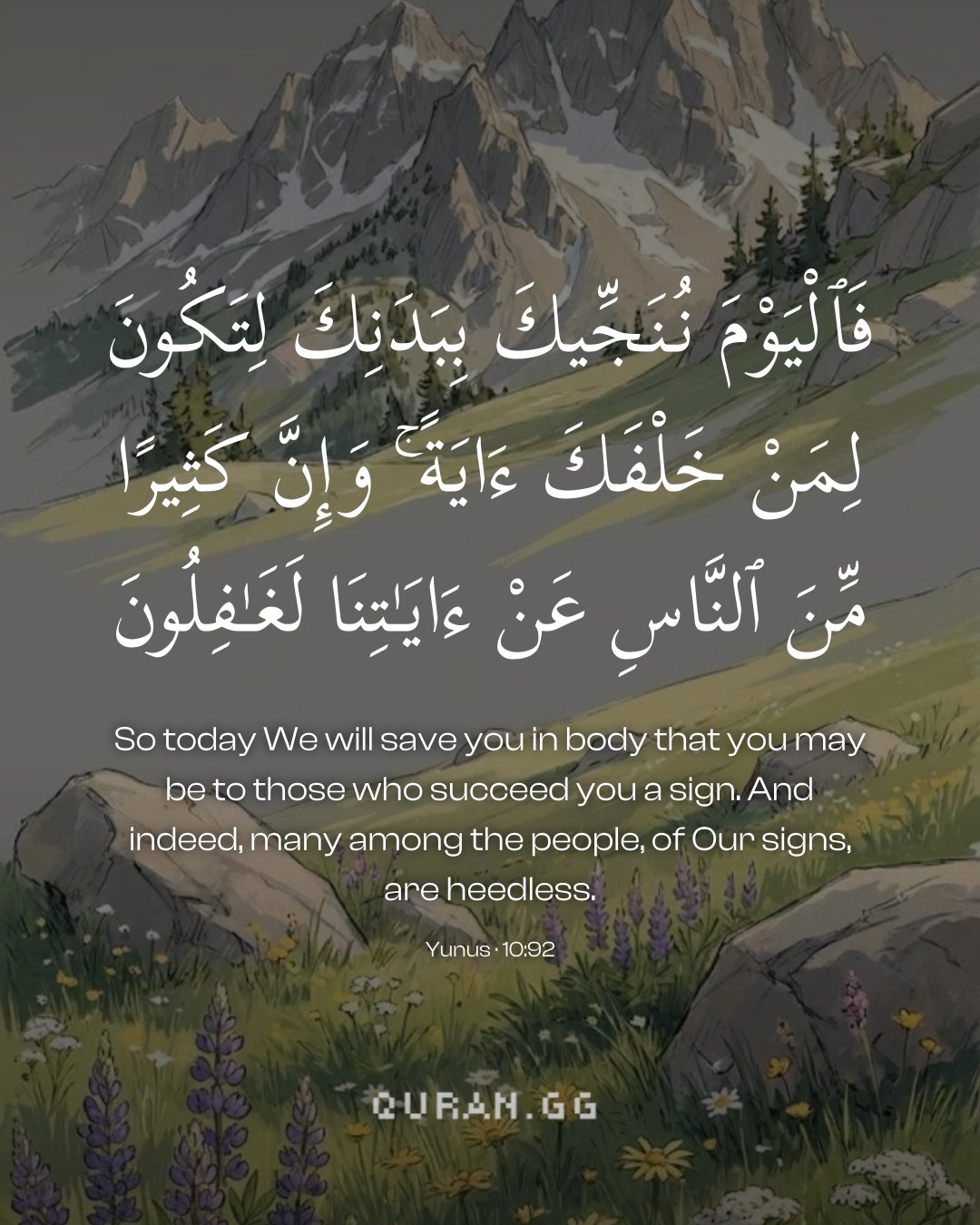
Addressing Pharaoh in the first verse (92), it was said that Allah will take his body out of the waters after he is drowned so that his body becomes a sign of Divine power, and a lesson for people after him.
It happened when, after having crossed the sea, Sayyidna Musa (علیہ السلام) told Bani Isra'il about the drowning of the Pharaoh, they were so overawed and subdued by him that they refused to believe the news and said that the Pharaoh was not drowned. To guide them right and to teach others a lesson, Allah Ta'ala had the dead body of Pharaoh thrown ashore by a wave of the sea. Everyone saw it and believed that he had died and then, this corpse became a sort of moral deterrent for everyone. After that, it is not known as to what happened to this corpse ultimately. The place where the dead body of the Pharaoh was found is still known as the mount of Pharaoh.
Some time back, newspaper reports indicated that the dead body of Pharaoh was found intact and was seen by the public at large and that it was deposited safely in the Cairo Museum. But, it cannot be said with certainty that this is the same Pharaoh who confronted Sayyidna Musa (علیہ السلام) or is some other Pharaoh because names of Pharaohs differ. Every ruler of Egypt in that period of history had the title of Pharaoh.
But, no wonder, the Divine power had thrown a drowned dead body ashore. Very similarly, it may have kept it even preserved against spoilage so that it could become a lesson for future generations. And it may still be there! (However it remains essential to learn a lesson from it as compared to becoming excited about its discovery as an archeological triumph).
At the end of the verse, it was said that many people pay no heed to the verses and signs of Allah. They do not ponder over them and fail to learn their essential lesson in living a better life. Otherwise, signs abound. They are everywhere, in every particle of this universe. A look at them would help one recognize Allah and His perfect power.
Tazkirul Quran
Maulana Wahiduddin Khan
With this thought, Pharaoh and his army entered the sea. The water of the sea had split in two only for the sake of Moses and his companions and not for Pharaoh and his followers. So, when Pharaoh and his army reached the middle of the sea, both sides of the water joined, in compliance with God’s command, and Pharaoh along with his army was drowned. While drowning, he declared his acceptance of faith, but it was useless, because in the eyes of Almighty God, only a voluntary embracing of the Faith is reliable and acceptable and not a compulsory profession of Faith. The result of disobedience to God arising from arrogance is destruction. Examples of such incidents used to occur from time to time during the period of the Prophet. However, some examples of this type have been given historical shape by God, so that they might continue to give lessons to man in later ages after the time of the prophets had ended. One of these historical examples from the period of Moses is that of Pharaoh (Rameses II) whose mummified body was found by archaeologists in the ancient Egyptian town of Thebes. It is now kept on display in the museum at Cairo.
Uthmani text of the Madinah mushaf (King Fahd Complex). Translation: Saheeh International. Tafsir via Quran.com.