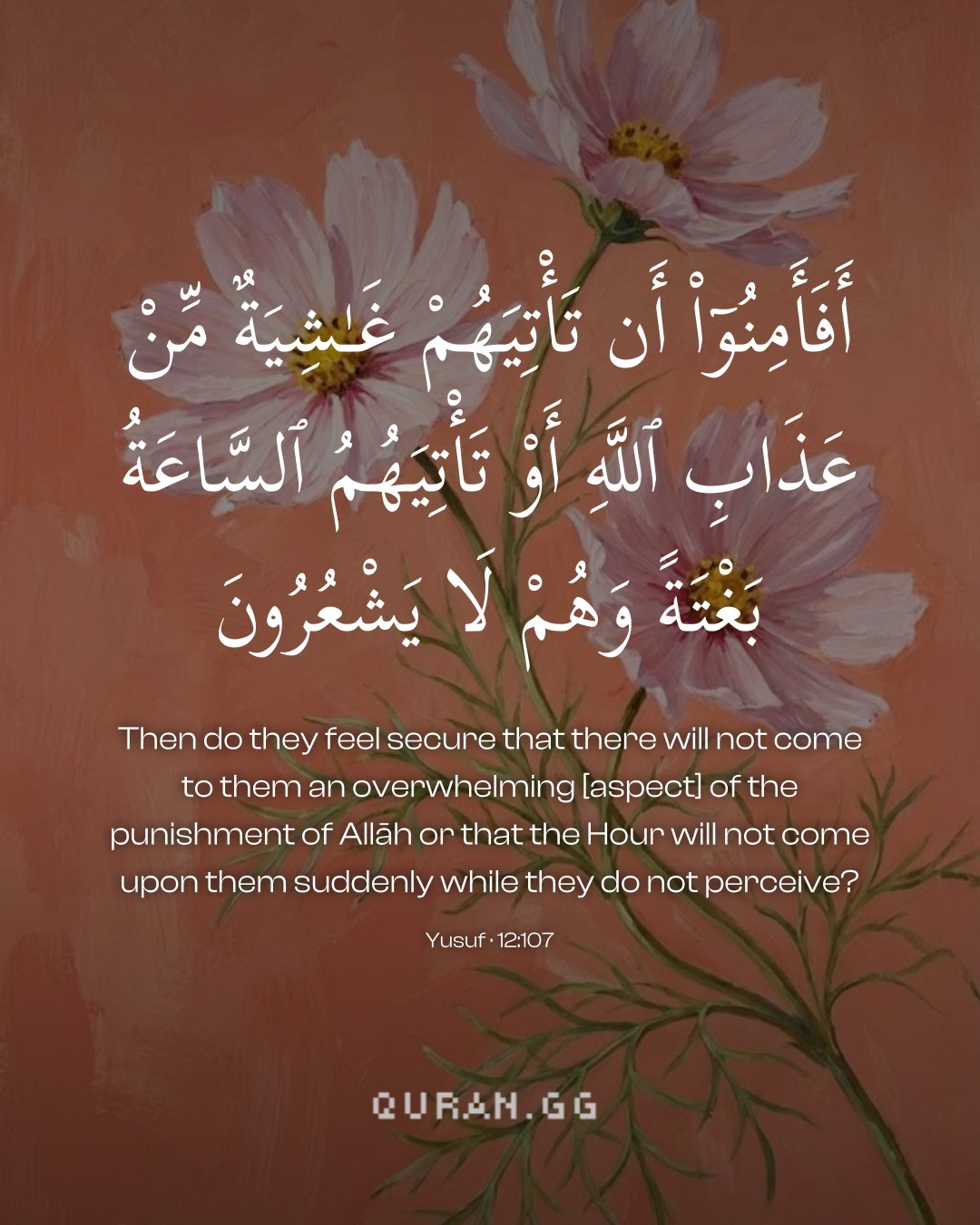
Then do they feel secure that there will not come to them an overwhelming [aspect] of the punishment of Allāh or that the Hour will not come upon them suddenly while they do not perceive?
Allah states that most people do not think about His signs and proofs of His Oneness that He created in the heavens and earth. Allah created brilliant stars and rotating heavenly objects and planets, all made subservient. There are many plots of fertile land next to each other on earth, and gardens, solid mountains, lively oceans, with their waves smashing against each other, and spacious deserts. There are many live creatures and others that have died; and animals, plants and fruits that are similar in shape, but different in taste, scent, color and attributes. All praise is due to Allah the One and Only, Who created all types of creations, Who Alone will remain and last forever. It is He Who is unique in His Names and Attributes. Allah said next,
And most of them do not believe in Allah without associating partners with Him - 106.
It means that those of them who profess a belief in Allah would do so by lacing it with Shirk. They would suggest others as partners in the attributes of knowledge and power which are exclusive for Allah Ta` ala - which is rank injustice, and ignorance.
Ibn Kathir has said that included under the sense of this verse are Muslims who, despite having 'Iman, are involved with different kinds of Shirk. According to the Musnad of Ahmad, the Holy Prophet ﷺ said: The most dangerous of things I apprehend for you is the small Shirk. When the Sahabah asked as to what could that be, he said: Hypocrisy is the small Shirk. Similarly, swearing by someone or something other than Allah has been called Shirk in another Hadith. (Ibn Kathir from Tirmidhi) Vows and offerings (Mannat and Niyaz) in the name of anyone other than Allah is also included under it, on which there is a consensus of Muslim jurists.
After that, in verse 107, questioned and deplored is their heedlessness and ignorance as to how could these people, despite their denial and rebellion, become so carefree of the possibility that there may come on them some punishment from Allah which overtakes them from all sides, or that the fateful Hour of the Day of Doom itself descends upon them all of a sudden while they are not ready for it?
Tazkirul Quran
Maulana Wahiduddin KhanOn ayahs 104–107
The story of Joseph is in itself a proof of the Quran being the revelation of God and not the discourse of a human being. This incident occurred about two and half thousand years prior to the advent of the Prophet Muhammad. He had neither witnessed this train of events himself, nor was it recorded in history books so that he could have read about it, nor could he have heard it from others. It was found only on the pages of the Torah, and before the age of the printing press, the Torah was a book which was known only to a few Jewish scholars at Jewish centres and not to anybody else. Moreover, the events pertaining to Joseph’s life have been described in the Quran in such a way that, in spite of their tallying basically with the descriptions in the Torah, they differ in respect of details. This difference is in itself a proof of the Quran being the revelation of God, because throughout the Quran its description appears to be very rational and natural. The descriptions given in the Quran are clearly consistent with Jacob’s and Joseph’s prophetic character, while the descriptions given in the Torah are not. Similarly, many very important aspects, for instance, Joseph’s speech in the prison ( 5: 37-40 ), which is mentioned in the Quran, find no place in the Bible or in the Talmud: even certain historical errors that are found in the Bible are not repeated in the Quran. For example, the Bible says that the king of Egypt in Joseph’s period was Pharaoh. In actual fact, the dynasty which assumed the title of Pharaoh became the rulers of Egypt only five hundred years after Joseph. During the period of Joseph, Egypt was ruled by an Arab dynasty, the Hyksos, known as the shepherd kings. (See Bible, chapter ‘Genesis’). The refusal to accept the Truth here is due to an apparent lack of reason. But as soon as a convincing argument is presented to an individual, he should immediately accept it. Most often the real reason for denial of the Truth is stubbornness. People do not accept the Truth because they do not want to do so. Acceptance of the Truth generally involves humbling oneself and this is a very difficult task for a human being. This is one reason why arrogant people never change their ways, in spite of valid arguments or reasoning being used to convince them. They will tolerate the downgrading of the truth, but they are not ready to humble themselves; they forget that those who keep a low profile in this world will be glorified in the Hereafter, whereas one who does not do so will be forever reduced to insignificance in the next world.