Surah Yusuf Ayah 60 (12:60) — Meaning & Tafsir | Quran.GG

Surah Yusuf, Ayah 60

12:60 · Meaning and tafsir

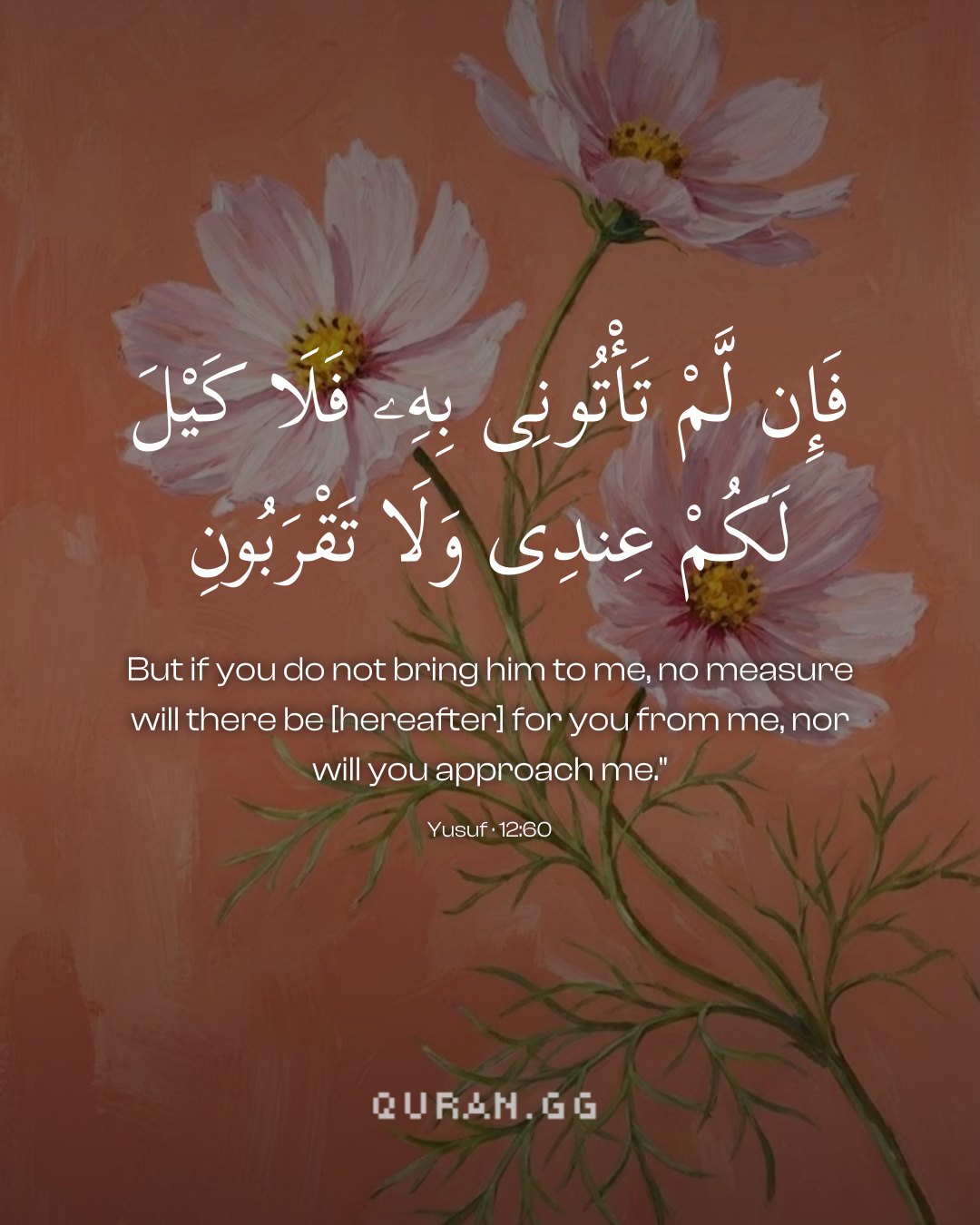
فَإِن لَّمْ تَأْتُونِى بِهِۦ فَلَا كَيْلَ لَكُمْ عِندِى وَلَا تَقْرَبُونِ ٦٠

But if you do not bring him to me, no measure will there be [hereafter] for you from me, nor will you approach me."

Surah Yusuf 12:60 in Arabic with its translation: “But if you do not bring him to me, no measure will there be [hereafter] for you from me, nor will you…”

Make something with this ayah

Turn it into a video for Stories, Reels or TikTok, recited by the reciter you pick, or an image on a background you choose. Free, in your browser.

Download this image

Tafsir Ibn Kathir (abridged)

Yusuf's Brothers travel to Egypt

As-Suddi, Muhammad bin Ishaq and several others said that the reason why Yusuf's brothers went to Egypt, is that after Yusuf became minister of Egypt and the seven years of abundance passed, then came the seven years of drought that struck all areas of Egypt. The drought also reached the area of Kana`an (Canaan), where Prophet Ya`qub, peace be upon him, and his children resided. Prophet Yusuf efficiently guarded the people's harvest and collected it, and what he collected became a great fortune for the people. This also permitted Yusuf to give gifts to the people who sought his aid from various areas who came to buy food and provisions for their families. Yusuf would not give a family man more than whatever a camel could carry, as annual provisions for them. Yusuf himself did not fill his stomach from this food, nor did the king and his aids eat except one meal a day. By doing so, the people could sustain themselves with what they had for the remainder of the seven years. Indeed, Yusuf was a mercy from Allah sent to the people of Egypt. Yusuf's brothers were among those who came to Egypt to buy food supplies, by the order of their father. They knew that the `Aziz of Egypt was selling food to people who need it for a low price, so they took some merchandise from their land with them to exchange it for food. They were ten, because Ya`qub peace be upon him kept his son and Yusuf's brother Binyamin with him. Binyamin was the dearest of his sons to him after Yusuf. When Prophet Yusuf's brothers entered on him in his court and the center of his authority, he knew them the minute he saw them. However, they did not recognize him because they got rid of him when he was still young, and sold him to a caravan of travelers while unaware of their destination. They could not have imagined that Yusuf would end up being a minister, and this is why they did not recognize him, while he did recognize them. As-Suddi said that Yusuf started talking to his brothers and asked them, "What brought you to my land" They said, "O, `Aziz, we came to buy provisions." He asked them, "You might be spies." They said, "Allah forbids." He asked them, "Where are you from" They said, "From the area of Kana`an, and our father is Allah's Prophet Ya`qub." He asked them, "Does he have other children besides you" They said, "Yes, we were twelve brothers. Our youngest died in the desert, and he used to be the dearest to his father. His full brother is alive and his father kept him, so that his closeness compensates him for losing our youngest brother who died." Yusuf ordered that his brothers be honored and allowed to remain,

Continue reading the tafsir of ayahs 58–62

Ma'arif al-Qur'an

And, along with it, he gave them a warning as well:

فَإِن لَّمْ تَأْتُونِي بِهِ فَلَا كَيْلَ لَكُمْ عِندِي وَلَا تَقْرَ‌بُونِ

Still, if you do not bring him to me, then you deserve no measure from me [ because it will prove that you have lied to me, and thus ], nor shall you come even close to me. - 60

Then, he made a secret arrangement as well. He ordered his young workers on the job to collect the cash, jewelry and any other articles paid by his brothers as the cost of the grains, and tie it up secretly with their supplies in the camel-packs in a way that they should remain unaware of it while there - so that, when they open their packs after having arrived home, and find their cash and jewelry back in their hands, they may have a reason to return for grains once again.

Tazkirul Quran

‘Place in my charge the storehouses of the land.’ (The original Arabic word translated here as storehouses [or granaries] literally means ‘treasure’). Seeing that he had the attention of the king, Joseph made this request to him, so that with the help of government resources he should be empowered to construct large granaries throughout the whole country, where surplus corn acquired from the farmers and could be stored for the first seven years. The king agreed to this and, exercising his constitutional royal authority, gave Joseph all kinds of power to facilitate this task. The king of Egypt was a polytheist. Verse 76 shows that after the appointment of Joseph the religion of the same king prevailed in Egypt for about ten years. This tradition of the Prophet of God shows that acceptance of a subordinate post under a non-Muslim government is not against Islam. On the same basis our predecessors accepted the posts of ‘Qazi’ under tyrant kings. (Tafsir an-Nasafi). What was Joseph’s purpose in assuming authority in Egypt? The information given in the Quran indicates that his purpose seems to have been to save the subjects of God from famine and then, as a result of this, to create opportunities for the Children of Israel to settle in Egypt.

Uthmani text of the Madinah mushaf (King Fahd Complex). Translation: Saheeh International. Tafsir via Quran.com.