As-Suddi, Muhammad bin Ishaq and several others said that the reason why Yusuf's brothers went to Egypt, is that after Yusuf became minister of Egypt and the seven years of abundance passed, then came the seven years of drought that struck all areas of Egypt. The drought also reached the area of Kana`an (Canaan), where Prophet Ya`qub, peace be upon him, and his children resided. Prophet Yusuf efficiently guarded the people's harvest and collected it, and what he collected became a great fortune for the people. This also permitted Yusuf to give gifts to the people who sought his aid from various areas who came to buy food and provisions for their families. Yusuf would not give a family man more than whatever a camel could carry, as annual provisions for them. Yusuf himself did not fill his stomach from this food, nor did the king and his aids eat except one meal a day. By doing so, the people could sustain themselves with what they had for the remainder of the seven years. Indeed, Yusuf was a mercy from Allah sent to the people of Egypt. Yusuf's brothers were among those who came to Egypt to buy food supplies, by the order of their father. They knew that the `Aziz of Egypt was selling food to people who need it for a low price, so they took some merchandise from their land with them to exchange it for food. They were ten, because Ya`qub peace be upon him kept his son and Yusuf's brother Binyamin with him. Binyamin was the dearest of his sons to him after Yusuf. When Prophet Yusuf's brothers entered on him in his court and the center of his authority, he knew them the minute he saw them. However, they did not recognize him because they got rid of him when he was still young, and sold him to a caravan of travelers while unaware of their destination. They could not have imagined that Yusuf would end up being a minister, and this is why they did not recognize him, while he did recognize them. As-Suddi said that Yusuf started talking to his brothers and asked them, "What brought you to my land" They said, "O, `Aziz, we came to buy provisions." He asked them, "You might be spies." They said, "Allah forbids." He asked them, "Where are you from" They said, "From the area of Kana`an, and our father is Allah's Prophet Ya`qub." He asked them, "Does he have other children besides you" They said, "Yes, we were twelve brothers. Our youngest died in the desert, and he used to be the dearest to his father. His full brother is alive and his father kept him, so that his closeness compensates him for losing our youngest brother who died." Yusuf ordered that his brothers be honored and allowed to remain,
Still, if you do not bring him to me, then you deserve no measure from me [ because it will prove that you have lied to me, and thus ], nor shall you come even close to me. - 60
Then, he made a secret arrangement as well. He ordered his young workers on the job to collect the cash, jewelry and any other articles paid by his brothers as the cost of the grains, and tie it up secretly with their supplies in the camel-packs in a way that they should remain unaware of it while there - so that, when they open their packs after having arrived home, and find their cash and jewelry back in their hands, they may have a reason to return for grains once again.
Tazkirul Quran
Maulana Wahiduddin KhanOn ayahs 61–63
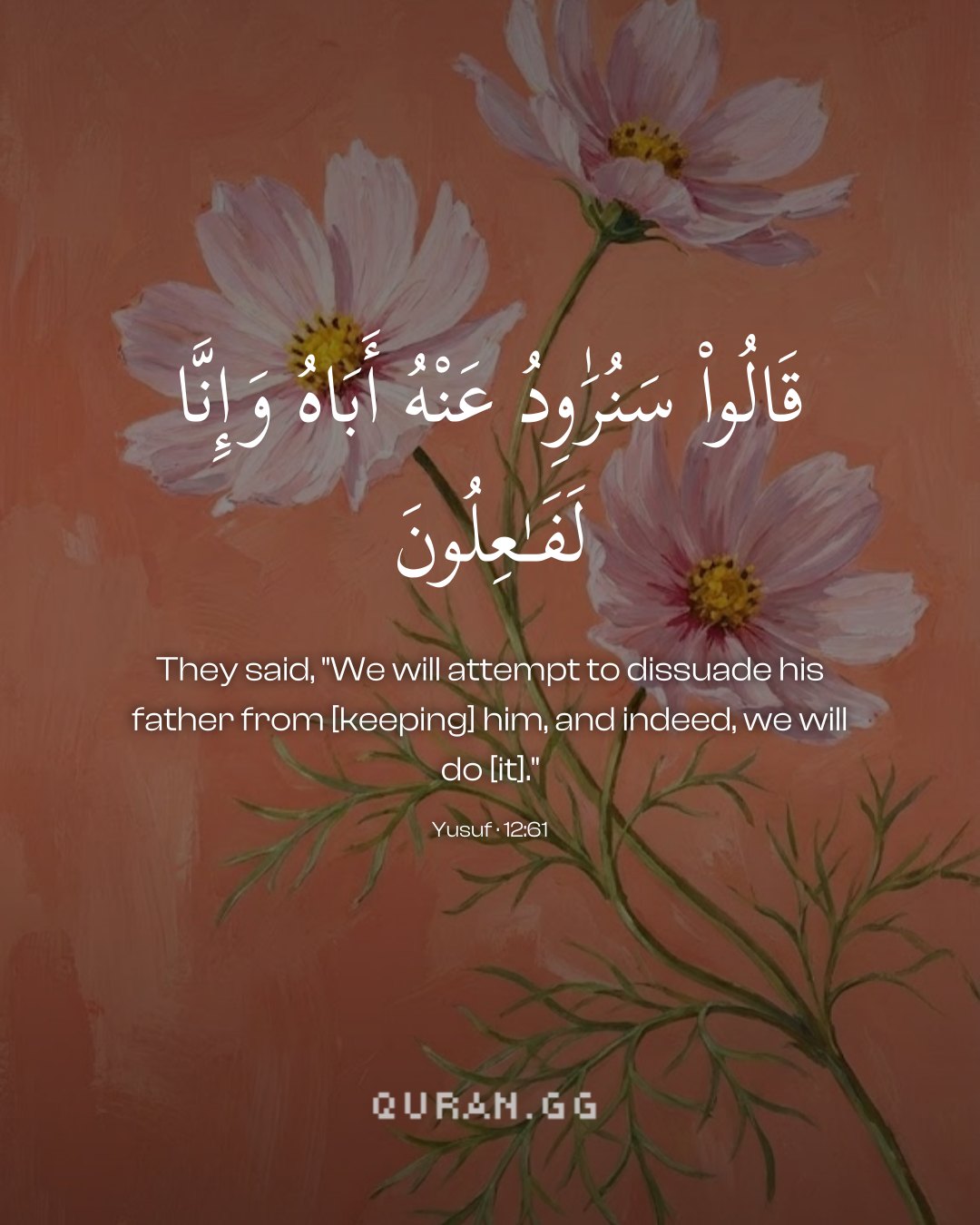
There were bumper crops during the first seven years of Joseph’s power. He had big granaries constructed throughout the whole country in which he stored surplus corn bought from the farmers every year. Thereafter when the years of famine commenced, he arranged to have this corn stored in the capital and started selling it at a fair price. This famine prevailed not only in Egypt but also in the surrounding areas, that is, in Syria, Palestine. Transjordan, etc. When the news spread far and wide that corn was being sold at a fair price in Egypt, Joseph’s brothers also came to Egypt to purchase corn. Although they were seeing Joseph after twenty years, they saw a resemblance to their brother in him. But immediately this thought vanished from their minds, because they could not understand how someone whom they had pushed into a dry well could assume the highest office of Egypt. Joseph arranged one camel-load of corn per head for his brothers. Now they wanted to have one more camel-load of corn in Benjamin’s name too. They said that one of their brothers had been detained by their old father to be with him, therefore they said that it would be very kind of him if Benjamin’s share could also be given to them. Joseph said that it was against his principles to hand over the share of an absentee. He also said that when they came again, they should bring their brother with them and then only could they have his share. Joseph added, ‘You have experienced my generosity. Even after this, are you reluctant to bring your brother with you? If you are unable to bring this brother the next time, it will be presumed that you were telling a lie and only wanted to get one more camel-load of corn by deceit. The punishment for this will be that in future you will be deprived of even your own share of corn.’
Uthmani text of the Madinah mushaf (King Fahd Complex). Translation: Saheeh International. Tafsir via Quran.com.