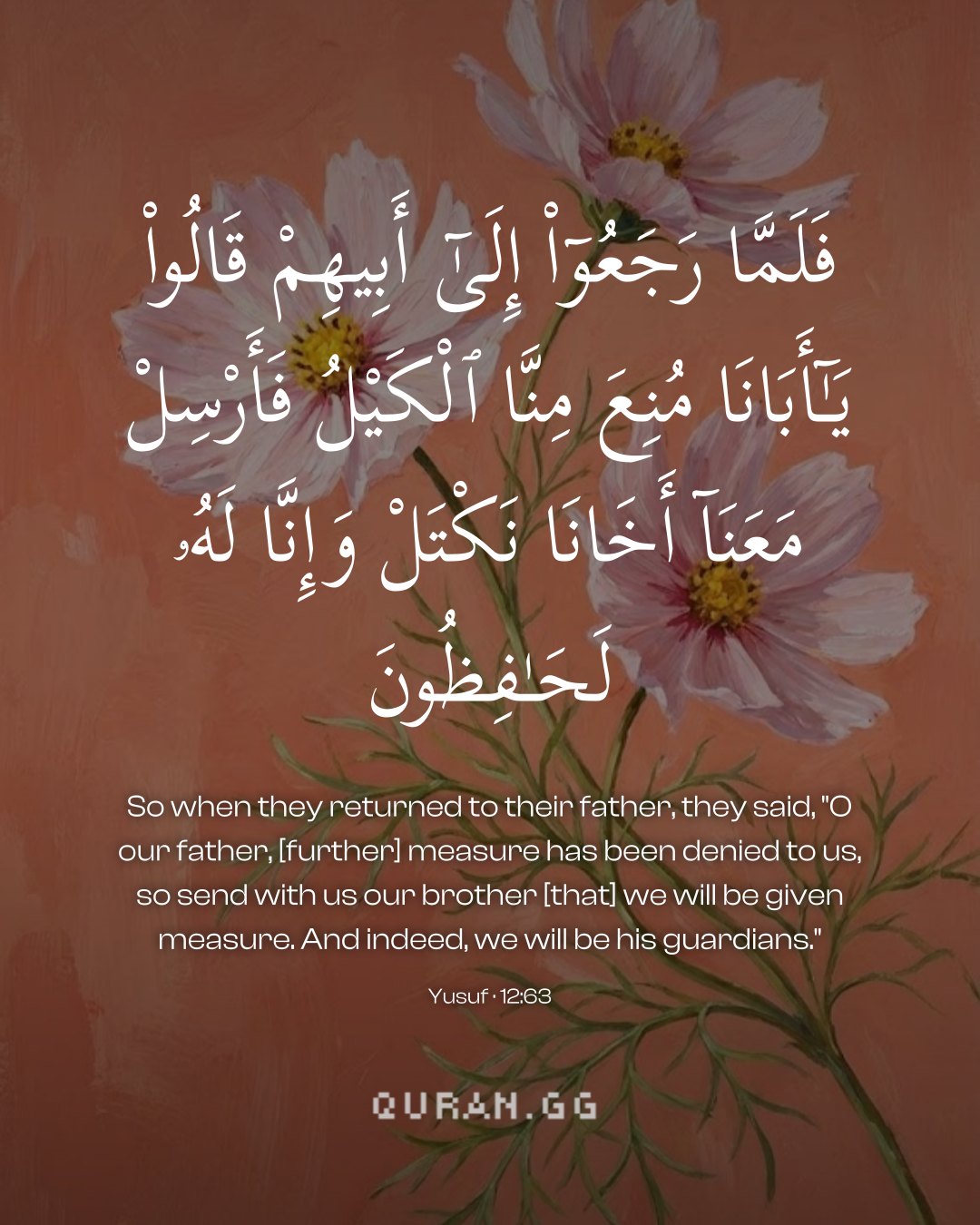
So when they returned to their father, they said, "O our father, [further] measure has been denied to us, so send with us our brother [that] we will be given measure. And indeed, we will be his guardians."
Yusuf's Brothers ask Ya`qub's Permission to send Their Brother Binyamin with Them to Egypt
Allah says that when they went back to their father,
قَالُواْ يأَبَانَا مُنِعَ مِنَّا الْكَيْلُ
(they said: "O our father! No more measure of grain shall we get...") `after this time, unless you send our brother Binyamin with us. So send him with us, and we shall get our measure and we shall certainly guard him.' Some scholars read this Ayah in a way that means, `and he shall get his ration.' They said,
وَإِنَّا لَهُ لَحَـفِظُونَ
(and truly, we will guard him.), `do not fear for his safety, for he will be returned back to you.' This is what they said to Ya`qub about their brother Yusuf,
(Can I entrust him to you except as I entrusted his brother Yusuf to you aforetime) He asked them, `Will you do to him except what you did to his brother Yusuf before, when you took him away from me and separated me from him'
فَاللَّهُ خَيْرٌ حَـفِظًا
وَهُوَ أَرْحَمُ الرَحِمِينَ
(But Allah is the Best to guard, and He is the Most Merciful of those who show mercy.) Ya`qub said, `Allah has the most mercy with me among all those who show mercy, He is compassionate with me for my old age, feebleness and eagerness for my son. I invoke Allah to return him to me, and to allow him and I to be together; for surely, He is the Most Merciful of those who show mercy.'
Ma'arif al-Qur'an
Mufti Muhammad Shafi
Commentary
The verses appearing above carry the remaining segment of the event, that is, when the brothers of Yusuf (علیہ السلام) returned home with food-grains from Egypt, they told their father about what had happened there, specially about the condition imposed by the ` Aziz of Misr that they would receive food grains in the future only if they would bring their younger brother with them. So they requested their father to let Benyamin also accompany them in order that they may receive food grains in the future as well. Then, they would be there to protect this brother of theirs at its best with assurance that they would see to it that he faces no inconvenience during the trip.
Their father asked them if they wanted him to trust them with Benyamin as he had done before with their brother, Yusuf (علیہ السلام) . The drive of his remark makes it obvious that he did not trust their word. He had trusted them once, and suffered - for they had promised in the same words spoken earlier that they would guard him.
This much was an answer to what they had said. But, he had the need of the family in sight, and because he was blessed with the quality of trust in the Divine dispension of matters, he talked about the reality as he knew it saying, in effect, that man has no control over his gain or loss unless Allah Ta ala Himself so wills. And when He wills it, it cannot be diverted or averted by anyone. Therefore, it is incorrect to place one's trust in the created beings of Allah in this matter and equally inappropriate is the dependence on their complaints to settle it.
Tazkirul Quran
Maulana Wahiduddin KhanOn ayahs 61–63
There were bumper crops during the first seven years of Joseph’s power. He had big granaries constructed throughout the whole country in which he stored surplus corn bought from the farmers every year. Thereafter when the years of famine commenced, he arranged to have this corn stored in the capital and started selling it at a fair price. This famine prevailed not only in Egypt but also in the surrounding areas, that is, in Syria, Palestine. Transjordan, etc. When the news spread far and wide that corn was being sold at a fair price in Egypt, Joseph’s brothers also came to Egypt to purchase corn. Although they were seeing Joseph after twenty years, they saw a resemblance to their brother in him. But immediately this thought vanished from their minds, because they could not understand how someone whom they had pushed into a dry well could assume the highest office of Egypt. Joseph arranged one camel-load of corn per head for his brothers. Now they wanted to have one more camel-load of corn in Benjamin’s name too. They said that one of their brothers had been detained by their old father to be with him, therefore they said that it would be very kind of him if Benjamin’s share could also be given to them. Joseph said that it was against his principles to hand over the share of an absentee. He also said that when they came again, they should bring their brother with them and then only could they have his share. Joseph added, ‘You have experienced my generosity. Even after this, are you reluctant to bring your brother with you? If you are unable to bring this brother the next time, it will be presumed that you were telling a lie and only wanted to get one more camel-load of corn by deceit. The punishment for this will be that in future you will be deprived of even your own share of corn.’