Surah Al-An'am Ayah 22 (6:22) — Meaning & Tafsir | Quran.GG

Surah Al-An'am, Ayah 22

6:22 · Meaning and tafsir

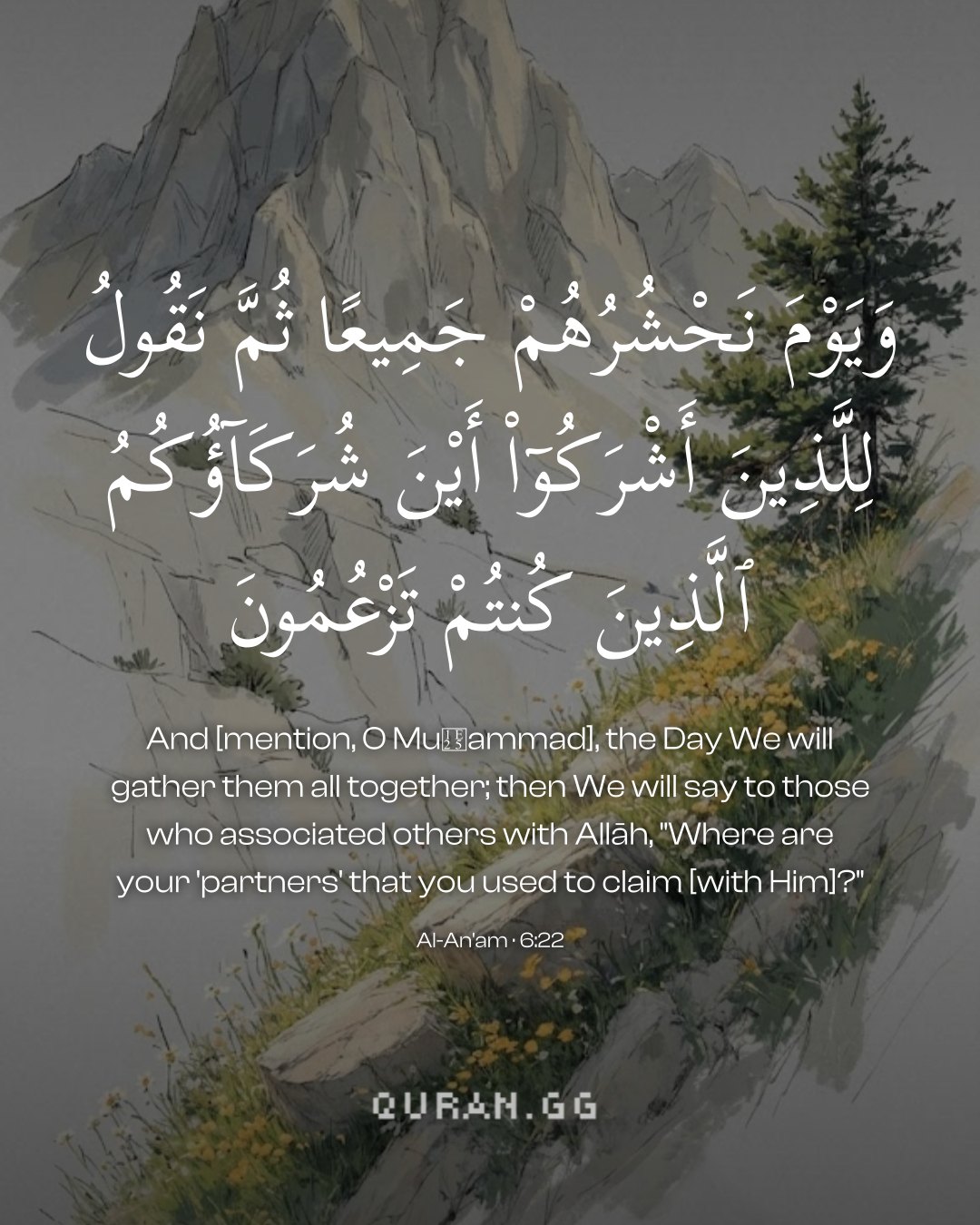
وَيَوْمَ نَحْشُرُهُمْ جَمِيعًا ثُمَّ نَقُولُ لِلَّذِينَ أَشْرَكُوٓا۟ أَيْنَ شُرَكَآؤُكُمُ ٱلَّذِينَ كُنتُمْ تَزْعُمُونَ ٢٢

And [mention, O Muḥammad], the Day We will gather them all together; then We will say to those who associated others with Allāh, "Where are your 'partners' that you used to claim [with Him]?"

Surah Al-An'am 6:22 in Arabic with its translation: “And [mention, O Muḥammad], the Day We will gather them all together; then We will say to those who associated…”

Make something with this ayah

Turn it into a video for Stories, Reels or TikTok, recited by the reciter you pick, or an image on a background you choose. Free, in your browser.

Download this image

Tafsir Ibn Kathir (abridged)

The Polythiests Shall be Questioned About the Shirk They Committed

About the polytheists, Allah said:

وَيَوْمَ نَحْشُرُهُمْ جَمِيعاً

(And on the Day when We shall gather them all together,) This is on the Day of Resurrection, when He will ask them about the idols and rivals that they worshipped instead of Him. Allah will say to them,

أَيْنَ شُرَكَآؤُكُمُ الَّذِينَ كُنتُمْ تَزْعُمُونَ

(Where are your partners (false deities) whom you used to assert (as partners in worship with Allah)) Allah said in Surat Al-Qasas,

وَيَوْمَ يُنَـدِيهِمْ فَيَقُولُ أَيْنَ شُرَكَآئِىَ الَّذِينَ كُنتُمْ تَزْعُمُونَ

(And (remember) the Day when He will call to them, and say, "Where are My (so-called) partners whom you used to assert") 28:62. Allah's statement,

ثُمَّ لَمْ تَكُنْ فِتْنَتُهُمْ

(There will then be (left) no Fitnah for them) means, argument. `Ata' Al-Khurasani said that,

ثُمَّ لَمْ تَكُنْ فِتْنَتُهُمْ

(There will then be (left) no Fitnah for them) in the face of the affliction that will be placed on them,

إِلاَّ أَن قَالُواْ وَاللَّهِ رَبِّنَا مَا كُنَّا مُشْرِكِينَ

(but to say: "By Allah, our Lord, we were not those who joined others (in worship with Allah).") Allah said next,

انظُرْ كَيْفَ كَذَبُواْ عَلَى أَنفُسِهِمْ وَضَلَّ عَنْهُمْ مَّا كَانُواْ يَفْتَرُونَ

(Look! How they lie against themselves! But the (lie) which they invented will disappear from them.) which is similar to His other statement,

ثُمَّ قِيلَ لَهُمْ أَيْنَ مَا كُنتُمْ تُشْرِكُونَ - مِن دُونِ اللَّهِ قَـالُواْ ضَـلُّواْ عَنَّا بَل لَّمْ نَكُنْ نَّدْعُواْ مِن قَبْلُ شَيْئاً كَذَلِكَ يُضِلُّ اللَّهُ الْكَـفِرِينَ

(Then it will be said to them: "Where are (all) those whom you used to join in worship as partners. Besides Allah" They will say, "They have vanished from us: Nay, we did not invoke (worship) anything before." Thus Allah leads astray the disbelievers.) 40:73-74

The Miserable Do Not Benefit from the Qur'an

Allah's statement,

وَمِنْهُمْ مَّن يَسْتَمِعُ إِلَيْكَ وَجَعَلْنَا عَلَى قُلُوبِهِمْ أَكِنَّةً أَن يَفْقَهُوهُ وَفِى ءَاذَانِهِمْ وَقْراً وَإِن يَرَوْاْ كُلَّ ءَايَةٍ لاَّ يُؤْمِنُواْ بِهَا

(And of them there are some who listen to you; but We have set veils on their hearts, so they understand it not, and deafness in their ears; if they see every one of the Ayat they will not believe therein;) means, they come to you, (O Muhammad ), so that they hear you recite the Qur'an, but its recitation does not benefit them, because Allah has set veils on their hearts, and so they do not understand the Qur'an,

وَفِى ءَاذَانِهِمْ وَقْرًا

(and (set) deafness in their ears;) that prevents them from hearing what benefits them. In another Ayah, Allah said;

وَمَثَلُ الَّذِينَ كَفَرُواْ كَمَثَلِ الَّذِى يَنْعِقُ بِمَا لاَ يَسْمَعُ إِلاَّ دُعَآءً وَنِدَآءً

(And the example of those who disbelieve, is as that of him who shouts at one who hears nothing but calls and cries.) 2:171 Allah said next,

وَإِن يَرَوْاْ كُلَّ ءَايَةٍ لاَّ يُؤْمِنُواْ بِهَا

(if they see every one of the Ayat they will not believe therein;) meaning, they will not believe in any of the Ayat, proofs, clear evidences and signs they witness because they do not have sound comprehension or fair judgment. In another Ayah, Allah said,

وَلَوْ عَلِمَ اللَّهُ فِيهِمْ خَيْرًا لأَسْمَعَهُمْ

(Had Allah known of any good in them, He would indeed have made them listen.) 8:23 Allah said,

حَتَّى إِذَا جَآءُوكَ يُجَـدِلُونَكَ

(to the point that when they come to you to argue with you...) using falsehood against truth,

يَقُولُ الَّذِينَ كَفَرُواْ إِنْ هَـذَآ إِلاَّ أَسَـطِيرُ الاٌّوَّلِينَ

(those who disbelieve say: "These are nothing but tales of the men of old.") The disbelievers say, what you (O Muhammad ) brought us was taken from the books of those who were before us, meaning plagiarized,

وَهُمْ يَنْهَوْنَ عَنْهُ وَيَنْأَوْنَ عَنْهُ

(And they prevent others from him and they themselves keep away from him,) They discourage people from following the truth, believing in Muhammad ﷺ and obeying the Qur'an,

وَيَنْأَوْنَ عَنْهُ

(and they themselves keep away from him,) They thus combine both evil acts, for they neither benefit themselves, nor let others benefit from the Prophet . `Ali bin Abi Talhah said that Ibn `Abbas said that the Ayah,

وَهُمْ يَنْهَوْنَ عَنْهُ

(And they prevent others from him.) means, they hinder people from believing in Muhammad ﷺ. Muhammad bin Al-Hanafiyyah said, "The disbelievers of Quraysh used to refrain from meeting Muhammad and they discouraged people from coming to him." Similar was reported from Qatadah, Mujahid and Ad-Dahhak and several others.

وَإِن يُهْلِكُونَ إِلاَّ أَنفُسَهُمْ وَمَا يَشْعُرُونَ

(and (by doing so) they destroy not but themselves, yet they perceive (it) not.) They destroy themselves by committing this evil action, and its harm will only touch them. Yet, they do not perceive this fact!

Ma'arif al-Qur'an

Commentary

Mentioned in the previous verse (21) was that the unjust and the deniers of truth will not receive salvation. Details appear in the present verses. The first (22) and the second (23) verses talk about the great trial to be held on the day of Resurrection before the Lord of all. It was said: وَيَوْمَ نَحْشُرُ‌هُمْ جَمِيعًا (And [ forget not ] the Day We shall gather them together), that is, ` gather all disbelievers and their self-made objects of worship together.' After that, it is said: ثُمَّ نَقُولُ لِلَّذِينَ أَشْرَ‌كُوا أَيْنَ شُرَ‌كَاؤُكُمُ الَّذِينَ كُنتُمْ تَزْعُمُونَ (then We shall say to those who associated partners with Allah, "Where are those you claimed to be partners of Allah?" ), that is, ` ask them about the objects of worship they had taken to as partners of Allah, and resolvers of their problems, and why would they not come to help them in their hour of trial.'

The word, ثُمَّ :'thumma' (then, after that), used here denotes delay, which tells us that the trial of answering fateful questions will not start soon after having been gathered on the Day of Resurrection. Instead, they shall keep standing in that state of wonder and perplexity for a long period of time. It will be a passage of time in between when the reckoning will commence.

In a Hadith, the Holy Prophet ﷺ has been reported to have said: What would happen to you when Allah Ta’ ala will gather you on the plains of Resurrection as arrows are gathered in the quiver - and you shall be in that state for fifty thousand years. And it ap-pears in another narration that everyone will tarry in the dark on that Day for one thousand years - not being able to even talk to each other. (This narration has been reported by Hakim in Al-Mustadrak, and by Al-Baihaqi)

The difference of fifty thousand and ten thousand in this narration also appears in two verses of the Holy Qur'an as well. In Surah Al-Ma` arij, it is said: كَانَ مِقْدَارُ‌هُ خَمْسِينَ أَلْفَ سَنَةٍ [ A Day ] the measure whereof is [ as ] fifty thousand years 70:4.' In Surah Al-Hajj, it is said: وَإِنَّ يَوْمًا عِندَ رَ‌بِّكَ كَأَلْفِ سَنَةٍ :A Day in the sight of thy Lord is like a thousand years of your reckoning - 22:47.' The reason for this difference is that this day will be long in terms of the severity of pain and the levels of pain will be different. Therefore, this day will seem to be that of fifty thousand years for some and that of one thousand years for others.

Tazkirul Quran

In the on-going struggle between the proponents, on the one hand of Truth and on the other of falsehood, the only decisive factor is the Book of God. There is nobody who knows the full facts or has any real authority except God. So God, the only Being who is capable of settling this dispute, has given an arbiter to the people in the form of the Quran. Now, man has only one course open to him. If he is not aware of the veracity of the Quran, he should investigate and satisfy himself that it is the Book of God. When he comes to know that it is really the Book of God, he should necessarily be satisfied with whatever is advocated therein. One who is not in agreement with the decision of the Quran runs the risk of being forced to accept its verdict in the Hereafter after much degradation and punishment. The Quran has been revealed so that, before the arrival of the time of Judgement, people may be made aware of what awaits them. The Prophet Muhammad performed this task during his prophethood and the same work has to be continued by his followers (ummah) till Doomsday. The Quran tells us in advance how God is going to treat people in the eternal world of the Hereafter. Those who are assigned the task of delivering this message to the people will be free of the responsibility once they have fully conveyed the message; but those to whom it is delivered will be free in the eyes of God only when they have accepted it and reformed themselves accordingly. The missionary’s responsibility ends with his ‘preaching’, while that of the addressee ends only on his ‘fulfilling his religious obligations’.

Continue reading the tafsir of ayahs 19–23

Uthmani text of the Madinah mushaf (King Fahd Complex). Translation: Saheeh International. Tafsir via Quran.com.