The Polythiests Shall be Questioned About the Shirk They Committed
About the polytheists, Allah said:
وَيَوْمَ نَحْشُرُهُمْ جَمِيعاً
(And on the Day when We shall gather them all together,) This is on the Day of Resurrection, when He will ask them about the idols and rivals that they worshipped instead of Him. Allah will say to them,
أَيْنَ شُرَكَآؤُكُمُ الَّذِينَ كُنتُمْ تَزْعُمُونَ
(Where are your partners (false deities) whom you used to assert (as partners in worship with Allah)) Allah said in Surat Al-Qasas,
وَيَوْمَ يُنَـدِيهِمْ فَيَقُولُ أَيْنَ شُرَكَآئِىَ الَّذِينَ كُنتُمْ تَزْعُمُونَ
(And (remember) the Day when He will call to them, and say, "Where are My (so-called) partners whom you used to assert") 28:62. Allah's statement,
Continue reading the tafsir of ayahs 22–26Ma'arif al-Qur'an
Mufti Muhammad Shafi
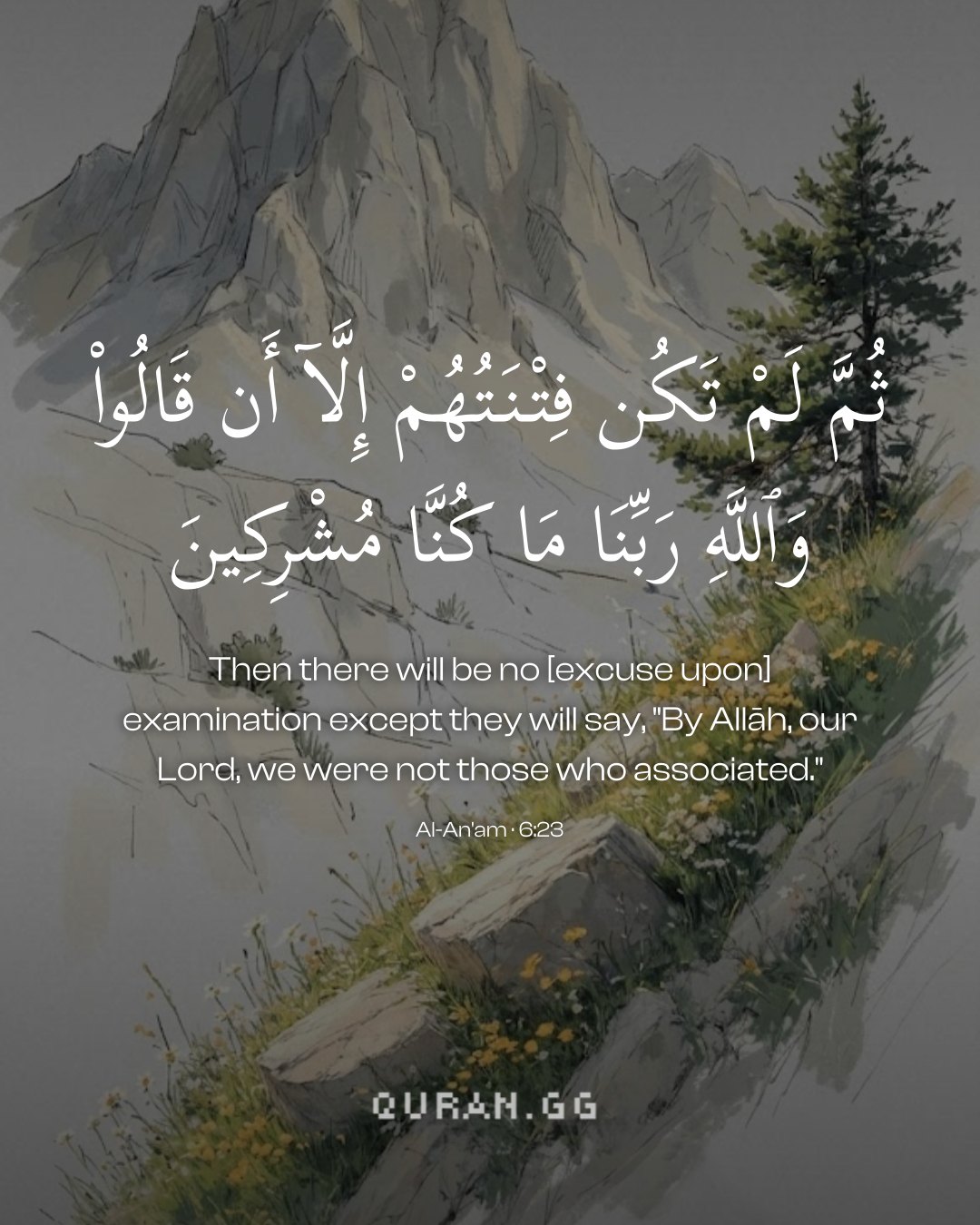
In short, on this venue of the great trial, a long period of time will pass for the trial to begin, so much so, that these people will wish that reckoning comes so that they can be relieved from their state of uncertainty, no matter what happens in the end. It is to indicate this length of stay that, as indicated earlier, the word, ثُمَّ (then) was prefixed to ثُمَّ (then We shall say). Similarly, the answer given by the disbelievers mentioned in the second verse (23) also appears with the word, نَقُول ; (then), which indicates that they too will come up with their answer after having deliberated over it for a long period of time, in which they will say: وَاللَّـهِ رَبِّنَا مَا كُنَّا مُشْرِكِينَ (By Allah, our Lord, we ascribed no partners to Allah). In this verse, their answer has been identified فِتنَہ 'fitnah' which could mean ` trial' or ` infatuation.' Both meanings can be taken here. In the first case, the answer given by the disbelievers becomes a trial by itself; while, in the second case, it would mean that these people were infatuated with idols and other self-made objects of worship, even made sacrifices for them, but all that infatuation was gone on this day when they had no choice but to declare their total disassociation from them.
There is something very astonishing in their answer. That was a nerve-shattering time with the day being the Day of Retribution with the awesome manifestations of the power and authority of their Lord all there, yet they had the courage to lie before their very Lord, and that too, with such shamelessness that they are swearing by His great name and saying that they were no disbelievers!
Most commentators explain this answer given by the disbelievers as something not based on foresight or hindsight. In fact, it was caused by the heat of surrounding awe and the loss of personal nerves, a condition in which one utters what is not intended. But, by giving some thought to the general happenings and conditions of the Day of Resurrection, it could be said that Allah Ta` ala had given them the freedom to say things as they used to say in their life of the mortal world so that everyone present on the Day of Resurrection could see their full profile and get to know that these people did not stop at disbelief and polytheism, but that they were also unmatched as liars, for they would not desist from lying at least on an occasion so horrifying. Another verse of the Qur'an (Surah Al-Mujdalah): فَيَحْلِفُونَ لَهُ كَمَا يَحْلِفُونَ لَكُمْ (then they will swear to Him as they swear to you - 58:18) gives a hint in this direction which means that very much in the manner they swear falsely before Muslims, they would not hesitate in swearing as falsely before the Lord of all the worlds Himself.
When these people have become sworn deniers of their Shirk and Kufr (attribution of partners to Allah and disbelief) on the day of Resurrection, that will be the time when Allah, in His absolute power, will have their mouths sealed with silence. His command will then go to the limbs of their bodies - ` now, you speak as witnesses to everything they did' - then, will come the proof that their own hands and feet and eyes and ears were all some kind of secret service agents who had been with them all along. They will tell, and tell everything they did. About that, it has been said in Surah Yasin: الْيَوْمَ نَخْتِمُ عَلَىٰ أَفْوَاهِهِمْ وَتُكَلِّمُنَا أَيْدِيهِمْ وَتَشْهَدُ أَرْجُلُهُم بِمَا كَانُوا يَكْسِبُونَ ﴿65﴾ (That Day shall We set a seal on their mouths. But their hands will speak to Us, and their feet bear witness, to all that they did - 36:65). After having witnessed this demonstration of unimaginable power, no one will, then, dare conceal anything or lie about it.
At another place in the Holy Qur'an, it is said: وَلَا يَكْتُمُونَ اللَّـهَ حَدِيثًا (And they shall not conceal anything from Allah - 4:42). Explaining its meaning, this is what Sayyidna ` Abdullah ibn ` Abbas ؓ had said: That is, they would first lie as much as they could, even swear falsely, but once their own hands and feet shall testify against them, they will not have the courage to say anything wrong after that.
So, we see that a wrong-doer shall be given full freedom to put his statement on record in the court of the Judge of judges. If he chooses to lie, as he did in his mortal life, his right to do that will not be snatched away from him - because Allah will Himself, in His absolute power, demolish the facade of his lie through the testimony of his own body parts.
This is why telling lies after death will not work. Think of an entrance examination or an admission test. After death, man's first test will be given by angels, مُنکَر Munkar and نَکِیر Nakir. Says the Hadith: When Munkar and Nakir will ask a Kafir (disbeliever): مَن رَّبُّکَ وَما دِینِکَ (Who is your Lord and what is your religion?), the Kafir will say: 4'bri bu (Oh 0, I do not know). In contrast a true Muslim will answer by saying: رَبِّی اللہ وَ دِینِیَ الاسلام
(Allah is my Lord and Islam is my religion). It appears no one will have the courage to lie in this test, otherwise a Kafir could have given the same answer as was given by a Muslim. The reason is that the test will be taken by angels who do not have the knowledge of the unseen, nor are they capable of making hands and feet give witness. If man had the choice of lying there, the angels would have simply acted in accordance with the answer given, but this would have disturbed the system. This is contrary to the test of the day of Resurrection where questions will be asked and answers given before Al-mighty Allah which means that no lie will work there even if resorted to.
Tafsir al-Bahr al-Muhit and Mazheri report from some elders that the people denying their Shirk on oaths will be those who did not openly declare a created being to be God or His deputy, but as for their deed, they had assigned all powers of Godhood to His created beings, and from them sought answers to their needs, in their name they would make offerings, and from them they would ask sustenance, health, children and everything they wished to have. These people did not consider themselves as Mushriks. Therefore, on the day of Resurrection they would swear to it that they were not Mushriks. Ultimately, Allah Almighty will expose their disgrace.
Another question which arises in this verse is about what has been said in some verses of the Qur'an - that Allah Almighty will not speak to the disbelievers and sinners - while, the present verse seems to be indicating clearly that such address will come to pass.
The answer is that such address or speech will not be in the form of honouring them or accepting their prayers. As for the negation of an address based on admonition, that is not intended in this verse. It could also be said that the address mentioned in this verse may be through the angels. As for the verse where Divine speech or address has been negated, it refers to an indirect address.
Uthmani text of the Madinah mushaf (King Fahd Complex). Translation: Saheeh International. Tafsir via Quran.com.