The Polythiests Shall be Questioned About the Shirk They Committed
About the polytheists, Allah said:
وَيَوْمَ نَحْشُرُهُمْ جَمِيعاً
(And on the Day when We shall gather them all together,) This is on the Day of Resurrection, when He will ask them about the idols and rivals that they worshipped instead of Him. Allah will say to them,
أَيْنَ شُرَكَآؤُكُمُ الَّذِينَ كُنتُمْ تَزْعُمُونَ
(Where are your partners (false deities) whom you used to assert (as partners in worship with Allah)) Allah said in Surat Al-Qasas,
وَيَوْمَ يُنَـدِيهِمْ فَيَقُولُ أَيْنَ شُرَكَآئِىَ الَّذِينَ كُنتُمْ تَزْعُمُونَ
(And (remember) the Day when He will call to them, and say, "Where are My (so-called) partners whom you used to assert") 28:62. Allah's statement,
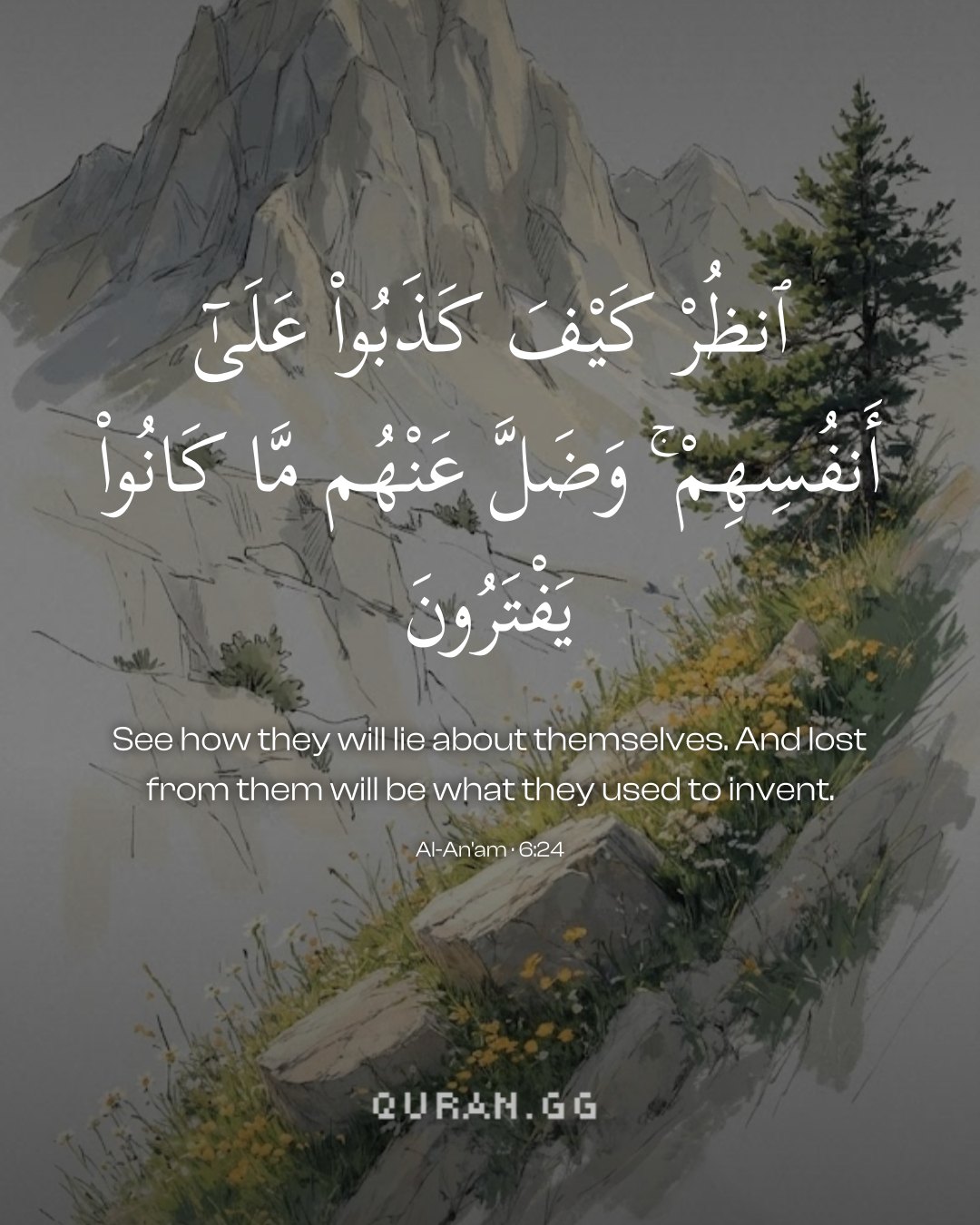
Continue reading the tafsir of ayahs 22–26 In verse 24, it was said: انظُرْ كَيْفَ كَذَبُوا عَلَىٰ أَنفُسِهِمْ ۚ وَضَلَّ عَنْهُم مَّا كَانُوا يَفْتَرُونَ (See how they lied about themselves - and lost to them was all that they used to coin). The address here is to the Holy Prophet ﷺ who has been asked to see how these people have lied against their own selves, and whatever they used to forge and fabricate against Allah (their idols and so-called partners to Allah) is lost to them. The expression translated as ` lied about themselves' means that the curse of this lie is going to fall on their own selves while the word, اِفتَرَاء translated as ` used to coin' may also mean that ascribing partners to Allah was a fabrication in the mortal world the reality of which was exposed on the day of Resurrection. And it is also possible that ` iftira' or fabrication could be referring to the false oath taken on the day of Resurrection following which the witness of the limbs of the body exposed their lie.
Some commentators say that ` iftira' or fabrication refers to interpretations they used to put on their false objects of worship in the mortal world, for example: مَا نَعْبُدُهُمْ إِلَّا لِيُقَرِّبُونَا إِلَى اللَّـهِ زُلْفَىٰ which means that ` We do not worship them taking them to be God but only do it so that they would intercede on our behalf with Allah and bring us closer to Him - 39:3.' This fabrication of theirs got exposed on the day of Resurrection when no one interceded on their behalf in their hour of trial, nor any one did anything to bring about a reduction in their punishment.
This bring us to a question, for the verse seems to indicate that at the time of trial featuring these questions and answers, all false objects of worship will not be present there, but a verse of the Qur'an says: احْشُرُوا الَّذِينَ ظَلَمُوا وَأَزْوَاجَهُمْ وَمَا كَانُوا يَعْبُدُونَ ﴿22﴾ (gather (gather up those who have been unjust, and their partners, and what they used to worship - 37:22). This seems to indicate that the false objects of worship will also be present on the day of Resurrection.
The answer is that the sense of their being absent from the plains of Resurrection, as it emerges from this verse, is limited to their being unavailable as partners, sharers or intercessors. Thus, though they would be unable to help their clients in any way but, they would be present there. So, there remains no contradiction between the two verses. Then, it is also possible that all of them could be gathered together at one time and place, then be separated and the question is asked after the separation.
In these two verses, it should be particularly borne in mind that the choice of free speech given to disbelievers on the day of Resurrection which they utilized by denying on false oath that they had any-thing to do with Shirk, is not without its implications. Perhaps, it carries a hint that the habit of telling lies is an evil habit which is never easy to shake off. So much so that these people, who used to swear falsely before Muslims during their life in the mortal world, were unable to stop lying even on the fateful day of Resurrection which put them to disgrace before the entire creation of Allah. Therefore, lying has been strongly condemned in the Qur'an and Hadith which give serious warning to those who tell lies. At many places in the Qur'an liars have been cursed. The Holy Prophet ﷺ said: Stay away from lying because a lie is the accomplice of sins, and a lie and a sin will both go to Jahannam. (Ibn Hibban in his Sahih)
The Holy Prophet ﷺ was asked what deed could take one to Hell. He said: A lie [ the Musnad of Ahmad ]. And on the night of the Mi` raj (the Ascent to Heaven), the Holy Prophet ﷺ saw a man having the corners of his mouth being slit apart which then fall back into their place and become as they were, and again they are slit apart ... something to keep happening to him throughout the day of Qiyamah. He asked the angel, Jibra'il al-Amin: "Who is he?" Angel Jibra'il said: "He is a liar."
And it appears in a narration from the Musnad of Ahmad that the Holy Prophet ﷺ said: One cannot become a complete Muslim unless he gives up lying altogether, to the extent that he would not lie even by way of joke or fun.
In addition to that, it appears in Al-Baihaqi and others, all on sound authority, that the character of a Muslim may have other bad traits - but, not breach of trust and lying. Yet another Hadith says that lying decreases one's Rizq (sustenance).
Reality is a familiar thing for man, because it is part of man’s own nature and it speaks the same silent language throughout the universe. This was truer of the Jews and the Christians, because their Prophets and their scriptures had clearly heralded the advent of the last of the Prophets and the Quran. So, for them to know about this was as good as knowing their own sons. In spite of things being so clear, why do people not accept the Truth? It is because of the fear of some immediate loss. The cost of acceptance of the Truth is that man has to pull himself down from a high status; he has to come out of the sphere of conformism and give up ready-made advantages. When a man is not ready to make these sacrifices, he does not accept the Truth, and for the sake of instant gain, he pushes himself into a position of eternal loss. If he has a false sense of satisfaction with the stand he has taken, it is because in this world of trial he is always successful in finding explanations and justifications in his support; he readily finds the words to reject arguments in favour of the Truth—so much so that he feels free to wilfully misinterpret truth and claim that the ‘real Truth’ is that which he has adopted. Whenever a man makes entities other than God the centre of his attention, a magical halo gradually forms around them. He indulges in such wishful thinking as gives him the illusion that he has a firm hold of a very strong support. But, on the Day of Judgement, when all the veils are torn asunder, and when he sees that all the supports except that of God were absolutely false, he will have no alternative but to contradict his own statements. In other words, such people at that time will become witnesses against their own falsity. In the Hereafter they will become the rejecters of those very things of which they had been proud of being attached to. The edifice of false beliefs and explanations they had constructed will be so totally destroyed that it will seem never to have existed.
Uthmani text of the Madinah mushaf (King Fahd Complex). Translation: Saheeh International. Tafsir via Quran.com.