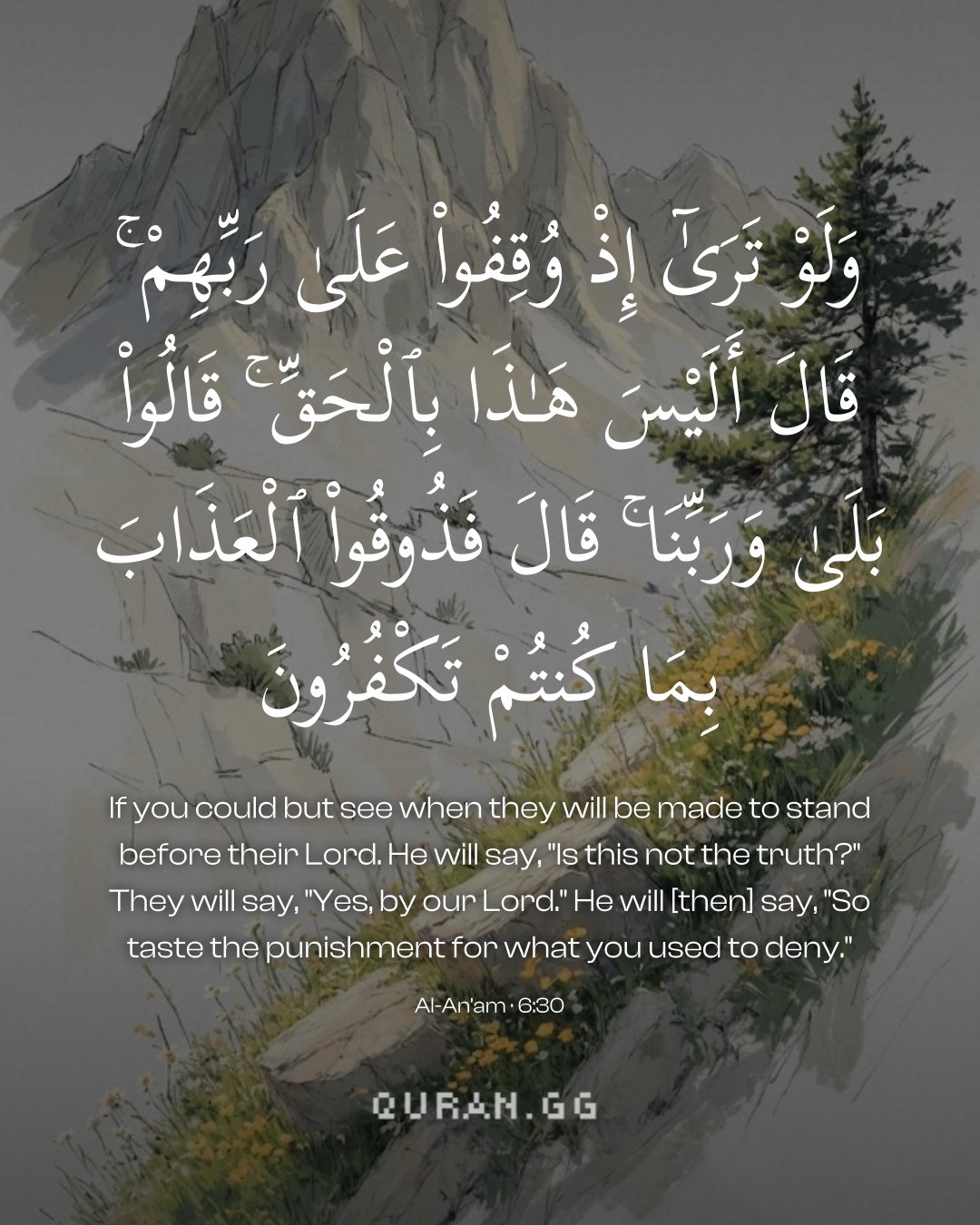
If you could but see when they will be made to stand before their Lord. He will say, "Is this not the truth?" They will say, "Yes, by our Lord." He will [then] say, "So taste the punishment for what you used to deny."
Wishes and Hopes Do Not Help One When He Sees the Torment
Allah mentions the condition of the disbelievers when they are made to stand before the Fire on the Day of Resurrection and witness its chains and restraints, along with seeing the horrible, momentous conditions in the Fire with their own eyes. This is when the disbelievers will say,
("Would that we were but sent back (to the world)! Then we would not deny the Ayat of our Lord, and we would be of the believers!") They wish that they would be sent back to the life of the world so that they could perform righteous deeds, refrain from disbelieving in the Ayat of their Lord and be among the believers. Allah said,
As for the statement in the third verse (29): وَقَالُوا إِنْ هِيَ إِلَّا حَيَاتُنَا الدُّنْيَا (And they say, "There is nothing real but this worldly life of ours" ), it reverts back to the word, عَادُوا (` adu: would again go for) in verse 28. Thus, it means that should they be returned to the world, then, once they reach there, they will still say that they do not accept any life other than the life of this world. Life here is the life and they were not going to be raised again.
A question arises here: When they have seen their return to life on the day of Qiyamah - and reckoning and accounting and reward and punishment - how can it be possible that they would deny it once they have been sent back into the world?
Whenever a man denies the Truth or follows the desires of his self, it is because he does not live his life in this world on the understanding that he will be resurrected after death and made to stand before the Lord of the universe to give an account of himself in everyday life. Man has been given a certain power which he uses unhesitatingly. He has the material prop of wealth, and friends and companions on whom he relies. He has been given a brain, which he uses to think out arrogant strategies and find clever pretexts for his transgressions. The success of his initiatives deceives him; he starts placing false reliance on things other than God, and imagines that the position he enjoys today is of a perennial nature. He forgets that whatever he has been given in this world is only by way of trial and is not a matter of entitlement. This type of life is thoroughly sinful, whether led in open denial of the Hereafter or without actually uttering the words of denial. On what basis does man rush towards worldly things—thinking them his own? Man has not paid any fee for the sunlight in which he walks or for the air he breathes. No part or ingredient of the earth from which he derives the wherewithal to live has been made by him. None of the favourite things towards which he rushes can he call his own. When these things have not been created by man, should not the Lord of all these things have any right over man? The fact is that man’s very utilisation of the present world makes it only logical that he should be made to stand before his Lord on the day of reckoning.
Uthmani text of the Madinah mushaf (King Fahd Complex). Translation: Saheeh International. Tafsir via Quran.com.