Allah describes the regret of the disbelievers when facing Him, and their disappointment at the commencement, along with theirsorrow for not performing good deeds and for their evil deeds
This is why Allah said,
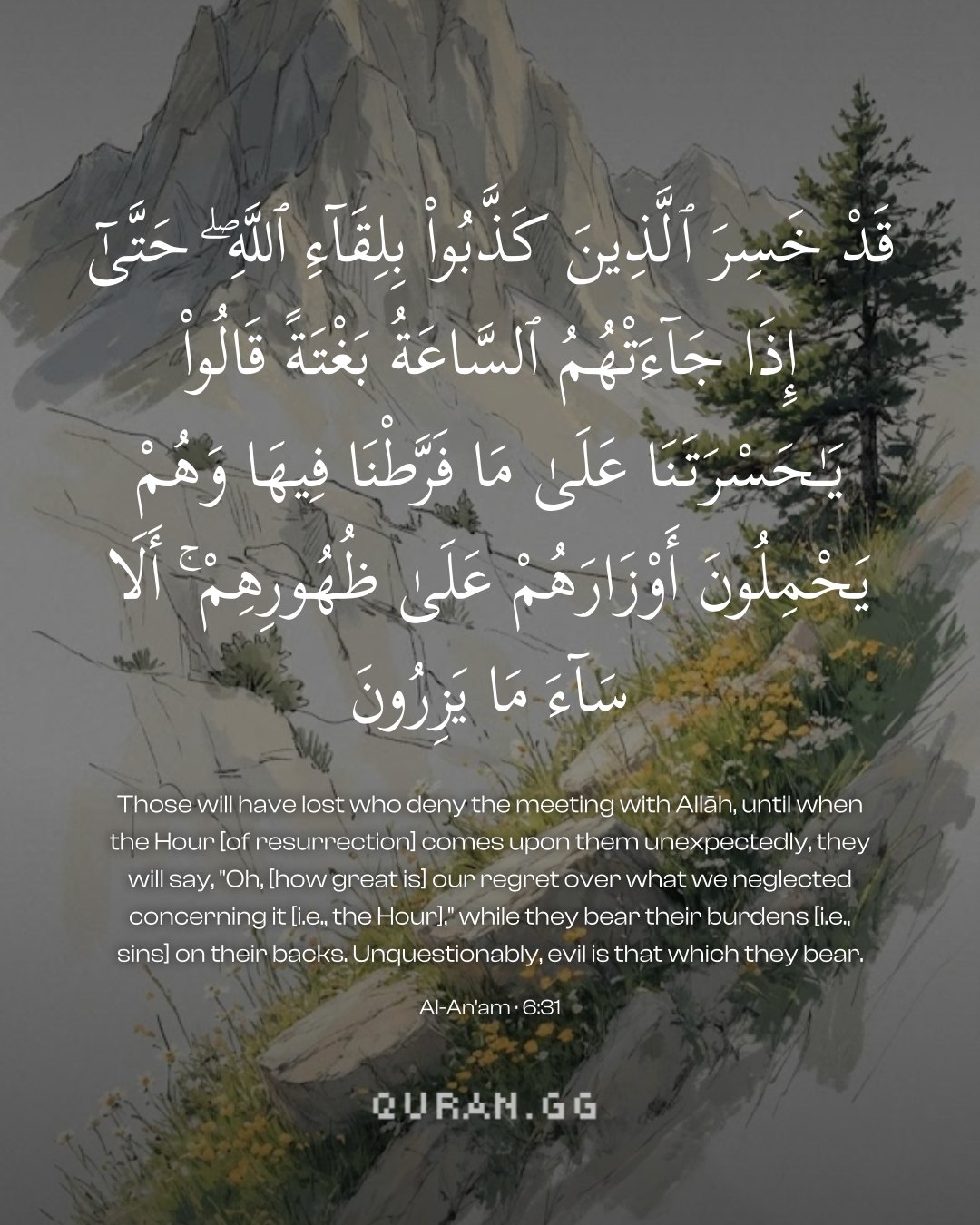
حَتَّى إِذَا جَآءَتْهُمُ السَّاعَةُ بَغْتَةً قَالُواْ يحَسْرَتَنَا عَلَى مَا فَرَّطْنَا فِيهَا
(until all of a sudden, the Hour (signs of death) is upon them, and they say: "Alas for us that we gave no thought to it.") `It' here refers to either the life of this world, or the affairs of the Hereafter. Allah's statement,
وَهُمْ يَحْمِلُونَ أَوْزَارَهُمْ عَلَى ظُهُورِهِمْ أَلاَ سَآءَ مَا يَزِرُونَ
(while they will bear their burdens on their backs; and evil indeed are the burdens that they will bear!) Asbat said that As-Suddi said, "Upon entering his grave, every unjust person will meet a man with an ugly face, dark skin, awful odor, wearing dirty clothes, who will enter his grave with him. When the unjust person sees him, he will say, `How ugly is your face!' He will reply, `So was your work, it was ugly.' The unjust person will say, `How foul is the odor coming from you!' He will reply, `Such was the case with your work, it stunk.' The unjust person will say, `How dirty are your clothes!' He will reply, `And your work too was dirty.' The unjust person will ask, `Who are you' He will reply, `I am your deeds.' So he will remain with the unjust person in his grave, and when he is resurrected on the Day of Resurrection, his companion will say to him, `In the life of the world, I used to carry you because you followed desire and lust. Today, you carry me.' So he will ride on the unjust person's back and lead him until he enters the Fire. So Allah said,
وَهُمْ يَحْمِلُونَ أَوْزَارَهُمْ عَلَى ظُهُورِهِمْ أَلاَ سَآءَ مَا يَزِرُونَ
(while they will bear their burdens on their backs; and evil indeed are the burdens that they will bear!) 6:31" Allah's statement,
وَمَا الْحَيَوةُ الدُّنْيَآ إِلاَّ لَعِبٌ وَلَهْوٌ
(And the life of this world is nothing but play and amusement.) means, most of it is play and amusement,
وَلَلدَّارُ الاٌّخِرَةُ خَيْرٌ لِّلَّذِينَ يَتَّقُونَ أَفَلاَ تَعْقِلُونَ
(But far better is the abode of the Hereafter for those who have Taqwa. Will you not then understand)
About the sentence: وَهُمْ يَحْمِلُونَ أَوْزَارَهُمْ (And they shall be carrying their burdens) in verse 31, it appears in Hadith narrations that, on the day of Qiyamah, the deeds of good people will become their ride while the evil deeds of evil people will be placed like a burden on their heads.
Noteworthy here is that disbelievers and sinners will do everything possible to save their skins on the fateful day of Resurrection. They will be nervous and confused. Sometimes they would hide behind false swearing. At others, they would wish to be returned to the world of their earlier experience. But, none of them will say: Now, we have believed and now we shall be doing nothing but what is good - because they would have seen reality and seen it very clearly - that the phase of Akhirah, the Hereafter, is not the Venue of Deeds (Dar al-Amal), and that the soundness of 'Iman (faith) depends on its being ` bil-ghayb,' that is, without having the need to see what is Unseen. Confirming what has been seen is simply acting in line with what has been personally seen. It is not what the attestation to the truth of Allah and His Messenger is. So, let us be very clear that working for the pleasure of Allah Ta` ala, earning its fruits in the form of the promised state of everlasting bliss, hoping to be blessed with Paradise in the Hereafter, and having a good life of peace and tranquility right here are things which can be achieved only (repeat, only) through the life of the present world, neither before, nor after - for it is not possible to achieve these in the universe of spirits (arwah) before it, nor is it possible to achieve it in the domain of the Hereafter, after the world of our experience is no more there.
The Present Life is a Great Blessing: Invest Wisely, and Prosper
Now we can see that the life of this world is a great blessing, and certainly an asset of unmatched value. (To borrow the terminology of modern investors, ` with such chips in one's hands, who would not go for such a deal of deals?' - Tr.). So, this life is an opportunity which must be taken seriously. That is why suicide is forbidden as Harm in Islam, and equally prohibited is praying for death, even the making of a wish to die. This is so because it shows ingratitude for a great blessing of Allah Ta’ ala.
Also clarified here is the basis on which worldly life has been characterized as game and fun in the last verse (32) here, as well as in several other verses of the Qur'an, or in many Ahadith which condemn worldly life. There, by worldly life what is censured is the time of life which is spent being heedless to the thought and concern of Allah Ta` ala. Otherwise, no wealth of the world is equal in worth to the time one spends in remembering Allah and doing what He has commanded us to do. This is also confirmed by a Hadith which says:
اَلدُّنیَا مَلعُونُ مَّا فِیھا اِلَّا ذِکرُ اللہِ اَو عَالِم اَو مُتَعَلِّمُ
Dunya is cursed and cursed is what is in it, except the Dhikr (Remembrance) of Allah, or ` Alim (a knowledgeable person) or a student.
If seen closely, a teacher (of religion) and a student (of religion) are included under the Dhikr (Remembrance) of Allah because 'Ilm' means the knowledge which becomes the cause of the pleasure of Allah. So, the learning and teaching of such an ` Ilm are both included under Dhikrullah. In fact, according to the clarification of Imam al-Jazri, everything done in this world which is done in conformity with obedience to Allah, that is, in accordance with the injunctions of the Shari'ah, is all included under the Dhikr of Allah. This tells us that everything necessary that must be done in this life of the world, all permissible ways of earning one's livelihood, and the fulfillment of other needs which are not beyond the limits set by the Shari'ah, shall all be considered as being included under the Dhikr of Allah. In fact, the fulfillment of the rights of family, relatives and friends, neighbours and guests and others has been identified as an act of Sadaqah (charity) and 'Ibadah (worship of Allah).
To recapitulate, it can be said that, there is nothing in this world more worthy of Allah's favour than اِطاعہ ` Ita` ah (obedience to Him) and Dhikr (remembrance of Him). Then, the dearest and the worthiest possession man has is his time of life in this world. And we know that this time is limited. And no one knows exactly how long his or her life is, seventy years or seventy hours, or no more than the span of a breath. On the other hand, we know that the pleasure of Allah which is the only guarantee of a good life, here and there, can be acquired only within the limits of our life in this world. Now, every human being, whom Allah has blessed with sense and vision, can decide it for himself how he is going to spend these limited moments and hours of his life, and in what. No doubt, common sense would demand that this precious time should mostly be spent in what would meet the pleasure of Allah. As for chores which are necessary to hold this life together, they should be taken to as needed.
In a Hadith, the Holy Prophet ﷺ has said:
اَلکَیِّسُ مَن دَانَ نَفسَہُ وَرَضِیَ بِالکَافِ وَ عَمِلَ لِمَا بَعدَ المَوتِ
Wise is he who controls his self, and stays pleased with minimal resources, and devotes his deeds for what is after death.
Uthmani text of the Madinah mushaf (King Fahd Complex). Translation: Saheeh International. Tafsir via Quran.com.