Showing the Triviality of the Worldly Life and encouraging Spending
Expressing the insignificance and worthlessness of the worldly life, Allah says,
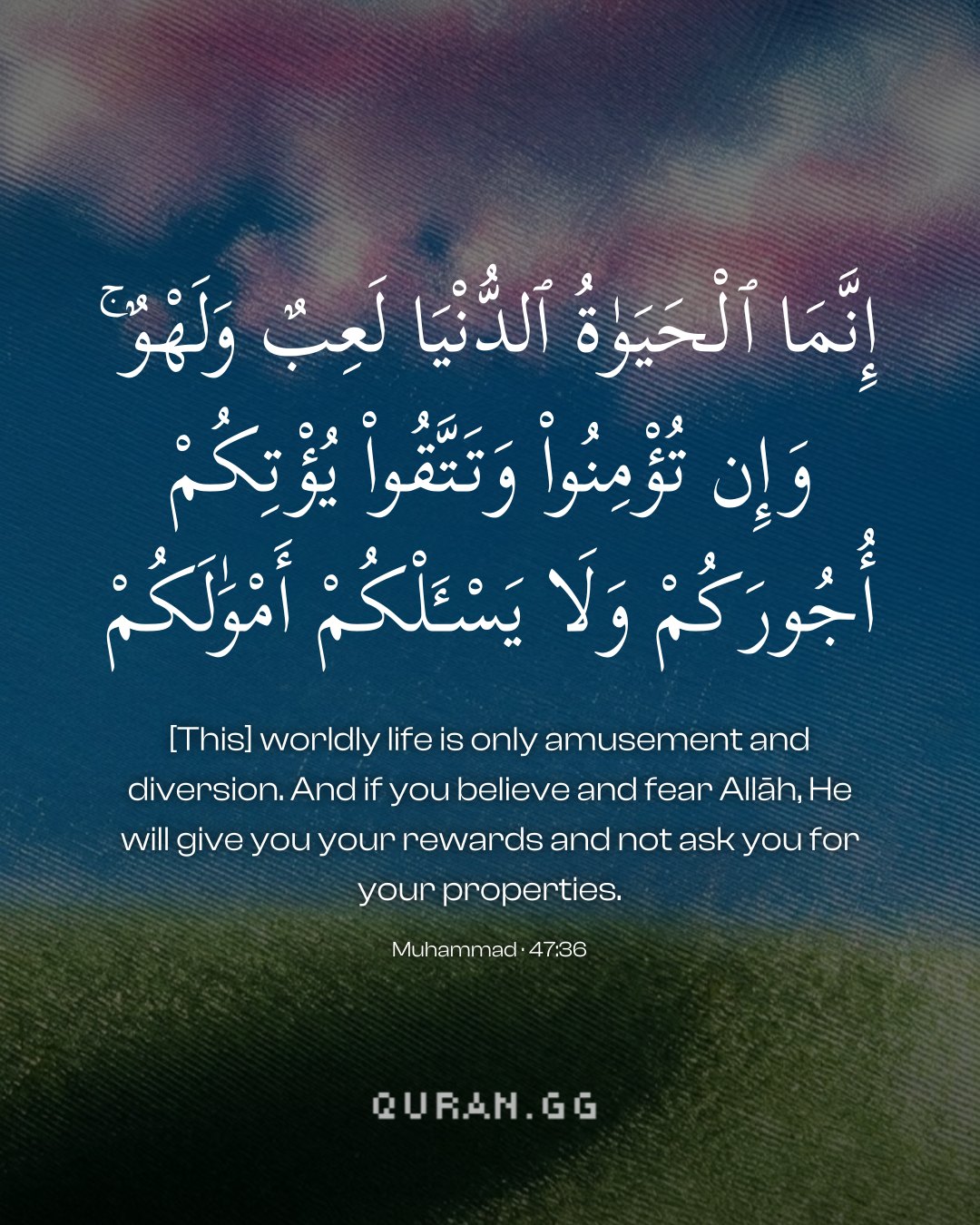
إِنَّمَا الْحَيَوةُ الدُّنْيَا لَعِبٌ وَلَهْوٌ
(This worldly life is only amusement and diversion.) which means that such is its outcome, except for that which is done for the sake of Allah. Because of this, Allah says,
وَإِن تُؤْمِنُواْ وَتَتَّقُواْ يُؤْتِكُمْ أُجُورَكُمْ وَلاَ يَسْـَلْكُمْ أَمْوَلَكُمْ
(And if you believe and have Taqwa of Allah, He will grant you your rewards, and will not ask from you (to sacrifice all of) your possessions.) meaning, He is in no need of you, and asks you for nothing. He only ordained giving charity from your wealth so that you would help your needy brothers. The benefit of that would then come back to you, as well as the rewards. Allah then says,
ؤإِن يَسْـَلْكُمُوهَا فَيُحْفِكُمْ تَبْخَلُواْ
(If He would demand of you all of it and urge you, you would withhold.) meaning, if He pressures you much, you would become stingy.
وَيُخْرِجْ أَضْغَـنَكُمْ
(And He will expose your (secret) ill--wills.) Qatadah said, "Allah knows that extracting wealth (i.e., money from people) brings about ill-wills. " Indeed, Qatadah has said the truth, because money is dear to the people, and they do not spend it except in things that are dearer to them than it. Allah then says,
هَآ أَنتُمْ هَـؤُلاَءِ تُدْعَوْنَ لِتُنفِقُواْ فِى سَبِيلِ اللَّهِ فَمِنكُم مَّن
(Here you are now invited to spend in Allah's cause; but among you are those who withhold (stingily).) meaning, they refuse to spend. Allah continues,
يَبْخَلُ وَمَن يَبْخَلْ فَإِنَّمَا يَبْخَلُ عَن
(And whoever acts stingily is but stingy toward himself.) meaning, he only reduces his own rewards, and the bad outcome of that will come back to him.
نَّفْسِهِ وَاللَّهُ
(For Allah is indeed Al-Ghani) Allah is in need of nothing else, whereas everything is ever in need of Him. Thus, Allah says,
الْغَنِىُّ وَأَنتُمُ
(while you are the needy.) meaning, specifically of Him. The description of Allah as Al-Ghani (in no need) is a necessary description of Allah; on the other hand, the description of the creation as Faqr (needy) is a necessary description for them that they cannot avoid. Allah then says,
وَإِن تَتَوَلَّوْاْ
(And if you turn away, ) which means, if you turn away from obeying Him and adhering to His Laws.
تَتَوَلَّوْاْ يَسْتَبْدِلْ قَوْماً غَيْرَكُمْ ثُمَّ لاَ يَكُونُواْ
(He will replace you with other people; then they will not be like you.) meaning, rather, they will be people who will listen to Him and obey His commands. This concludes the Tafsir of Surat Al-Qital. And Allah is worthy of all praise and gratitude.
إِنَّمَا الْحَيَاةُ الدُّنْيَا (The worldly life is but play and pastime - 47:36.) As Muslims have been enjoined to fight in the cause of Allah, they will, for this purpose, have to make sacrifices of life and money. But the love of this world is the only thing that can prevent man from fighting. In this verse we are told that neither of these mundane benefits is permanent. After all, they all will perish and come to an end. Even if we succeed in saving them for now, they will be lost another time. The bounties of the next world are permanent and eternal: the believers need to develop love for them - not for the perishable things of this ephemeral world.
وَلَا يَسْأَلْكُمْ أَمْوَالَكُمْ (...and will not ask you your riches... 47:36). The apparent meaning of this verse is that Allah does not demand or urge you to hand over your wealth. But the Qur'an is replete with verses relating to payment of zakah, charities and spending wealth in the way of Allah. Even in the next verse, the reader is emphatically called upon to expend in Allah's way. Thus there appears to be conflict between these verses. Some scholars resolve the conflict by saying that the present verse means that Allah does not need their money for His benefit, but it is for their own benefit that sacrifices of life and money are demanded.
Earlier in this very verse, it has been declared expressly: يُؤْتِكُمْ أُجُورَكُمْ (… He will give you your rewards, (47:36)”. The believers are required to spend in Allah's way which will help them in the Hereafter where they will need their righteous works most pressingly. That is where they will be rewarded. This interpretation of the verse has been preferred by Maulana Thanawi رحمۃ اللہ علیہ . A verse of identical meaning is مَا أُرِيدُ مِنْهُم مِّن رِّزْقٍ (I do not desire [ to receive ] any provision from them, nor do I desire that they should feed Me…51:57)
Other scholars, however, assign another meaning to the words, "and will not ask you your riches". They say that "asking your riches" means to demand all of one's wealth. Their argument is that this clause needs to be read in conjunction with the next verse [ 37] lwhich says, إِن يَسْأَلْكُمُوهَا فَيُحْفِكُمْ (If He were to ask you of it, and were to press you,…) the word yuhfi is derived from ihfa which means to pursue a work persistently and insistently until it is accomplished. All scholars agree that the meaning of verse [ 37] is that if Allah demands for all of their wealth, they would become niggardly and acting upon this injunction would displease them. The displeasure would become visible at the time of expending. To sum up: the meaning of verse [ 36] is the same as verse [ 37]. The general meaning of the former verse is restricted by the latter verse. The meaning of these two verses is as follows: The pecuniary obligations, such as zaka that Allah has imposed on the believers is for their own benefit – Allah does not need their money or wealth. Further, Allah, through His grace and compassion, has imposed a nominal percentage for expending. For example, only 1/40th = 2.5% for zakah, 1/10th = 10% or 1/20th = 5% for agricultural produce, and one goat out of every hundred goats, have been imposed. Thus it is clear that Allah is not demanding for all of our wealth because that would be displeasing and a burden and it would weigh heavily on us. In fact, He has asked for so little of our wealth that we should discharge our obligation readily and happily. The concluding clause in verse [ 37] يُخْرِجْ أَضْغَانَكُمْ ”...you would show miserliness, and He would expose your grudges." contains the word adghan which is the plural of dighn. It refers to secret malice, grudge or hatred. Naturally, man feels unhappy to part with all of his wealth. Even if he does not express his unhappiness openly, he would procrastinate at the time of payment. Procrastination would disclose his unhappiness. In short, if Allah had demanded from people all of their wealth, they would be tight-fisted and because of tight-fistedness their hearts will harbor rancour, malice and spite against spending in the cause of Allah which would be exposed. Therefore, He has imposed upon their wealth a small and nominal percentage to expend in the cause of Allah, but people are niggardly even in this case. This is what the Qur'an says in the last verse:
It is mentioned in a tradition that, during the period of the Prophet Muhammad, certain Muslims opined that if they professed, ‘la ilaha illallah’ (there is nobody worth worshipping except God), they would come to no harm by any sin. In that connection, this verse 33 was revealed. In this light the verse means that a man should combine obedience with Faith. He should carry out not only the harmless commandments but also those commandments for which he has to crush his self and jeopardize his interests. If he does not do so, his earlier deeds will be of no avail. The position of weak Muslims is that they will support the Truth on the condition that they should not have to incur the displeasure of the great men of their day. When they see that supporting the Truth is becoming a cause of displeasure to them, they tilt towards them even if these great men are rejecters of the Truth or stubbornly resistant to it. Those who reject the Truth or set themselves up as its opponents can never receive the grace of God. Then how can those who side with such rejecters of Truth meet with any other fate? In Islam there is war as well as peace. But that war is not Islamic which is fought under provocation. In Islam only defensive war is permitted. Such a war should not be the consequence of an emotional reaction, but one which results from a proper decision, and is defensive by nature.
Uthmani text of the Madinah mushaf (King Fahd Complex). Translation: Saheeh International. Tafsir via Quran.com.