This is from the completion of Musa's speech concerning the description of His Lord when Fir`awn asked him about Him. He (Musa) said,
الَّذِى أَعْطَى كُلَّ شَىءٍ خَلْقَهُ ثُمَّ هَدَى
(He Who gave to each thing its form and nature, then guided it aright.) Then, Fir`awn attempted to present some argumentative rebuttal during Musa's reply. Yet, Musa continued by saying, "He is the One Who made the earth as a bed for you." Some recited the word as Mihadan and others recited it as Mahdan, which means `a place of rest that you settle down upon.' It also may mean `that which you stand upon, sleep upon or travel upon its back.'
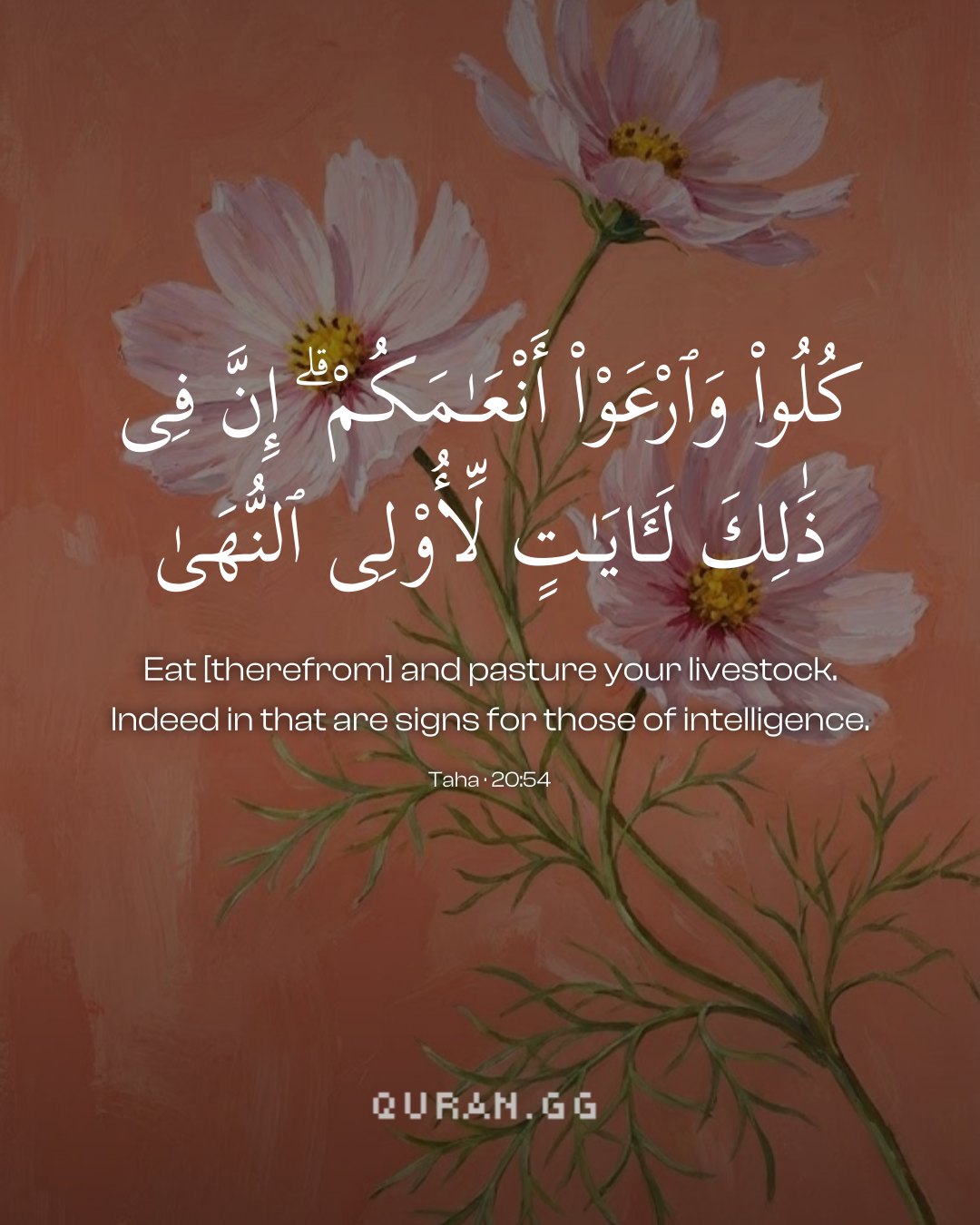
The next verse (54) says إِنَّ فِي ذَٰلِكَ لَآيَاتٍ لِّأُولِي النُّهَىٰ (Surely, in that there are signs for the people of understanding. (20:54). The word النُّهَىٰ is the plural of نُھیَۃ (nuhyah) which is used in the same sense as عققل (aql: Intelligence) because it enables wise and intelligent persons to avoid harmful acts.
Tazkirul Quran
Maulana Wahiduddin KhanOn ayahs 52–54
Pharaoh’s question, ‘Who is your Lord?’ did not mean that he was not aware of any god besides himself, or that he quite finally denied the existence of a superior god. All it showed, in fact, was contempt for Moses’ utterance, rather than being a straight denial. In Egypt, Joseph had preached the oneness of God. Moreover, hundreds of thousands of Israelites were still living there and they professed faith in the one God. In this way, belief in one superior God existed in Egypt, but the power, pomp and glory were Pharaoh’s. According to the belief of the Egyptians, Pharaoh was the worldly manifestation of their greatest god, the sun. He was Egypt’s god-king and idols and statues of him had become objects of worship throughout Egypt. Moses, in stark contrast to this, belonged to the Israelite community—a community held in low esteem because of its slave-labour status. Against this background, his faith could have no public significance in Egypt. In this world there are innumerable things, each one of which has its peculiar structure and its own method of working. Everything functions according to immutable laws. Even an arrogant king like Pharaoh was not exempt from this system—which clearly proves the existence of a Superior Creator. When Moses made this statement, Pharaoh felt that he had no direct reply to it; so he gave the matter a new turn. Finding himself weak in the field of reasoning and arguments, he wanted to incite prejudicial feelings and thus maintain his own superiority among his people. Therefore, he asked Moses—if whatever he said was true—what had happened to the great ones of the past, who, according to Moses, had died while in a misguided condition. Moses did not answer this question directly. Instead he said, ‘You had better leave this matter to God and think about yourself.’